

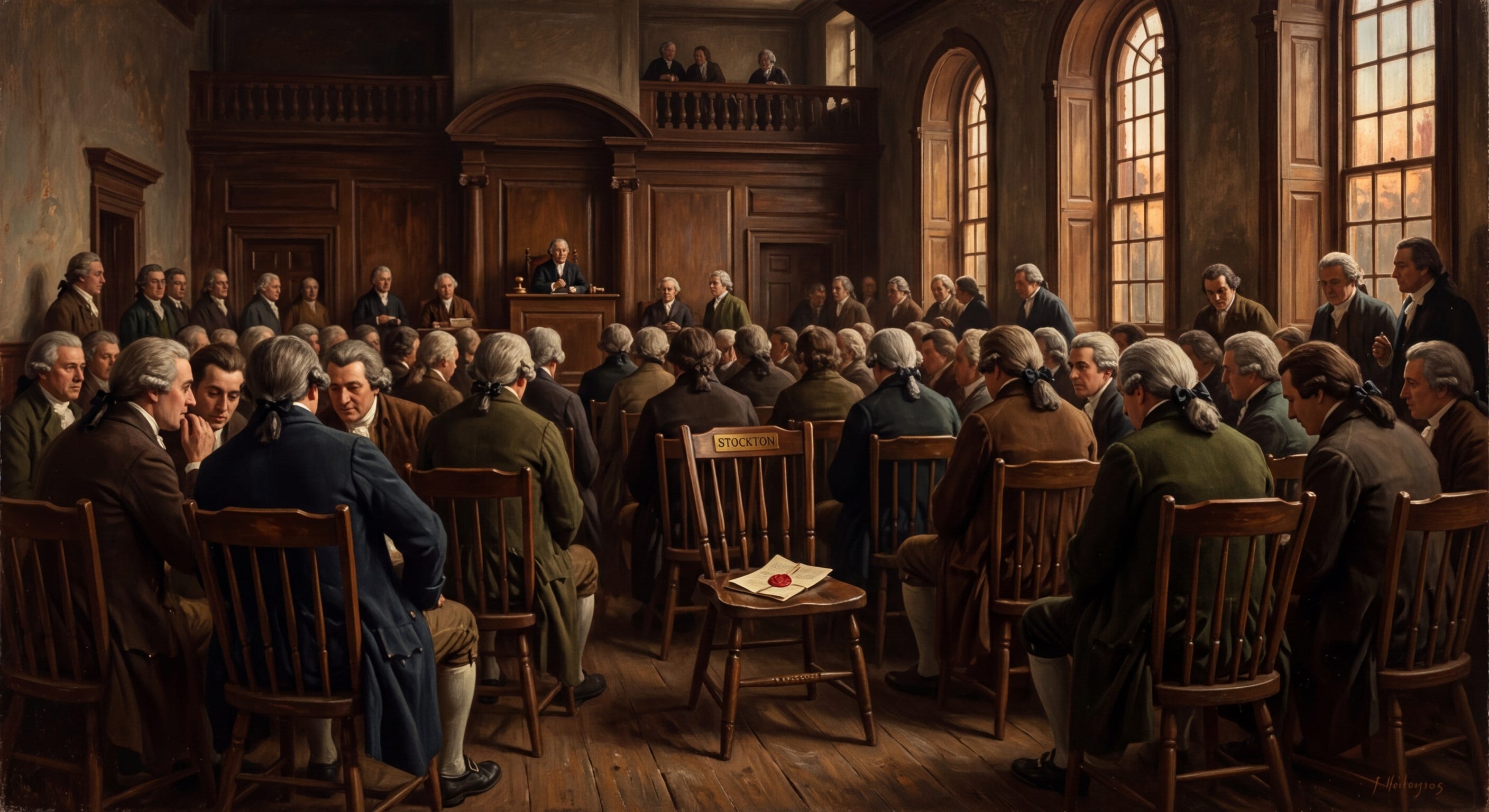
A young Englishwoman named Esther DeBerdt met Richard Stockton in London in 1767 and wrote about him in a letter afterward. “I like Mr. Stockton exceedingly,” she wrote. “He is certainly the cleverest man I have yet seen from America.” Stockton was thirty-seven years old, in England on a mission for the College of New Jersey, moving through the best rooms in London with the ease of a man who had been moving through the best rooms his whole life.
He had already met the King. He had already spoken to Parliament about the coming war. Edinburgh had given him the freedom of the city, an honor they handed to almost no one. He had fought off an armed robber in Scotland and missed a ship that sank with everyone aboard. He was heading home with a personal coat of arms, a Latin motto, and a conviction that the British Empire and the American colonies could still work things out.

Fourteen years after Esther DeBerdt wrote that letter, Richard Stockton was dead at fifty. His own neighbors had dragged him from his bed in the middle of the night, beaten him, chained him in a frozen prison, destroyed his library, burned his papers, looted his estate, and left him with a cancer that no surgeon could stop. And if the evidence is right, they may have also gotten him to sign away everything he stood for, in exchange for the chance to go home and die slowly among the ruins of it.
The Man Who Had Everything
Richard Stockton’s grandfather bought the family’s land from William Penn himself in 1701. By the time Richard was born on October 1, 1730, the Stocktons were one of the most powerful families in New Jersey. Their estate, called Morven, sat on 150 acres in Princeton: a 146-foot brick mansion with one of the finest private libraries in the colonies, gardens designed by his wife Annis after the estate of the English poet Alexander Pope, and a dining table where Congress members, college professors, and George Washington himself came to eat and argue about the future.
Stockton graduated from the College of New Jersey (now Princeton) in its very first class, in 1748. The college sat across the street from his front door. He studied law and by 1763 held the title of serjeant-at-law, the highest legal rank in the colonies. His son-in-law Benjamin Rush later called him “timid where bold measures were required” but “sincerely devoted to the liberties of his country.” That tension between caution and conviction would define the rest of his life.
The Mission to Scotland
Both close calls happened during a fifteen-month trip through England, Scotland, and Ireland. Late one night in Edinburgh, a robber came at Stockton on a dark cobblestone street. Stockton drew the small sword he carried as part of his formal dress and fought the man off, wounding him before walking away clean. Weeks later, he booked passage on a ship to Ireland but arrived at the dock too late. The ship sailed without him, hit a storm in the Irish Sea, and went down with everyone aboard.

The college trustees had sent Stockton to recruit a new president, a Scottish minister named John Witherspoon. Witherspoon was one of the most respected religious thinkers in Scotland, and the college desperately needed his credibility. But Witherspoon had already turned them down once. His wife was terrified of the Atlantic crossing and had no interest in leaving Scotland for what she saw as the American wilderness.
Stockton enlisted a young American medical student named Benjamin Rush, who would later marry Stockton’s daughter Julia. Together, they spent weeks working on Mrs. Witherspoon. Stockton used his lawyer’s charm. Rush used his youthful enthusiasm. Eventually, she agreed. Witherspoon came to Princeton in 1768 and turned the college into one of the most important schools in America, educating a generation that included future president James Madison. Witherspoon signed the Declaration of Independence alongside Stockton. The Edinburgh recruitment may have been the most consequential academic hire in American history.
While in England, Stockton was formally presented to King George III at court and attended the Queen’s birthday ball. In meetings with senior members of Parliament, he warned them directly: taxing the colonies without giving them a voice would lead to war.
On his way home, he knocked a piece of Roman brick off Dover Castle and mailed it to Annis (he addressed her by the romantic nickname “Emilia” throughout their marriage), a souvenir for the collection of ancient artifacts she was building at Morven. A man collecting beauty from castle walls for his wife.
Taxing the colonies without giving them a voice would lead to war - Richard Stockon
This was Richard Stockton in 1767: charming kings, fighting off muggers, dodging shipwrecks, sending his wife souvenirs from ancient castles. He came home with a personal coat of arms and a Latin motto, Omnia Deo Pendent, “All Depends on God.”
Within a decade, he would find out if he believed it.
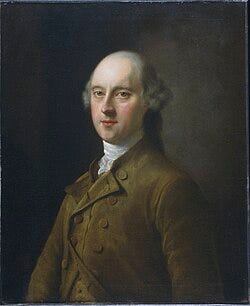
When he got home, Stockton wrote to Lord Dartmouth, the British official in charge of the colonies, with a detailed plan for American self-government under the Crown. The proposal was remarkably forward-thinking. Stockton suggested a system where the American colonies would govern themselves through their own legislatures but remain loyal to the King, a model that looked a lot like the British Commonwealth that would not exist for another 150 years. He warned Dartmouth in plain language that if Britain refused to compromise, “the result would be an obstinate, awful, and tremendous war.” In modern terms: this will be long, it will be bloody, and nobody will forget it.
The British ignored the proposal completely.
By 1776, Stockton had given up on peace. He resigned his positions in the colonial government and threw his support behind independence. New Jersey sent him to the Continental Congress in June 1776. He voted yes on independence on July 2 and signed the Declaration in August, the first person from New Jersey to put his name on it.
He was right about the war.
Barefoot Soldiers and a Collapsing Front
Congress put Stockton to work immediately. In September 1776, they sent him north to inspect the army at Fort Ticonderoga in upstate New York, a key position guarding the route from Canada. What he found there changed him.
The soldiers were in terrible shape. Whole regiments of men from New Jersey were marching without shoes, their bare feet cracked and bleeding on frozen ground. They were starving. Many were sick. The supplies Congress had promised had never arrived. Stockton, who had spent his life in paneled rooms and on horse chestnut walks, was looking at the actual cost of the document he had just signed.
He wrote a desperate letter to his fellow signer Abraham Clark:
“My heart melts with compassion for my brave countrymen who are thus venturing their lives in the public service and yet so distressed. There is not a single shoe or stocking to be had in this part of the world, or I would ride a hundred miles through the woods to purchase them with my own money.”
He came back to New Jersey in November 1776 to find the situation at home even worse. The British had invaded the state. General William Howe, commander of the entire British army in America, was pushing Washington’s battered forces toward Pennsylvania in a retreat that looked like it might end the Revolution entirely. New Jersey was in chaos. The British army and Loyalist militias moved through the countryside looting farms, settling grudges, and hunting anyone connected to the rebel cause.
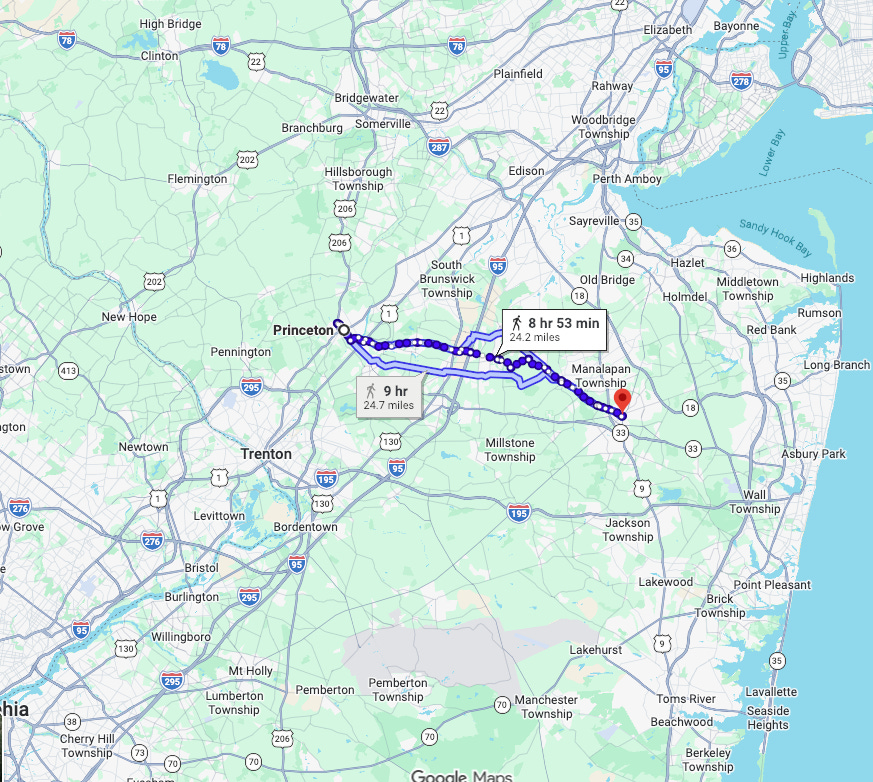
Stockton rushed to evacuate his family. He sent Annis and the children to the home of a friend, John Covenhoven, in Monmouth County, near what is now Freehold. He thought the distance from the front lines would keep them safe.
Monmouth County was full of Loyalists. And they knew exactly where to find a man who had just signed a document declaring war on the King.
The Night Everything Changed
On November 30, 1776, in the middle of the night, a Loyalist militia guided by a local man named Cyrenus Van Mater raided the Covenhoven house. They dragged Stockton from bed in his nightshirt and breeches. They beat him. They stripped him in freezing weather and marched him to Perth Amboy, where they handed him to British military authorities.
The people who did this were not soldiers from across the ocean. They were from Stockton’s own colony, possibly from his own county. They may have known him, or known people who knew him. This is what the Revolution looked like in New Jersey in the winter of 1776. Historians who study the period call it a civil war within a revolution. Families were divided. Friendships became intelligence networks. Loyalists and Patriots lived side by side, and when the British army arrived, it gave people who had been nursing quiet resentments the power to act on them. Local Loyalist commanders like Lieutenant Colonel Elisha Lawrence organized raids specifically to capture prominent rebels. Van Mater, who guided the raiders to Covenhoven’s house, was a neighbor. He knew the roads.
Other signers were targeted by the British during the war. Several had their homes destroyed or their families threatened. But Stockton was the only one who was actually captured and held as a prisoner.
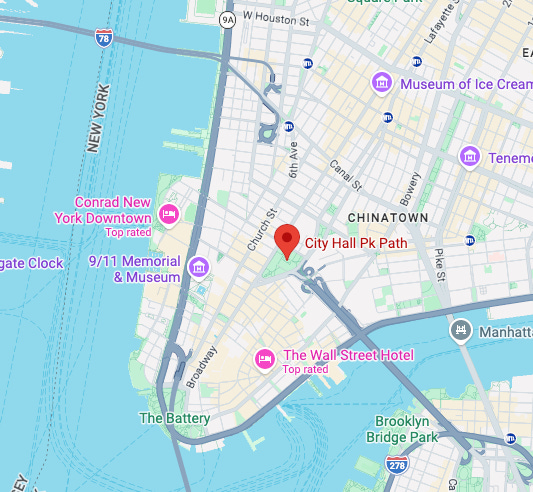
They shipped him to the Provost Prison in New York City. The Provost was a converted jail near what is now City Hall Park. It was overseen by Captain William Cunningham, a Loyalist with a personal grudge against American Patriots. Before the war, a Patriot mob had publicly humiliated Cunningham in the streets of New York. He never forgot it.
Cunningham ran the Provost like a revenge operation. He called the room where he kept high-ranking American prisoners “Congress Hall,” a mockery of the government they had tried to build. He threw drunken parties where he paraded captured officials in front of his guests, jeering at them as “rebel judges.” He withheld food for twenty-four hours at a stretch, sometimes longer. Prisoners later alleged that guards mixed poison into the already meager rations to speed up the death rate.
The cold was the constant. Guards stripped prisoners of their coats and left them in their shirts. The New York winter of 1776-1777 was bitter. Rain and snow blew through shattered, unglazed windows. The floors were bare oak planks. Prisoners slept packed so tight on the floor that they had to roll over on command when a guard shouted “Turn over! Right! Left!” The smell was what you would expect from hundreds of unwashed, starving, sick men crammed into a building with no sanitation: human waste, rotting straw, the sour sweat of men who had not been clean in weeks. Typhus spread easily in those conditions. So did dysentery.
Stockton was kept in heavy irons. The tall, polished lawyer who had charmed the court of King George III was now shivering in his shirt on a wooden floor, starving, listening to men cough and die in the dark around him. Somewhere across the water, his library was burning. His wife was pulling their letters from soldiers’ straw. And someone, at some point during those weeks, slid a piece of paper in front of Richard Stockton that would come to haunt him.
Congress itself took note of Stockton’s condition. On January 3, 1777, they passed a formal resolution protesting that Stockton, a sitting member of Congress, had been “ignominiously thrown into a common gaol” and directed Washington to investigate and complain directly to General Howe. Washington did complain, writing to Howe about the “inhuman treatment” at the Provost and warning that he would “retaliate instantly” against British prisoners if it continued.
Over the course of the war, more than 11,500 Americans died on British prison ships anchored in Wallabout Bay alone, in what is now Brooklyn. Thousands more died in jails like the Provost. The total exceeded all the Americans killed in battle during the entire Revolution. The prison ships were the worst. But the Provost was where the British kept the people they wanted to break.
When Rush, Stockton’s son-in-law, heard what was happening, he wrote a furious letter to fellow delegate Richard Henry Lee: “My much honored father in law who is now a prisoner with General Howe suffers many indignities and hardships... every particle of my blood is electrified with revenge, and if justice cannot be done him in any other way I swear by the ghost of General Warren that I will revenge his indignities.”
The Paper
On the same day Stockton was captured, November 30, 1776, the British commanders issued a proclamation offering a deal to any American who wanted out of the war. The terms were simple: sign a printed form promising “peaceable obedience to his Majesty” and pledge not to fight against Britain. In return, you get a full pardon and a guarantee that your property will not be seized. The form was standardized, starting with the words “I, [your name], do promise and declare...” It was mass-produced. The British were running a bureaucratic machine for switching sides.
The timing was devastating. Washington’s army was in retreat. The Revolution looked like it was failing. About 4,800 Americans signed the deal. 2,700 of them came from New Jersey alone. Among the signers were judges, legislators, and local officials. John Covenhoven, the friend at whose house Stockton was captured, also signed.
Did Richard Stockton sign?
The surviving evidence all points in one direction.
A British military order from December 29, 1776, written by Lieutenant Colonel James Webster of the 33rd Regiment, states that “[General] Howe having granted a full pardon to Richard Stockton, Esq.” and orders the return of his horse and property. That language is significant. Under normal rules of war, a captured gentleman could give his word not to fight and walk free. That was called a parole, and it required no oath of loyalty to anyone. What Stockton received was different. A “full pardon” with property rights attached meant he had been forgiven for a crime, which meant he had admitted to committing one. Those terms match the loyalty proclamation exactly.
Congress soon found out about it. By late December, Massachusetts delegate Elbridge Gerry was writing to colleagues that Stockton had “sued for pardon.” By February, Abraham Clark, another New Jersey signer, told the state assembly that Stockton “by his late proceedure, cannot act” in Congress. John Hancock, the president of Congress, confirmed it the next day: “Stockton it is said, and truly, has received General Howe’s protection.” Three independent sources, all saying the same thing.
But the most important source is a letter from John Witherspoon, Stockton’s Princeton neighbor and the man Stockton had personally recruited from Scotland a decade earlier. In March 1777, Witherspoon wrote a private letter to his son David, passing along what he had been hearing around Princeton. He was not making a formal accusation. He was telling his son what everyone already seemed to know: that Stockton had signed the British loyalty deal and given his word not to participate in American affairs for the rest of the war.
Then, in the same letter, Witherspoon reported a worse rumor: that Stockton had actually been on his way to surrender voluntarily when he was captured. Stockton denied this. And Witherspoon, even while reporting the loyalty deal as fact, shot down the uglier version. The man spreading it, a Loyalist named Richard Cochran, had a well-known personal grudge against Stockton, and that “makes it very doubtful to candid Persons.”
The most important witness delivers the accusation and the defense in the same letter. That contradiction is the center of the mystery. It is made worse by the fact that Stockton had a Loyalist cousin, also named Richard Stockton, known locally as “Double Dick,” who was captured around the same time, and whose name may have been confused with the signer’s in the gossip spreading through Philadelphia.
No signed loyalty oath with Stockton’s name has ever been found. 250 years later, the question remains open.
What Was Left
On February 15, 1777, the New Jersey legislature quietly accepted Stockton’s resignation from Congress. No trial. No public condemnation. The Continental Congress, which would later denounce Benedict Arnold with fury heard across the continent, simply let Stockton disappear. If the British could prove that one of the signers had taken back his sacred honor, it could have broken the entire revolutionary coalition apart.
Stockton came home to Morven and found a ruin. Lieutenant Colonel William Harcourt and the 16th Light Dragoons had used it as their headquarters during the occupation of Princeton. They had systematically destroyed the place. The east wing library, one of the finest private collections in the colonies, was ashes. Every law book, every volume of philosophy, every document from a legal career that stretched back decades, all burned. The family portraits had been slashed with bayonets. The silver was gone. The livestock was gone. The grain stores were gone. Rush, his son-in-law, estimated the total loss at 5,000 pounds, roughly $700,000 in today’s money, enough to wipe out the family’s savings entirely.
When Annis came back, she walked through what was left. Soldiers had slept on straw bedding scattered across the floors. Stuffed into the straw, she found personal letters, the kind of private correspondence between a husband and wife that was never meant for anyone else. She pulled them out and saved what she could. It was one of the few things she was able to recover.
On December 22, 1777, the New Jersey Council of Safety summoned Stockton and made him take a formal oath renouncing whatever deal he had made with the British. This oath was called the Oath of Abjuration and Allegiance. It existed specifically for people who had signed the loyalty proclamation. If you refused to take it, the state could seize and publicly auction everything you still owned. Stockton stood before the Council, swore the oath, and walked out. Whatever he had promised the British in that prison cell, he had now publicly taken it back in front of the men who controlled his property, his legal standing, and what was left of his reputation.
He tried to rebuild. He went back to practicing law, but it was not the same. The rumor of what he had done followed him. In 1779, he wrote that angry mobs threatened him when he showed up in court. “A tyranny in the Country,” he complained, “instead of liberty and law.” The man who had once argued cases before the King’s own judges in London could no longer safely walk into a courtroom in New Jersey.
His health was destroyed. Rush said it took him over two years to even partially recover from the physical effects of the prison. The starvation, the cold, the sustained psychological abuse had broken something in him that never healed. People around him described what they called “nervous disorders,” a term used in that era for conditions that today might be recognized as severe trauma.
Then, in 1779, a cancer appeared on his lip. It spread to his throat and neck. Rush, who was one of the most respected doctors in America, performed two surgeries to try to remove it. Both failed.
Annis sat by his bed through the final nights, writing poetry by candlelight. “By that glimmering taper’s light,” she wrote, “hearing his groans and making each sigh my own.”
On February 28, 1781, Richard Stockton died at Morven. He was fifty years old. The war would not end for another two years, when the Treaty of Paris was signed in 1783. He never saw the country he helped create.
After Stockton
His family buried the story. Rush wrote in his autobiography that Stockton had been “permitted to return to his family upon parole,” with no mention of a loyalty oath. Annis’s poetry cast her husband as a patriot martyr and nothing else. It worked. For 150 years, nobody questioned the hero version. In 1888, New Jersey placed a marble statue of Stockton in the Capitol building in Washington.
Then, in 1975, military historian Frederick Bernays Wiener published “The Signer Who Recanted” in American Heritage magazine. Wiener dug up the Clark and Witherspoon letters and laid out the evidence that Stockton had signed the loyalty proclamation. The article noted that Stockton “appears never to have denied” the accusation. The hero story cracked open. In recent years, researcher Todd Braisted found the Webster military order in the New Jersey State Archives, the first British document directly confirming the “full pardon.”
His son, Richard “The Duke” Stockton, became a US Senator and rebuilt the family fortune. His grandson, Robert “The Commodore” Stockton, conquered California during the Mexican-American War and declared himself military governor on the spot. The man who may have broken in a frozen prison cell in 1776 left behind a dynasty that bent American history for the next hundred years.
The Question
Esther DeBerdt called him the cleverest man she had ever seen from America. He fought off a robber with a sword in an Edinburgh alley and walked away clean. He missed a ship that killed everyone aboard because he stayed too long at a party. He stood in front of King George III, looked the man in the eye, went home, and signed a piece of paper that made them enemies forever. He watched barefoot soldiers bleed in the snow and offered his own money to buy them shoes.
Then his neighbors dragged him out of bed in his nightshirt and handed him to a man who called his cell block Congress Hall.
No signed oath has ever been found. Stockton never confirmed what happened in that prison. He never denied it. He walked out, went home to a ruined estate and a shattered reputation, watched his health collapse, and died at fifty with his wife writing poetry at his bedside by candlelight. Annis kept writing about him for twenty years after he was gone, always as a hero, never once mentioning the accusation.
The other signers pledged their lives, their fortunes, and their sacred honor. Most of them kept all three. Stockton lost every one. Whether he lost them to the British or to his own decision in a frozen cell, nobody alive can say for certain. The cleverest man Esther DeBerdt had ever seen from America took that answer with him when he died.
Next: Thomas Jefferson
From the accused traitor, we turn to the author.
Thomas Jefferson wrote the Declaration of Independence. He put into words the principles that Stockton signed and may or may not have betrayed.
Jefferson is the most famous signer after Washington and Franklin. He is also one of the most complicated. He wrote “all men are created equal” while living in a world that was anything but equal. How a man holds those two ideas in his head at the same time, and what it means that the country he helped build inherited the same contradiction, is the question his essay will try to answer.
Next Sunday, we tell the story of the pen of the Revolution, and the man who held it.
This is Essay #24 of 56 in the “The 56” series, profiling every signer of the Declaration of Independence. New essays every Friday and Sunday, ending on July 4, 2026, the 250th anniversary of American independence.
Subscribe to follow the journey.
Sources:
Was Richard Stockton a Hero? | Journal of the American Revolution
Winning Hearts and Minds: Pardons and Oaths of Allegiance | Journal of the American Revolution
Lt. Col. James Webster dispatch, Dec 29, 1776 | NJ State Archives
John Witherspoon to David Witherspoon, March 17, 1777 | via A House Called Morven
Abraham Clark to John Hart, February 8, 1777 | NJ Executive Correspondence
Biography of the Signers of the Declaration of Independence | Wikipedia