

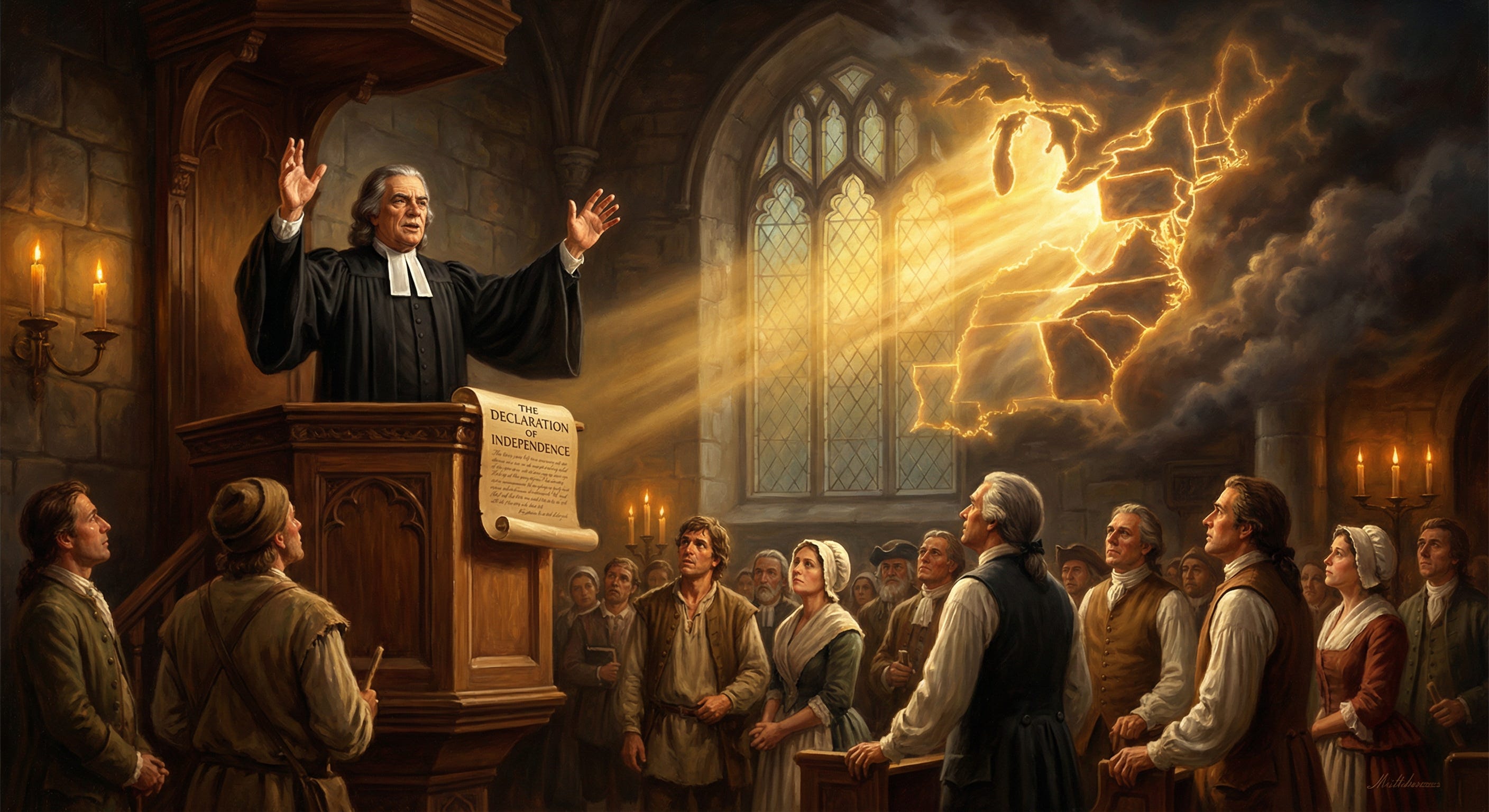
A preacher told his congregation that rebellion was God’s will.
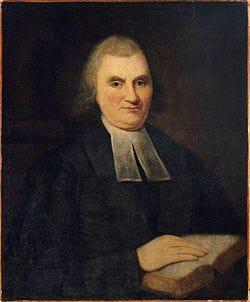
John Witherspoon stood at his pulpit in Princeton and said what no other minister in the colonies was willing to say. He told them that fighting the British wasn’t just politics. It was God’s work, and staying loyal to the Crown was a sin.
In 1776, ministers were the loudest voices in public life. Churches were where news spread and arguments were settled. When a minister blessed something, it carried weight that no political argument could match.
“There is not a single instance in history,” Witherspoon declared, “in which civil liberty was lost and religious liberty preserved entire.”
The fight for independence, in Witherspoon’s view, wasn’t about taxes or representation.
It was a holy cause.
When Witherspoon signed his name to the Declaration, he brought something that lawyers and merchants couldn’t: the blessing of heaven.
The Scottish Minister
John Witherspoon was born in Scotland on February 5, 1723, in the parish of Yester, near Edinburgh.
He studied at the University of Edinburgh and became a Presbyterian minister at twenty-two. He quickly rose to become one of the most respected clergymen in Scotland, known for his writing and his powerful preaching.
He might have spent his entire life in Scotland. But in 1766, an offer came from across the Atlantic.
The College of New Jersey was looking for a new president. Today we call that college Princeton. The school had been founded by Presbyterians, and they wanted a respected minister to lead it. They invited Witherspoon.
He initially declined. His wife Elizabeth hated the idea of crossing the ocean and starting over in the wilderness. Witherspoon loved his wife, and he was not going to force her.
Then Benjamin Rush intervened.
Rush, a young Philadelphia physician who would later sign the Declaration himself, was visiting Scotland. He met with Elizabeth Witherspoon and somehow convinced her that America was worth the risk. The details of their conversation are lost, but the result was clear: Elizabeth changed her mind, and in 1768, the Witherspoons sailed for America.
The Educator
Witherspoon transformed Princeton.
When he arrived, the college was struggling, underfunded and understaffed, overshadowed by Harvard and Yale. Witherspoon rebuilt it from the ground up, raising money and hiring new faculty while updating classes that had fallen behind. He taught many students himself, mixing ideas from Scotland’s best thinkers with lessons about right and wrong. The goal was leadership, not ministry.
His students included James Madison, who would help write the Constitution, and Aaron Burr, who became vice president. Dozens more served in Congress or on the federal bench.
The Revolutionary
Within a decade of arriving, Witherspoon was a revolutionary.
The shift happened gradually. Like many colonists, Witherspoon initially hoped to make peace with Britain. He respected British institutions and had no desire for violence.
But as tensions escalated, Witherspoon moved toward independence. By 1774, he was writing pamphlets attacking British rule, and two years later he took a seat in the Continental Congress.
His sermons from this period are powerful documents. Witherspoon argued that political freedom and religious freedom were tied together. A people ruled by a tyrant could not freely worship God. Therefore, resistance to tyranny was not just a political duty. It was a religious one.
Many colonists worried that rebellion was sinful, a violation of the biblical command to obey earthly authorities. Witherspoon argued the opposite. He gave Americans permission, even a duty, to fight.
On May 17, 1776, Witherspoon delivered what became his most famous sermon: “The Dominion of Providence Over the Passions of Men.” It spread widely across the colonies.
“While we give praise to God, the Supreme Disposer of all events, for His interposition in our behalf,” Witherspoon declared, “let us guard against the dangerous error of trusting in, or boasting of, an arm of flesh.”
Witherspoon was saying something simple: We fight because God wills it. But we fight with humility, knowing that victory comes from Him, not from us.
The Congress
Witherspoon arrived at the Continental Congress in late June 1776, just as the final debates over independence were reaching a breaking point.
He didn’t hesitate. On July 2, when a delegate argued that the colonies weren’t “ripe” for independence, Witherspoon is said to have replied: “In my judgment, sir, we are not only ripe, but rotting.”
The line may not be true. Many famous founding quotes are hard to verify. But it captures Witherspoon’s impatience. He had been making the case for independence from his pulpit for months. He was ready.
On August 2, Witherspoon signed the Declaration. He was fifty-three years old.
His signature meant something. It told the world this was a cause blessed by God.
The Losses
The Revolution cost Witherspoon dearly.
The British occupied Princeton in late 1776, driving Witherspoon and his family into exile. They used Nassau Hall as a barracks. The library was ransacked, and scientific equipment was destroyed. Years of work were undone in weeks.
Witherspoon’s son James was killed at the Battle of Germantown in 1777. He was twenty-two years old and a Princeton graduate. His father’s pride. Witherspoon never fully recovered from the loss.
Another son was taken prisoner and a son-in-law killed. The family estates in New Jersey were stripped bare.
By the war’s end, Witherspoon had lost his son and much of his property. The college he led had also been badly damaged. The minister who had blessed the Revolution had paid for it with blood.
The Later Years
After the war, Witherspoon returned to Princeton and tried to rebuild.
It was slow work. The college was broke and the buildings were damaged. Witherspoon spent the rest of his life fundraising, trying to piece back together what the British had destroyed.
He stayed in politics too, serving in the New Jersey legislature and helping approve the Constitution in 1787. He supported the new government, though he worried about concentrations of power. Like many founders, he wanted liberty and feared what happens when crowds become mobs.
Witherspoon went blind in his final years. He died on November 15, 1794, at seventy-one.
He was buried at Princeton, near the college he had spent his life building.
What Witherspoon Teaches Us
John Witherspoon brought something unique to the Revolution: the authority to say what was right.
The other signers argued about rights and taxes. Witherspoon argued about sin and salvation, and that reframing did something the lawyers couldn’t: it made the cause feel bigger than a dispute with Parliament.
That kind of moral authority can be dangerous. Wars fought in God’s name tend to be brutal, because the enemy stops being an opponent and becomes a demon. Witherspoon kept both in the same sermon: fight, yes, but do not boast.
In 1776, Witherspoon’s blessing mattered. It gave Americans permission to fight, and it turned a political argument into a moral cause that ordinary colonists understood.
He paid for that blessing with his son’s life.
Next: Thomas Nelson Jr.
From the preacher who blessed the Revolution, we turn to the planter who sacrificed everything for it.
Thomas Nelson Jr. was a wealthy Virginia aristocrat. He had everything to lose and little obvious to gain from rebellion. He signed the Declaration and spent heavily on the war effort. He later became governor of Virginia.
And then, at the Battle of Yorktown, he did something extraordinary.
The British had occupied his own mansion, using it as a headquarters while they defended the town. American artillery was directed at the fortifications, carefully avoiding civilian property.
Nelson ordered them to fire on his house.
One quote often linked to him says, “Spare no private property. Destroy it all if necessary.”
They did. Nelson’s mansion was shelled, and his fortune was ruined. The British were later driven out. He died broke, worn down by the stress of war.
Next Sunday, we’ll tell the story of the governor who ordered his own home to be destroyed.
This is Essay #16 of 56 in the “The 56” series, profiling every signer of the Declaration of Independence. New essays every Friday and Sunday, ending on July 4, 2026, the 250th anniversary of American independence.
Sources: