

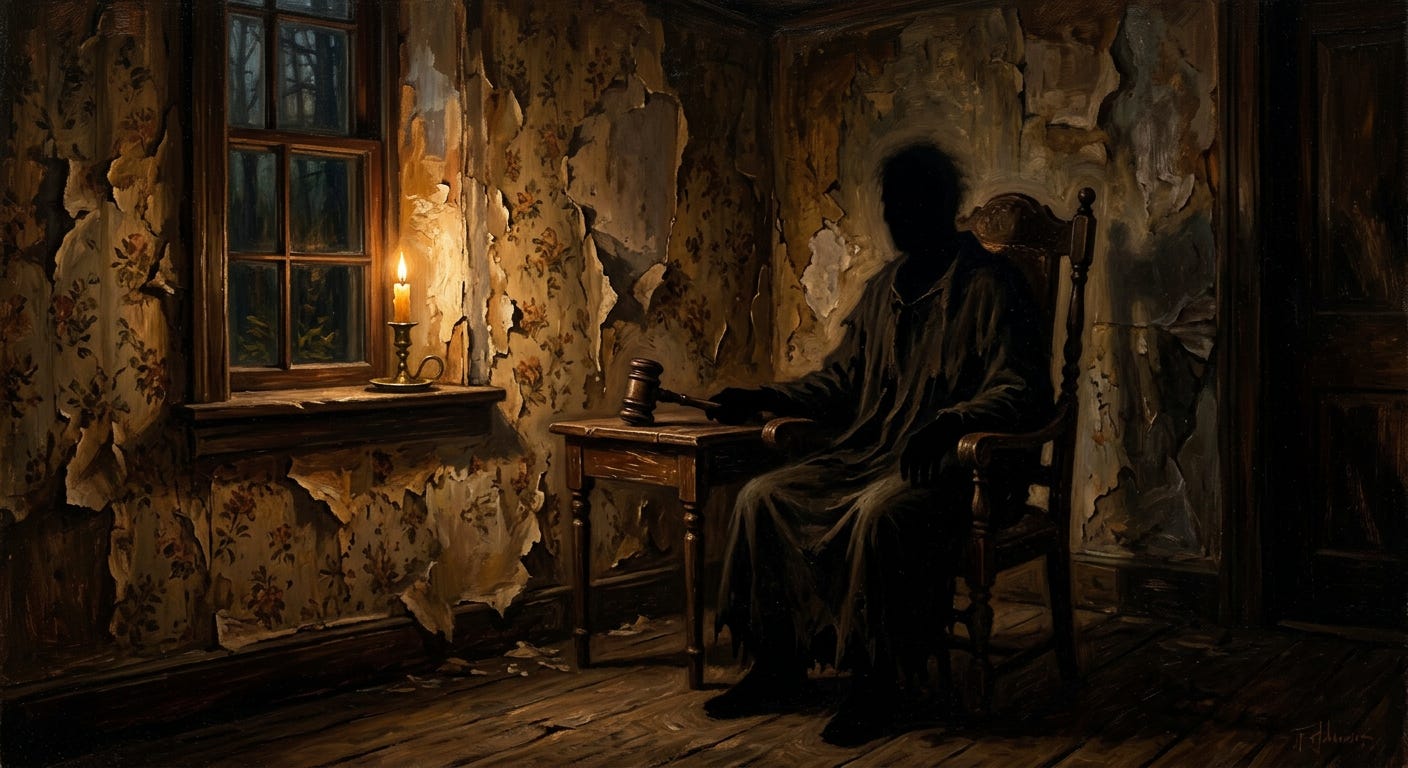
In September 1797, a Supreme Court justice sat in a jail cell in Burlington, New Jersey, writing a letter to his son.
He needed $600. He also needed shirts and stockings. “I want them exceedingly,” James Wilson wrote.
A man named Thomas Shippen heard what had happened and wrote it down with disbelief: “What shall we come to? One [member] of the highest Court in the United States in a Jersey Gaol!”
This was James Wilson, signer of the Declaration of Independence, one of the chief architects of the Constitution. George Washington had named him to the first Supreme Court. At the Constitutional Convention, Wilson spoke more than almost any other delegate. He pushed for a single president with broad powers. And he kept insisting that authority belonged to the people, not the government.
Now he was locked up for debts he could not pay. And this was only the beginning of the end.
The Immigrant
James Wilson was born on September 14, 1742, in Carskerdo, a farming community near St. Andrews, Scotland. His parents were Presbyterian farmers who wanted him to enter ministry, and they scraped together enough to send him to the University of St. Andrews, where he studied Latin, philosophy, and the bold new ideas about reason and human nature that Scottish thinkers were developing at the time.
His father’s death in 1762 ended those plans. Wilson worked as a tutor and accountant, but he found Scotland’s rigid class system stifling, and in 1765 he crossed the Atlantic with letters of introduction and a twenty-three-year-old’s ambition.
His first job in Philadelphia was teaching Latin at the College of Philadelphia. Within a year, he shifted to law, studying under John Dickinson, one of Pennsylvania’s leading attorneys. Wilson borrowed money to pay for the privilege of reading law in Dickinson’s office. It was a pattern that would repeat for the rest of his life.
He was admitted to the bar by 1767 and moved his practice to Carlisle, on the Pennsylvania frontier, where he handled land disputes for Scots-Irish settlers. The Carlisle court records show Wilson appearing in nearly half of all cases in the county. By the early 1770s, he was one of the most respected lawyers in Pennsylvania, known for sharp arguments and a deep grasp of constitutional theory.
He was building something else, too: a political philosophy that would shape the founding.
The Theorist
In 1774, Wilson published “Considerations on the Nature and Extent of the Legislative Authority of the British Parliament.”
Wilson argued that Parliament had no authority over the American colonies. In his view, the colonies owed allegiance to the king, but not to Parliament.
This was radical. Many patriots still accepted some parliamentary role in imperial affairs. Wilson rejected that view outright.
The pamphlet spread fast and shaped the debates leading to independence. When the Continental Congress later declared that the colonies owed no allegiance to Parliament, they were adopting Wilson’s position almost word for word.
Wilson had provided the intellectual framework for revolution. Now he would help build the government itself.
The Convention
If the Declaration was Wilson’s preliminary work, the Constitution was his masterpiece.
But before that summer of 1787, Wilson had to survive a mob.
By 1779, Philadelphia was a city of shortages and rage. Inflation had made Continental currency nearly worthless, food was scarce, and militia families blamed merchants and lawyers for profiting from the war while ordinary people suffered. Wilson had made himself a target. He defended men accused of helping the British during their occupation of Philadelphia. He had recently won an acquittal, and the city’s most militant patriots were furious.
On October 4, roughly 200 militiamen gathered at Burns Tavern, led by Captain Ephraim Faulkner. The artist Charles Willson Peale tried to redirect the march, but when the crowd shouted “Get Wilson!” there was no stopping them. They headed for Wilson’s home at Third and Walnut Streets. Wilson and thirty-five associates, including Robert Morris, barricaded themselves inside.
What followed was a firefight. The militia tried to force the doors with crowbars, set the first floor on fire, and dragged a small cannon into view. Robert Campbell, defending the house from an upstairs window, was killed. Pennsylvania’s top official, Joseph Reed, arrived with cavalry and dispersed the crowd. When the shooting stopped, six lay dead and seventeen were wounded. Wilson fled to Morris’s country estate and hid there until the anger passed.
He could have left Philadelphia. Instead, he stayed. Eight years later, he walked into Independence Hall for the Constitutional Convention.
At the Convention in 1787, Wilson spoke 168 times, more than any other delegate except Gouverneur Morris. He sat on the Committee of Detail and helped produce the first full draft of the Constitution, pushing hard for direct election of the president and proportional representation in Congress.
Not all of his ideas prevailed. The Senate ended up with equal votes for each state regardless of size. But Wilson’s fingerprints are all over the final document.
His biggest mark was the presidency. Many delegates wanted multiple executives, or a weak office controlled by Congress. “Mr. Wilson moved that the Executive consist of a single person,” the convention records show, and he argued that a single leader would create “energy, dispatch, and responsibility.” He insisted this was not a step toward monarchy but “the best safeguard against tyranny.” That argument won, and the presidency as we know it exists in large part because Wilson made the case.
He also insisted that the government’s power came from the people, not the states. Most delegates thought of the country as a collection of independent states that had agreed to cooperate. Wilson saw it differently. The Constitution, in his view, was an act of “We the People,” not a deal between governments. That idea would take decades to become the dominant view, but Wilson planted it at the founding.
Madison is often called the “Father of the Constitution.” Wilson deserves the title “Uncle.”
The Justice
George Washington appointed James Wilson to the Supreme Court in 1789, as one of the original six justices.
The early Court had little to do. Cases were scarce, and the justices spent most of their time traveling the country to hear lower-court cases on circuit. Wilson wanted to shape American law from the bench, but the bench barely existed yet.
His most important opinion came in Chisholm v. Georgia in 1793. Wilson argued that citizens of other states could sue a state directly. In the opinion, he mocked the idea that a state could dodge a creditor’s lawsuit by claiming sovereignty. Could Georgia, when summoned to answer a debt, simply shape-shift into a sovereign and refuse to show up? “Surely not,” Wilson wrote. The backlash was fierce enough to produce the Eleventh Amendment, which reversed that result entirely.
Four years later, Wilson would be the one fleeing creditors. The justice who ridiculed sovereign-debtor evasion became a debtor fugitive himself.
He kept writing and teaching, too. In 1790, he became the first professor of law at the College of Philadelphia. His opening lecture was a major event, attended by President Washington, the First Lady, the Vice President, and members of Congress. Wilson’s ambition was enormous: he wanted to build a distinctly American legal theory from the ground up, a rival to the great English legal texts that every lawyer in America had grown up reading. The foundation of his theory was natural rights and the power of the people, the same ideas he had championed at the Convention.
But Wilson had a problem. The same confidence that made him a bold legal thinker made him reckless with money. He started speculating in land.
The Fall
Land speculation destroyed James Wilson.
Like Robert Morris, Wilson believed that American expansion would send frontier land prices soaring. He was an early subscriber and likely drafter of key documents for the Bank of North America. He was also one of its largest debtors, borrowing heavily to finance his land purchases. He had helped build those financial institutions to steady the new republic. Now they were the instruments that destroyed him.
He borrowed against that reputation to buy vast tracts across Pennsylvania, New York, Virginia, and Georgia. The Illinois-Wabash Company alone claimed roughly thirty million acres; Wilson’s personal share ran to roughly one million acres. In Georgia, he was the largest single shareholder in the Georgia Land Company, one of the Yazoo companies, investing $25,000 for rights to 750,000 acres. His reputation secured the credit. The credit bought more land.
Then came the collapse. The Illinois-Wabash Company’s claims were based on direct purchases from Native American tribes, but the federal government ruled that only the national government could acquire Indian lands. The constitutional supremacy Wilson had championed in 1787 destroyed his largest investment in the 1790s. The Yazoo grants were rescinded. European buyers never materialized. Land prices fell. Wilson borrowed more to cover what he already owed, sometimes at interest rates as high as thirty percent. Under the laws of the time, even a Supreme Court justice could be jailed for debt.
Wilson started running. A sitting Supreme Court justice, moving from town to town to dodge arrest. The Burlington jail was first. His son Bird secured bail, but freedom was temporary. Senator Pierce Butler of South Carolina, one of Wilson’s creditors, demanded payment of $197,000. Wilson could not pay and was jailed again. Butler eventually agreed to his release, but Wilson was trapped.
By early 1798, he had reached Edenton, North Carolina, where fellow Justice James Iredell lived. Wilson lodged at Horniblow Tavern near the courthouse, a modest inn where room and board were expensive and his clothes grew threadbare. His second wife, Hannah Gray, eventually joined him after months of separation. She had married Wilson in 1793, when she was nineteen and he was fifty-one. Now she nursed him through illness without changing her own clothes “for three days and nights,” and described his mind as “harassed and perplexed.”
Back in Philadelphia, Wilson’s stepdaughters were selling their needlework to survive. In Congress, members openly discussed impeaching him. The spectacle of a Supreme Court justice dodging legal process for private debts was an embarrassment the young government could not afford.
Wilson was ill and getting worse. He died on August 21, 1798, still formally on the Court’s roster, still a fugitive from creditors.
The Irony
James Wilson’s story is Robert Morris’s story, but worse.
Morris, at least, had been a businessman his whole life. Speculation was an extension of what he already did. Wilson was a legal theorist and a sitting Supreme Court justice. His land gambling cut against everything he had built his reputation on.
He had spent his life building legal structures. Those structures chased him to his grave. In 1779, he was besieged by a militia crowd enraged at his legal defense of unpopular clients. In 1797, he was besieged by creditors using the legal system to seize his body. The instrument was the same. Law as coercion. Only the plaintiffs changed.
He championed federal supremacy over the states. That supremacy invalidated his land claims. He mocked debtors who hid behind sovereignty. Then he hid from his own debts. He argued for an energetic executive that could act with “dispatch and responsibility.” That same government could now seize him like any other debtor.
The same confidence that let him challenge Parliament also fed his belief that his land bets would pay off. He was used to being right. Land didn’t care.
In his 1787 speech defending the Constitution, Wilson wrote: “It is the nature of man to pursue his own interest, in preference to the public good.” He meant it as political science. It reads now like an accidental self-portrait.
Disgrace is temporary. Ideas endure.
A century passed. In 1906, the U.S.S. Dubuque carried Wilson’s remains from North Carolina to Philadelphia. His body lay in state at Independence Hall. Then, finally, he was reinterred at Christ Church alongside his first wife, Rachel, a formal return that the scandal of his life had denied him.
The man who had written to his son from a jail cell, asking for shirts and stockings, was finally home.
What James Wilson Teaches Us
Wilson’s story is not about greed. Plenty of founders speculated in land. What makes Wilson different is the gap between what he understood and what he did.
He understood constitutional law better than almost anyone alive. He could see how power flowed and how institutions bent under pressure. He built systems designed to protect people from exactly the kind of ruin that eventually consumed him.
But understanding a system and being immune to it are not the same thing. Wilson could name every force that drives men to overreach. He just couldn’t stop himself from overreaching.
That’s the lesson. Seeing clearly is not enough. You also have to act on what you see. The smartest person in the room can still make the worst bet.
Next: William Ellery
From the fugitive justice, we turn to the curious customs collector.
William Ellery of Rhode Island is remembered for one thing: he watched.
When the Declaration of Independence was being signed, Ellery positioned himself near the table so he could study each signer’s face as they wrote their names. He wanted to see how men looked when they committed treason.
What did he see? “Undaunted resolution,” Ellery wrote later. Every man signed “with a firm and steady hand.”
It’s a small detail, but a telling one. Ellery understood that he was witnessing history. He wanted to remember it.
Next, we’ll tell the story of the signer who watched.
This is Essay #20 of 56 in the “The 56” series, profiling every signer of the Declaration of Independence. New essays every Friday and Sunday, ending on July 4, 2026, the 250th anniversary of American independence.
Subscribe to follow the journey.
Sources: