


On February 15, 1798, Robert Morris walked into the Prune Street Debtors’ Prison in Philadelphia.
He would not walk out for three and a half years.
This was the man who had financed the American Revolution.
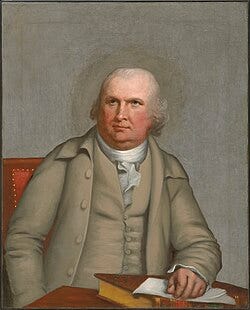
When Washington’s army was starving at Valley Forge, Morris found money.
When Congress couldn’t pay its soldiers, he pledged his own credit.
And when the whole war effort nearly collapsed, he held it together through sheer financial nerve.
George Washington called him “the Financier of the Revolution.” Congress appointed him Superintendent of Finance, essentially the nation’s first treasury secretary.
At his peak, Morris was probably the richest man in America.
And now he was in prison. Ruined by bad investments. Unable to pay his debts.
The cell was small. The food was bad. The other prisoners included thieves, bankrupts, and men who had simply been unlucky. Morris spent his days writing letters to friends, pleading for help that rarely came, watching his life’s work dissolve.
He was sixty-four years old, a man who had helped create a nation.
He would die with nothing.
The Merchant
Robert Morris was born in Liverpool, England, on January 20, 1734. His father was a tobacco merchant who traded with the American colonies. Young Robert followed him across the Atlantic, arriving in Maryland as a teenager.
He went to work for the Philadelphia merchant firm of Charles Willing. Morris was smart and ambitious, exactly the qualities a colonial merchant needed. By his early twenties, he had become a partner in what would become Willing & Morris, one of the most successful trading houses in America.
The firm traded in everything: tobacco, wheat, and manufactured goods. They ran ships across the Atlantic, made risky bets on land, and loaned money to other merchants. By the 1770s, Morris was extremely wealthy, a man whose fortune touched every corner of the colonial economy.
He was also becoming political.
As tensions with Britain rose, Morris found himself drawn into the patriot cause. He wasn’t an idealist, but he was a businessman. He understood that British policies at the time were bad for business.
The Financier
When war came, the Continental Congress discovered a problem: they had no money.
Congress couldn’t collect taxes. That power belonged to the states, who were often reluctant to pay. Borrowing was just as hopeless. No one trusted a government that might not exist in a year. They tried printing money, but the resulting “Continentals” quickly became worthless. “Not worth a Continental” became a common phrase.
Robert Morris could do things Congress couldn’t.
He had credit. Decades of successful business had established his reputation across the Atlantic world. When Morris said he would pay, people believed him. They trusted his word when they wouldn’t trust Congress’s.
Starting in 1776, Morris began using that credit to fund the war. He advanced money for supplies and guaranteed loans, putting his personal fortune up as a guarantee for public debt. When the government couldn’t pay, Morris paid instead.
Between 1781 and 1784, Morris raised about $11 million through loans, taxes, and creative financing. He created the Bank of North America, the country’s first commercial bank, partly to fund the war effort. He issued “Morris notes,” which people used as money because people trusted Morris even when they didn’t trust the government.
Washington’s army at Yorktown was paid and supplied largely through Morris’s efforts. Morris personally advanced about $1.4 million for the campaign. The siege that won the war was financed by a man who was betting his entire fortune on American independence.
The Risk
Morris did this partly out of patriotism. He believed in the American cause and was willing to sacrifice for it. He also expected to profit from an independent America through contracts and land deals, plus the general prosperity that peace would bring.
But mostly, Morris was a gambler.
He bet everything, and he expected to win everything. “The door to fortune is open,” he wrote during the war. Morris saw opportunities everywhere. Government contracts. Risky land deals. The chaos of a new nation finding its footing. He was willing to risk everything because he believed he could win everything.
For a while, he was right. After the war, Morris was one of the most powerful men in America. He served in the Constitutional Convention, helping to shape the document that would govern the nation he had financed. He was offered the position of Treasury Secretary under Washington but declined, recommending Alexander Hamilton instead.
“The door to fortune is open,” - Robert Morris
He was also buying land. At his peak, he held about 6 million acres. Huge stretches of New York and Pennsylvania, stretching into the western territories. Morris believed that American expansion would make land the most valuable asset in the world. He was betting on America’s future. And this time, he was wrong.
The Crash
The land bubble burst in the Panic of 1796-1797.
Morris had borrowed heavily to pay for his purchases, expecting that rising land prices would let him pay off his debts while keeping a fortune. Instead, prices collapsed. Immigration slowed. The western lands that Morris had bought turned out to be worth a fraction of what he had paid.
His creditors came calling. Morris owed about $3 million, spread across banks, individual investors, and European lenders who had trusted his name. He couldn’t pay. He tried to sell his holdings, but the market was flooded with land and there were no buyers.
In 1798, his creditors had him arrested.
Debtor’s prison in the late 18th century was exactly what it sounds like: a prison for people who couldn’t pay their debts. You stayed until you paid, or until your creditors gave up and released you. Some prisoners died inside. Others spent years in limbo, unable to work off their debts because they were locked up.
Morris entered Prune Street in February 1798. He would remain there until August 1801, more than three years.
The Prison Years
He begged friends for help, tried to arrange deals to pay off his debts, and complained about his health and the terrible food. He couldn’t believe this was happening to him. Robert Morris, the Financier of the Revolution, locked up like a common criminal.
George Washington visited him once. The two old friends sat in Morris’s cell and talked about the past. Washington offered sympathy but couldn’t offer money. His own finances were tight. After Washington died in 1799, Morris was more alone than ever.
Some people tried to help. Gouverneur Morris (no relation), a friend from the Constitutional Convention, provided some support. Other old allies sent what they could. But it wasn’t enough. Morris’s debts were measured in millions, and no amount of charity could bridge the gap.
In 1800, Congress passed a federal bankruptcy law, the first in American history. The law allowed debtors to clear their debts and start over. Morris applied immediately.
On August 26, 1801, Robert Morris walked out of Prune Street a free man. He was sixty-seven years old. Penniless and broken.
The End
Morris spent his final years in a small house in Philadelphia, supported by his wife Mary and the occasional charity of friends.
He never recovered his fortune and never returned to public life.
The nation he had financed moved on, and Morris faded with it.
On May 8, 1806, Robert Morris died. He was seventy-three years old.
His grave in the Christ Church burial ground in Philadelphia is near those of Benjamin Franklin and other founders. But while tourists flock to Franklin’s grave, few visit Morris’s.
The man who financed the Revolution has been largely forgotten.
The Lesson
What happened to Robert Morris?
He gambled and lost.
He had always been a risk-taker, and his risks had always paid off. Land speculating ended that. The skills that made him successful during the war were the same skills that destroyed him afterward.
The difference between Morris at war and Morris at peace was simple.
During the war, Morris’s interests and the nation’s interests lined up perfectly. He profited from the Revolution, but the nation profited too. His gambles paid off for everyone.
After the war, that connection broke down. Morris’s land deals benefited only himself. When it failed, he bore the consequences alone. The nation he had financed moved on without him.
Many founders followed the same arc.
Some prospered.
Some failed.
Morris did both.
What Morris Teaches Us
Robert Morris’s story is about how easily fortune can disappear.
You can be the most important person in the room and still end up in a cell. You can finance a nation’s independence and still die with nothing.
There’s no moral safety net in history.
Being good doesn’t protect you from bad luck.
Being essential doesn’t protect you from ruin.
Morris did more for American independence than almost anyone, and it didn’t save him.
But there’s another way to read it.
Morris gambled on America, and America survived. His personal fortune was lost, but the nation he financed endured. The bet paid off, just not for him.
That might be enough. The point of Morris’s sacrifice was never personal reward. Morris gave everything he had to American independence. He succeeded in helping to create a new nation at the cost of his wealth and freedom.
Robert Morris got sentenced to debtors prison.
The rest of us got an amazing country.
Next: Samuel Adams
From the financier of the Revolution, we turn to its propagandist.
Samuel Adams of Massachusetts was John Adams’s older cousin, and in many ways, his opposite. Where John was a lawyer who defended British soldiers, Samuel was an agitator who organized mobs. Where John wrestled with principle, Samuel dealt in what worked.
Samuel Adams was the man who made the Revolution popular. He wrote pamphlets, organized boycotts, founded the Sons of Liberty, and helped plan the Boston Tea Party. Without his decades of organizing, there might not have been a revolution to finance.
He was also, by all accounts, a terrible businessman. He failed at every business he attempted. His only talent was politics, and in politics, he was a genius.
Next Friday, we’ll tell the story of the man who mastered propaganda before Twitter existed.
This is Essay #13 of 56 in the “The 56” series, profiling every signer of the Declaration of Independence. New essays every Friday and Sunday, culminating on July 4, 2026, the 250th anniversary of American independence.
Subscribe to follow the journey.
Sources:
Robert Morris: Financier of the American Revolution | Charles Rappleye
Debtor’s Prisons in Early America | Journal of Economic History