

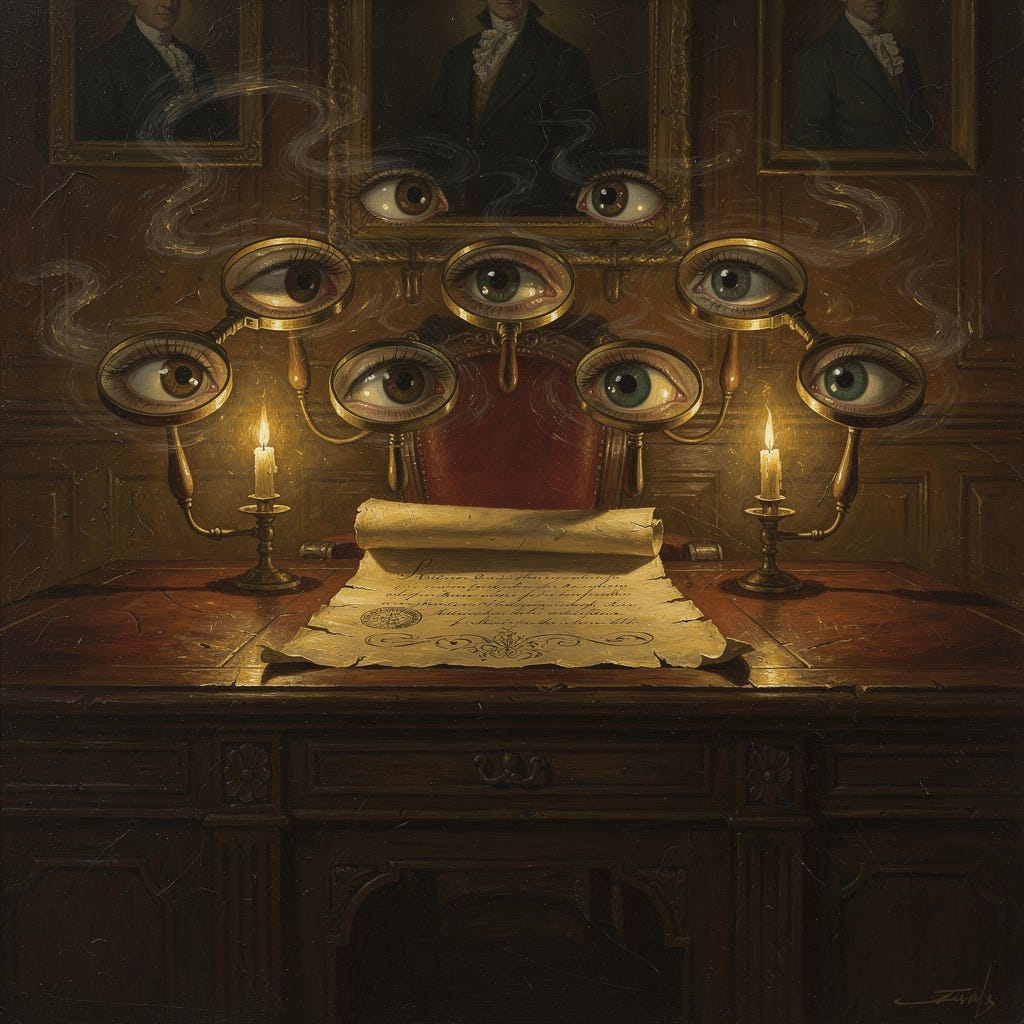
“Undaunted resolution.”
That is how William Ellery described the faces of the men who signed the Declaration of Independence.
On August 2, 1776, while other delegates waited for their turn at the signing table, Ellery did something no one else thought to do. He positioned himself right next to Secretary Charles Thomson, close enough to study every face as each man stepped forward to sign. Most signers left almost no record of what it felt like in that room. Ellery was different. He watched closely, and he wrote it down.
He was a small man, about five foot five, thin and light. The kind of person who could slip to the front of a room without anyone noticing. He later wrote that “undaunted resolution was displayed in every countenance.” No trembling hands. No long pauses. Just name after name on a sheet of parchment that could have sent every one of them to the gallows.
The large-bodied Benjamin Harrison of Virginia looked at Ellery and saw an opportunity for a joke. “I shall have a great advantage over you, Mr. Ellery, when we are all hung for what we are now doing,” Harrison said. “From the size and weight of my body, I shall die quickly, but from your lightness of body, you will dance for some time before you are dead.”
Gallows humor. Literal gallows humor, from men signing what they believed could be their own death warrant. Ellery did not record whether he laughed. He recorded that he watched.
The Late Bloomer
Ellery was born December 22, 1727, in Newport, Rhode Island, a city that most Americans today could not place on a map but that in 1727 was one of the wealthiest ports in British North America. Newport was the fifth-largest city in the colonies, with a population of roughly 9,200. Its deep-water harbor ranked as the third-busiest port on the continent. Ships carried rum, whale oil, and candles across the Atlantic. The streets near the waterfront were lined with merchant houses, distilleries, and the workshops of some of the finest furniture makers in the colonies. A Jewish community had settled there as early as 1658, and by the 1760s they had built the Touro Synagogue, still standing today as the oldest synagogue in North America.
This was the Newport that shaped young William Ellery. His father, William Ellery Sr., was a prominent merchant and member of the colonial legislature. Young William graduated from Harvard in 1747, where he was reportedly better known for his humor than his studies, and seemed headed for an ordinary life in trade or law.
For the next two decades, nothing stuck. He tried his hand as a merchant, served as a clerk for the Rhode Island legislature, and held minor local offices. His first wife, Ann Remington, died in 1764. He married Abigail Cary and, nearing fifty, finally settled into a law practice. He was admitted to the bar in 1770, at the age of forty-three.
A family story, passed down through his grandson William Ellery Channing (who would later become one of America’s most famous ministers), captures his temperament. Ellery’s wife kept a family almanac. One day she recorded as its “most precious event” that her husband had spent the evening at home with her and the children. Ellery read the entry. He said nothing. He went out that evening as usual. Then, when he returned, he announced he had come for a “parting cup” and declared he would seek his evenings at home from then on. No argument. No speech. Just a private decision, made quietly and kept.
By his own assessment, he was a “quack lawyer.” Despite the self-deprecation, or perhaps because of it, he had found his calling. The law gave structure to the restlessness. And that restlessness found its purpose when the Revolution arrived.
In 1765, when the Stamp Act protests erupted, Ellery did not just join the local resistance. He helped lead a march through Newport’s streets, and in a letter to a friend, he wrote with an intensity that revealed how far the quiet observer could go: “You must exert yourself. To be ruled by Tories, when we may be ruled by Sons of Liberty, how debasing. There is liberty and fire enough, it only requires the application of the bellows. Blow then, a blast that will shake this country.”
In May 1776, Rhode Island became the first colony to formally renounce allegiance to the British Crown. Weeks later, delegate Samuel Ward died of smallpox in Philadelphia. The colony sent Ellery to take his seat in the Continental Congress.
He arrived just in time to vote for independence and sign the Declaration. He was forty-eight years old, and his signature was the second-largest on the document, right after John Hancock‘s. The quiet watcher wrote his name bigger than almost everyone else in the room.
But signing a document and surviving its consequences were two different things.
The War at Home
The Revolution cost William Ellery everything he had built.
Before the British came, Newport was a thriving port city of nearly 9,500 people, a place where merchants, craftsmen, and sailors crowded the streets around the Brick Market at the head of Long Wharf. The Colony House, where the Declaration of Independence had been read aloud in July 1776, stood at the center of civic life.
In December 1776, a British fleet of more than seventy ships sailed into Narragansett Bay. Seven thousand British and Hessian soldiers occupied the city, and Newport began to die. The soldiers turned churches into barracks and stables. They cut down every tree on Aquidneck Island for firewood during three brutal winters. They tore down roughly 300 houses, ripping them apart board by board for fuel. Fences, orchards, and woodlots disappeared. The population collapsed from over 9,200 to barely 5,300 as residents fled.
The Jewish community scattered. Aaron Lopez, the merchant who had helped build Newport’s candle and whale oil industries, left for Leicester, Massachusetts, and most of the community followed. Isaac Touro, the synagogue’s prayer leader, protected the building during the occupation but was forced to flee under British escort in 1779. He never returned. He died in poverty four years later.
British soldiers targeted patriot property specifically. Ellery’s house on Thames Street, directly across from the Liberty Tree, was one of many buildings burned in retribution for his “treason.” His furniture, personal effects, and a large portion of his personal library were destroyed.
Ellery was not there to see it. He was serving in Congress in Philadelphia. When he learned what had happened, he kept working. He sat on the Marine Committee and the Board of Admiralty, helping oversee the small American navy. To save money, he traveled between Rhode Island and Philadelphia on horseback, a small man on a long road. He later joked that few people along the route would have taken him for a “Lord of the Admiralty.”
He served in Congress until 1785, building a new government while the city he grew up in shrank around him. When he finally returned to Rhode Island, the “quack lawyer” was elected Chief Justice of the state’s Supreme Court, a position he held while the state wrestled with debt crises and paper money fights.
When the British left Newport in October 1779, they left behind a stripped, scarred town. The orchards were gone. Half the houses were gone. The merchants had scattered to Providence and Boston and never came back. Newport would not recover its pre-war population for decades. The city William Ellery grew up in no longer existed.
The Enforcer
In 1790, George Washington appointed Ellery customs collector for the District of Newport. He was sixty-two years old. He would hold the job for thirty years, under five presidents, until the day he died.
The work was not glamorous. Ellery walked to the customs house every morning to review shipping records, cargo lists, crew manifests, and bills of sale. His annual salary in 1817 was $1,275.67, a figure that reads like accounting because that is exactly what the job was. The same eyes that had studied every face at the signing table now tracked tonnage and invoices at a wounded harbor.
But the customs job was not ceremonial, and Ellery was not a passive observer.
In the late 1790s, he went to war with the DeWolf family of Bristol, one of the wealthiest and most powerful clans in Rhode Island. The DeWolfs ran an illegal trading network through the port, and Ellery, as the federal customs collector, was the one person standing between them and unchecked commerce.
In 1799, Ellery seized a schooner called the Lucy, owned by the DeWolfs and captained by a man named Charles Collins. When a court ordered the ship sold at auction, Ellery sent his deputy to bid on it for the government. The DeWolfs tried to convince the deputy to back off. He refused. So they kidnapped him. In broad daylight, the deputy was grabbed and carried onto a boat. He later wrote: “I was forcibly seized and carried on Board of a small sail Boat... I struggled... but in vain.” Several bystanders watched and did nothing.
With the government’s bidder gone, a straw buyer purchased the Lucy back for the DeWolfs at a fraction of its value.
Ellery did not stop. He kept filing reports, kept enforcing federal law. The DeWolfs responded with politics. James DeWolf, who had powerful connections to President Jefferson’s party, lobbied for the creation of a separate customs district in Bristol, one that would be outside Ellery’s jurisdiction entirely. In 1801, Jefferson approved it. And in 1804, Charles Collins, the very captain whose ship Ellery had seized, was appointed as the new Bristol customs collector.
Then, in 1809, came a gut-punch from above. Ellery seized ships carrying illegal cargo from Cuba. Treasury Secretary Albert Gallatin sent a letter ordering him to “release the vessel and cargo.” The man on the wharf enforced the law. The man at the capital overruled him.
Ellery held his post anyway. He kept walking to the customs house. He kept filing reports. He kept watching.
A letter to Ezra Stiles from July 1776 captures the finality of his commitment: “The door is shut. We have been driven into a Declaration of Independency and must forget our former love of our British brethren. The Sword must determine our quarrel.” Once Ellery made a decision, he did not unmake it. Not at the signing table, and not at the customs house.
The Long Life
William Ellery lived to be ninety-two years old.
Past eighty, he bragged about helping pioneer more intensive vegetable gardening in Newport, boasting that “ten times” as many vegetables were raised on the same ground as before. He was especially proud of his peas. He maintained that a diet from his own garden, combined with goat’s milk and cheese from his own livestock, was the secret to his “healthful and agreeable” condition. He was still competing, still measuring, still improving.
He fathered seventeen children across two marriages, seven with Ann and ten with Abigail. He outlived both wives. His grandson, William Ellery Channing, became the most important Unitarian minister in American history. In his later years, Ellery wrote letters to Channing that mixed advice, classical references, and the same ironical humor that had followed him since Harvard.
During congressional sessions decades earlier, Ellery had spent his time writing short, biting poems about his fellow delegates, capturing their vanities in verse. The observer never stopped observing. But late in life, he asked his friends to preserve none of his personal correspondence. A man who watched others sign their names to history tried to erase his own written record. He wanted the public act remembered. Not the private man.
By the time Ellery died on February 15, 1820, John Adams, Thomas Jefferson, Charles Carroll, and William Floyd were still alive among the signers. He was the fifth-to-last survivor.
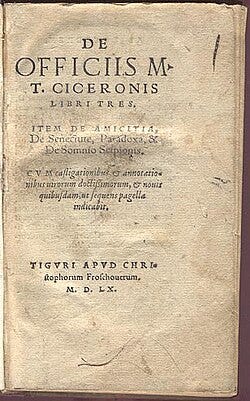
On the morning of his death, he rose as usual. He sat in an armless, flag-bottomed chair that he had used for half a century, a chair that had been rescued from the flames when his house was burned during the occupation. He opened Cicero’s De Officiis and began to read in the original Latin, without glasses, despite the small print.
His physician stopped by and found him thin and pale. Ellery told him: “I am going off the stage of life, and it is a great blessing that I go free from sickness, pain and sorrow.”
His daughter helped him to his bed. He sat upright and asked for the book again. A few moments later, he died without a struggle, still holding De Officiis, still on the page.
De Officiis means “On Duties.” A fitting last text for a man who had spent ninety-two years attending to his.
What Ellery Teaches Us
Most of the signers are remembered for what they did. Ellery is remembered for what he saw.
He was the one who positioned himself next to the secretary so he could watch every face. He was the one who wrote down “undaunted resolution” while everyone else was thinking about their own name on the page. He was the customs collector who spent thirty years watching ships and cargo lists, catching what others missed or chose to ignore.
Ellery was not a general. He was not a famous writer. He never led a charge or published a pamphlet that changed the course of the war. But he paid attention. And in a room full of men who were focused on their own moment, Ellery focused on theirs. That is why we know what it looked like when the country began.
The lesson is simple: someone has to watch. Someone has to notice. Someone has to write it down. Most of the time, that person does not get credit. Ellery did not expect credit. He asked for his letters to be burned.
But “undaunted resolution” survives because one man in a room full of signers chose to look at their faces instead of the document.
Next: Lyman Hall
From Rhode Island’s curious observer, we turn to Georgia’s healing physician.
Lyman Hall was one of the few physicians among the signers. He came to Georgia as a missionary and later became a leader in a fragile patriot movement.
Georgia was the most reluctant colony to join the Revolution. It was small and dependent on British protection against frontier attacks. When the Continental Congress first met, Georgia sent no delegates.
Lyman Hall changed that. He represented St. John’s Parish, a small district along the Georgia coast, at Congress before Georgia itself was officially participating. He helped bring his colony into the Revolution, one community at a time.
Next up: the physician who helped heal a colony.
This is Essay #21 of 56 in the “The 56” series, profiling every signer of the Declaration of Independence. New essays every Friday and Sunday, ending on July 4, 2026, the 250th anniversary of American independence.
Subscribe to follow the journey.
Sources:
Signers of the Declaration Factsheet | U.S. National Archives
OCCUPIED! Newport and the Fight for Independence | Newport Historical Society
Newport Historical Society Walking Tour & Manuscripts Collection
Ezra Stiles Literary Diary | Yale University Library / Massachusetts Historical Society
The Rhode Island Signers of the Declaration of Independence (1913) | Digitized Collection
U.S. State Department Register of Officers and Agents (1818)
Leonardo Marques, “Federal Enforcement and the Slave Trade” (scholarly article)
The Huntington Library, “Albert Gallatin Letter to Newport Customs Collector, 1809”
Love this Jay! So very interesting to see this perspective on one of the most consequential times in American history.