

On March 20, 1776, Joseph Hewes wrote from Philadelphia to Samuel Johnston in North Carolina: “I see no prospect of a reconciliation. Nothing is left now but to fight it out.”
For most men in Congress, that was a political judgment. For Hewes, it was also a break with the faith that had shaped him. He had spent months as a moderate, pushing for peace because he still believed the empire could be reformed from within.
His mother, Providence Hewes, had survived a musket ball to the neck during a frontier attack and still chose pacifism. She became a Quaker minister. She raised her oldest son to believe that violence solved nothing. How does a man formed in that house end up helping launch a war fleet?
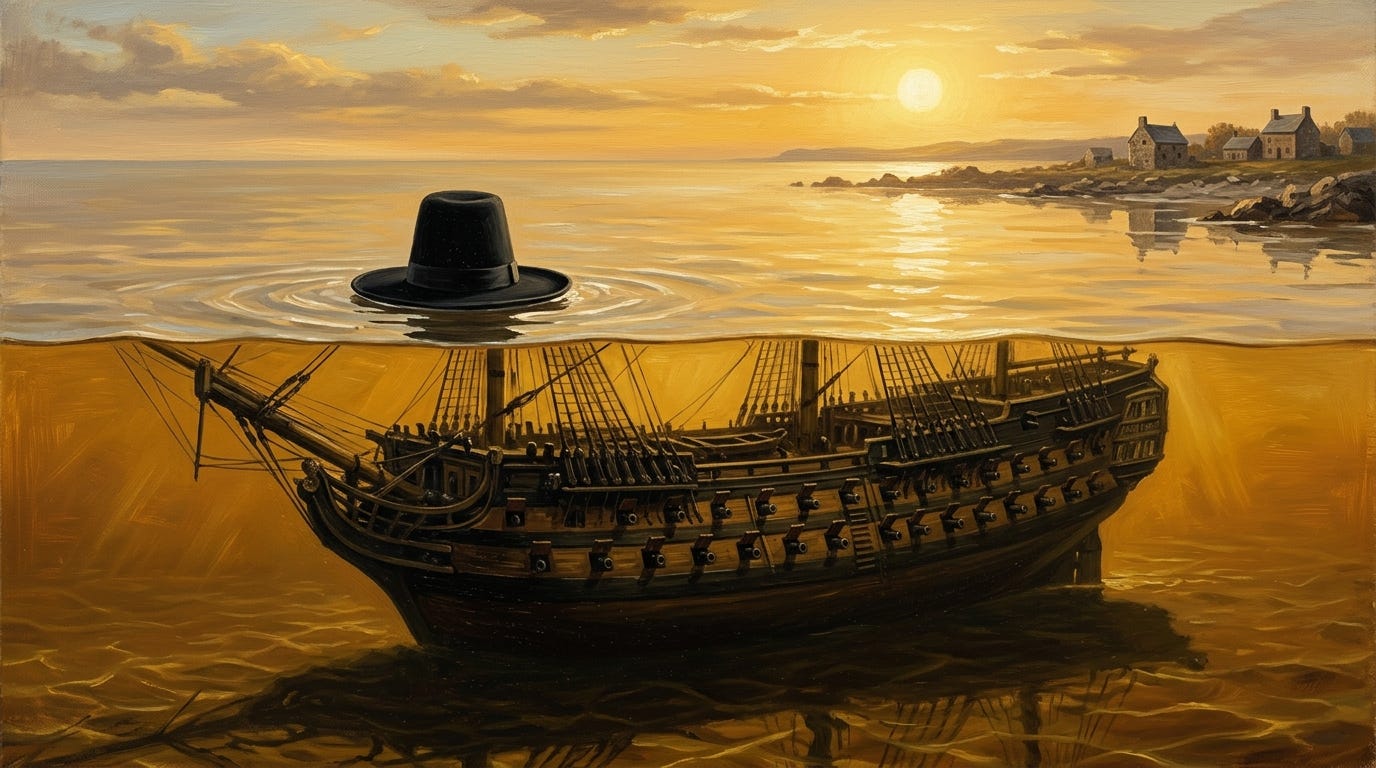
Joseph Hewes did not become a revolutionary because he loved war. He became one because he decided war had already been chosen for him, and once he made that decision he gave it his ships and then his health.
By March, the evidence was piling up faster than any moderate case for peace could survive. King George III had declared the colonies in open rebellion. Parliament had passed the Prohibitory Act, authorizing the seizure of American ships and cargo. The British were hiring Hessian mercenaries to crush the resistance.
When the vote for independence came, John Adams, writing in an 1813 letter to Governor William Plumer, remembered Hewes rising from his seat, lifting both hands toward heaven “as if he had been in a trance,” and crying, “It is done and I will abide by it.” Adams said he would give more for a perfect painting of “the terror and horror upon the face of the old majority at that critical moment” than for the best piece of Raphael.
It is a magnificent scene. It is also a late memory, written decades after the fact, and Adams overstated the idea that Hewes had spent all spring resisting independence. Hewes’s own March letter shows the turn had already happened. The famous outcry, if Adams remembered it right, was not the start of the transformation. It was the moment he made it public.
What is not in dispute: Joseph Hewes signed his name to the Declaration. Then he went to work building the one thing the new nation needed most desperately, a navy capable of challenging the greatest maritime power on Earth.
A Quaker Family, Forged in Violence
Joseph Hewes was born on July 9, 1730, at Maybury Hill near Princeton in West Jersey. His parents, Aaron and Providence Hewes, were devout Quakers. Aaron was a successful farmer who, according to some accounts, had also spent time as a sea captain. They came to New Jersey after Puritan intolerance and frontier violence drove them from their previous home.
During their journey south, according to family accounts, the family was attacked by a Native American raiding party. A musket ball struck Providence Hewes in the neck. She survived.
That his mother carried a scar from frontier violence and still raised her son in absolute pacifism tells you something about the depth of the Hewes family’s Quaker convictions. That her son would later chair the committee that built a war fleet and sponsor the Revolution’s most celebrated naval fighter is one of the deepest contradictions in his life.
The family settled at Maybury Hill. When Joseph was five, the original house burned and was rebuilt. Joseph attended the Kingston Friends’ Grammar School, where the education was practical and the values were Quaker: simplicity, honesty, public duty.
When Joseph was nineteen, he faced a choice: stay in New Jersey and work the family land, or seek his fortune elsewhere. He chose elsewhere.
The Making of a Merchant
In 1749, Hewes traveled to Philadelphia and apprenticed himself to Joseph Ogden, a prosperous merchant in the import-export trade who happened to be married to Hewes’s first cousin, Jimima Hewes. For five years, he learned the business from the inside. But the apprenticeship was not spent behind a desk. Hewes traveled as a supercargo on cargo ships, the person responsible for buying and selling goods at every port. He visited Boston, New York, Charleston, Edenton, and even Tortola in the British Virgin Islands. A bill of lading from one voyage listed cloth, bonnets, powder, snuff boxes, and cheese heading south. The return cargo included snakeroot, beeswax, myrtle wax, and rice. That was Atlantic trade at its most granular, and Hewes learned it from the deck of a rolling ship.
It was during one of these voyages that Edenton, North Carolina, lodged itself in his mind. Later accounts described it as a “prospering well protected port town on a small bay on the north side of Albemarle Sound.” What Hewes would have smelled coming into that harbor was the entire economy of the place: boiling pitch, coal tar, rosin, the sharp tang of raw turpentine, and the dust of sawn lumber and barrel staves. Edenton’s export trade was built on naval stores, the raw materials that kept ships afloat. The town advertised itself through its nose before it revealed itself to the eye. It was a backwater by Philadelphia standards, but Hewes saw what a merchant sees: growing trade and less competition.
When his apprenticeship ended in 1754, Ogden offered him a partnership. Hewes declined. He secured modest start-up funds from his father’s estate and headed south. By early 1755, he had set up shop in Edenton.
His first business partnership was with Charles Blount, in a firm called Blount, Hewes and Co. Within a few years, Hewes had become Edenton’s leading merchant. He named his first ship Providence, after his mother.
The Business of Prosperity
By the early 1770s, Hewes’s reorganized firm, Hewes and Smith, had become a maritime empire in miniature. The partnership owned warehouses, a wharf, and a fleet of five ships, three sloops, and two brigs. Hewes also owned a ship repair and shipbuilding yard at Pembroke Creek. During the war he established a rope walk there covering 131 acres, one of the first in North Carolina, where workers braided the ropes, cables, and hawsers that kept American ships rigged.
He didn’t just buy and sell cargo. He understood how ships were built, rigged, and crewed because he had spent years close to the work itself. That made him irreplaceable when Congress needed someone who actually understood ships.
By 1774, the firm was valued at 20,000 pounds, and Hewes had turned that wealth into civic power as a justice of the peace, port inspector, and colonial assemblyman.
And like most wealthy colonists in the South, Hewes was a slaveholder. Chowan County tax records list sixteen enslaved people in his firm’s holdings by 1774. By 1779, the combined personal and business records show roughly thirty, including individuals recorded as “Frank, A Cripple,” “Cuff, A Cripple,” “Gun, abt 45 years old,” and “Peter, 6 months old.” The tax records stand as they are.
He was successful and comfortable, and by the early 1770s the empire he had built was about to collide with the empire that had made it possible.
The Lost Love
In 1760, Joseph Hewes fell in love with Isabella Johnston, the younger sister of Samuel Johnston, one of North Carolina’s most prominent political figures. The Johnston family seat was Hayes Plantation, near Edenton. Hewes was by then the town’s leading merchant, moving in the same circles, attending the same social events. The match made sense on every level.
They became engaged. And then, within days of the planned wedding, Isabella contracted a sudden illness, likely one of the coastal fevers that moved through tidewater towns with the summer heat, and died.
The best account comes from James Iredell, a future Supreme Court Justice who knew Hewes personally and described him elsewhere as “one of the best and most agreeable men in the world.” In a letter written around 1772, Iredell described what the loss did to him:
“About six or seven years ago he was within a very few days of being married to one of Mr. Johnston’s sisters, who died rather suddenly, and this unhappy circumstance for a long time embittered every satisfaction in life to him. He has continued ever since unmarried. His connection with Mr. Johnston’s family is just such as if he had been really a brother-in-law.”
“Embittered every satisfaction in life.” Iredell was writing years after the event, and the bitterness was still the defining fact. The Johnston family maintained ties with Hewes despite the tragedy. Samuel Johnston became an important political ally and treated Hewes as family for the rest of his life. But Hewes never married and never had children.
In 1776, the artist Charles Willson Peale painted a miniature portrait of Hewes on ivory, set in a gold frame with garnets and designed as a lady’s brooch. Hewes gave this portrait not to a relative or political ally, but to Helen Blair, Isabella Johnston’s niece.
That detail, which almost no popular account mentions, tells you everything the surviving letters do not. The miniature is now in the collection of the U.S. Naval Academy Museum in Annapolis.
The Man Who Belonged to No Church
Hewes’s religious identity defies easy labels.
The standard account says he broke with the Quakers when they formally denounced the Revolution in 1775. The reality is more complicated. Quaker historian Charles Francis Jenkins made the careful argument that Hewes “never resigned or was disowned” from his birthright meeting, that he was a member of Chesterfield, New Jersey, Monthly Meeting his entire life, and that “when he died his death was recorded in his old home meeting showing that they, at least, regarded him as one among them.”
If this is true, Hewes died formally a Quaker while serving on the committee that built the Continental Navy.
But he was also a vestryman at St. Paul’s Anglican Church in Edenton, an active leadership position, not a nominal one. Iredell’s private diary adds another layer. Iredell noted that Hewes had “imbibed some Prejudices which cannot stand the Test of a fair Inquiry,” a phrase understood by historians as a coded reference to deism, the eighteenth-century philosophy that acknowledged a creator but rejected church authority and supernatural revelation.
The National Park Service biography adds one more detail: Hewes’s drift from Quaker practice had been underway for years before the Revolution, driven at least partly by his “love of dancing and other social pleasures.” The Quakers condemned dancing as vanity. Hewes liked to dance. The break was physical before it was political. By the time the Revolution demanded he choose between pacifism and independence, he had already been living a life that did not fit Quaker discipline for a long time.
He was also a Freemason, affiliated with Unanimity Lodge in Edenton. He would be buried with Masonic honors.
He was born a Quaker and served an Anglican church, and later writers also placed him among deists and Freemasons. No single label fits.
The Coming Storm
By 1773, Hewes had joined North Carolina’s Committee of Correspondence, the network of colonial leaders coordinating resistance to British policy. In August 1774, he was selected as one of three delegates to the Continental Congress.
He arrived in Philadelphia on September 14, 1774, aligned with the “moderate Whigs,” colonists who wanted their rights respected but hoped to achieve reform within the empire. As late as July 1775, Hewes wrote to a British contact with startling candor: “We do not want to be independent, we want no revolution... we are loyal subjects to our present most gracious Sovereign, in support of whose crown and dignity we would sacrifice our lives.”
The first Continental Congress was largely a success for the moderates. The delegates agreed on a unified boycott of British goods and petitioned the king for redress. Then they went home hoping London would see reason.
London did not see reason. Lexington and Concord and Bunker Hill made that plain enough, and Hewes still supported the Olive Branch Petition, the last plea for reconciliation sent to King George III. The king rejected it and proclaimed the colonies in open rebellion.
Meanwhile, back in Edenton, the women of his own community were acting. In October 1774, fifty-one women had signed a public resolution boycotting British tea and cloth, one of the earliest organized political actions by women in American history. Hewes supported them. The people around him were already choosing sides.
By March 1776, he had crossed the line from reluctant patriot to committed revolutionary.
On April 12, 1776, the North Carolina Provincial Congress, meeting in Halifax, adopted the Halifax Resolves, the first official colonial action authorizing delegates to vote for independence. They sent copies to their Philadelphia delegation, and Hewes acknowledged receiving them on May 16.
Then something odd happened. Hewes sat on the documents for eleven days. The Journal of Congress records that the North Carolina instructions were not presented until May 27, the same day Virginia presented its own similar instructions.
Why the delay? No explanation survives. Was it caution from a man still uncomfortable with where events were heading? Was he coordinating the presentation with Virginia to maximize political impact? The question is unanswered. What is clear is that when the final vote came, Hewes was ready.
Building a Navy From Nothing
In late 1775, months before the Declaration, Congress established a Naval Committee to create an American navy. The members included John Adams of Massachusetts, Stephen Hopkins of Rhode Island, Richard Henry Lee of Virginia, and Joseph Hewes of North Carolina.
Their task was close to absurd. Britain had a vast war fleet. America had merchant vessels and the hope that privateers would help close the gap.
Every evening at six o’clock, the committee walked from the Pennsylvania State House to a rented room in the Tun Tavern on the Philadelphia waterfront. It was a working-class dockside bar. The Continental Marines had been recruited there weeks earlier. The committee worked by candlelight, sometimes past midnight, with no precedent and no money. Adams would later call these evenings “the pleasantest part of my labours for the four years I spent in Congress.” In those late hours, Hewes became the committee’s working engine. He served as secretary from November 1775 to February 1776, effectively the first administrator of what would become the American Navy, personally keeping the accounts and handling much of the committee’s enormous correspondence. The work was granular: coal tar, tallow, rosin, and all the other dull essentials that kept wooden ships afloat.
The burden fell disproportionately on Hewes. His two North Carolina colleagues were away from Philadelphia for months, leaving him as the sole representative of his state. Even on days when Congress did not meet, the calendar kept its grip. In a note to James Iredell on May 17, 1776, Hewes explained that Congress had not sat because it was “a day of humiliation, fasting and prayer (or in vulgar language Congress Sunday).” It is the only surviving flash of humor from a man the record otherwise shows only under pressure. In a July 8, 1776, letter, he described the toll:
“I had the weight of North Carolina on my shoulders within a day or two of three months. The service was too severe. I have sat some days from Six in the morning till five, and sometimes Six in the afternoon without eating or drinking.” Source
When it came time to actually equip the first fleet, Hewes put his entire merchant fleet at the disposal of the Continental forces. The ships he had spent decades acquiring, the shipyard at Pembroke Creek, the rope walk that braided the cables and hawsers, all of it went to the war effort.
Years later, Adams would say that he and Hewes “laid the foundation, the cornerstone of the American Navy.” The Naval Institute’s more measured assessment acknowledged the collective effort: “No one man founded our navy.” But Hewes was the one who understood ships from the waterline to the mast, and that made him the committee’s working engine.
The Discovery of John Paul Jones
Hewes’s most lasting contribution to the navy was not a ship, a regulation, or a supply chain. It was a man.
In late 1773 or early 1774, a Scottish sailor named John Paul arrived in Virginia from Tobago under circumstances he deliberately kept vague. He had killed a mutinous crewman with a sword and, unwilling to face trial in what he considered a hostile jurisdiction, fled to Virginia. According to long-held tradition, he found shelter with Willie and Allen Jones, revolutionary sympathizers, and added their surname to his own. (Historians have questioned whether Jones actually met the Jones brothers, but the name stuck.) John Paul became John Paul Jones.
John Paul Jones was talented. He had been a ship’s boy on a merchantman and a captain by twenty-one. He had instincts for aggressive naval tactics that most career officers lacked. But in 1775, he was nobody, a foreign-born sailor with a changed name and no connections.
On April 25, 1775, before the Naval Committee even existed, Jones wrote to three members of Congress seeking a naval appointment. Hewes was the first name on the list, ahead of Robert Morris and Thomas Jefferson.
When the Naval Committee was selecting the first officers for the Continental Navy, Hewes advocated for Jones as one of the four initial ship captains. The basis for his confidence is not recorded in surviving documents, but Jones’s seamanship was real and Hewes, a man who understood ships, would have recognized it.
Adams disagreed. His reasoning, as he later framed it, was sectional: a Southerner had already been given the Army in Washington. Adams believed the Navy should go to New England. He prevailed. The command of the first fleet went to Esek Hopkins of Rhode Island.
Jones received only a lieutenant’s commission, a step below what Hewes had wanted, assigned to the flagship Alfred. That winter, Jones would hoist the Grand Union flag over the Alfred, the first man to raise an American flag over a naval vessel. But that moment was still ahead. In the summer of 1775, he had needed someone to believe in him first, and Hewes had. Jones never forgot it.
On August 17, 1777, Jones wrote to Hewes with a directness that the famously difficult captain rarely showed anyone:
“You have laid me under the most singular Obligations, & you are indeed the Angel of my Happiness; since to your Friendship I owe my present enjoyments, as well as my future prospects.”
“Angel of my Happiness.” The phrase appears in no other Jones letter to anyone. From a man not given to emotional language, it captures a depth of personal gratitude that the official naval histories rarely convey.
The vindication of Hewes’s judgment was complete. Esek Hopkins, Adams’s choice, was suspended from command by early 1777 for insubordination and poor leadership. Jones went on to fight the most famous single-ship engagement of the Revolution, the battle between the Bonhomme Richard and HMS Serapis in September 1779, during which he reportedly declared “I have not yet begun to fight.”
The man Hewes had backed, at real political cost, became the Navy’s most celebrated hero.
(A note on sources: in 1900, a writer named Augustus C. Buell published a popular biography of Jones that included forged letters between Jones and Hewes, romanticizing their relationship with invented dialogue. These fabrications were accepted as fact for decades before modern historians debunked them. The quotes used in this essay are from verified primary sources, not the Buell forgeries.)
The Toll of Service
After independence was declared, Hewes returned to North Carolina periodically, but Congress kept pulling him back. There was too much work. The war effort needed supplies, ships, money, coordination.
Then, in April 1777, the political knives came out.
When the North Carolina General Assembly met to appoint delegates to the Continental Congress, John Penn, a fellow signer of the Declaration, led a faction that accused Hewes of two offenses: holding multiple offices in violation of the new state constitution (since he served on the Marine Committee while seeking a delegate position), and profiting personally from his position overseeing naval procurement.
The profiteering accusation had a specific barb. Prize ships captured by the Continental Navy had been sent to Hewes’s partner Robert Smith in Edenton, with cargo consigned to “Messrs Hewes & Smith the Owners.” Seven words that turned a man who had donated his own fleet into a man who appeared to be profiting from the same war. The accusation had political traction. North Carolina’s Constitutional Convention had split bitterly between Conservatives and Radicals, and Hewes was caught in the factional crossfire.
Penn prevailed. Hewes was left out of the delegation. He withdrew from congressional politics for two years, refusing to stand for any office in 1777 or 1778, feeling that his reputation had been unjustly smeared.
The Last Summer
In 1779, at the urging of popular sentiment, Hewes allowed himself to be returned to the Continental Congress. He arrived in Philadelphia on July 22, already unwell.
Within weeks, Congress assigned him to the Treasury and Marine committees. Within a month, he received two more assignments. The institution could not function without him and did not care what the work was doing to his body.
By mid-August, he wrote to Governor Richard Caswell describing the illness in his own words: “I have been much distressed with a continual head ach attended with a kind of stupor which renders me unfit for business of any kind and altho I do attend Congress yet I cannot pay that attention to business which the urgency of our affairs seem to require.”
By late September, with high fevers and fading vision, he could no longer walk to Carpenter’s Hall, where Congress met.
On October 29, 1779, Hewes submitted his formal resignation. He could not travel home. He remained in his Philadelphia rooming house, hoping rest would restore him.
It did not. He was confined to his room at Mary House’s boarding house, an upscale establishment on Market Street where delegates like Thomas Jefferson and James Madison also stayed. In a candlelit room, listening to carriages rattle past on the cobblestones, the forty-nine-year-old Hewes waited for a recovery that would not come. On the night of November 9, carrying into the early hours of November 10, he died.
The Pennsylvania Packet captured his end in a sentence that works as both eulogy and indictment: “His mind was constantly employed in the business of his exalted station until his health, much impaired by intense application, sunk beneath it.”
By contemporary accounts, he was the only member of the Continental Congress to die in Philadelphia while Congress was in session.
The Funeral Nobody Remembers
The Continental Congress’s response was an extraordinary public honor that has been almost entirely forgotten.
When news reached Congress on November 10, delegates voted to attend the funeral as a body and proclaimed a one-month period of mourning, the same mourning period typically reserved for military commanders. The funeral notice, published in the Pennsylvania Packet, directed that Congress would attend “as mourners, with a crape round the left arm.” The committee superintending the funeral invited the General Assembly of Pennsylvania, the President and Supreme Executive Council of the state, the Minister Plenipotentiary of France, and “other persons of distinction in town.”
On November 11, 1779, at three in the afternoon, the procession formed at the boarding house. Pallbearers carried the coffin through the streets of Philadelphia to Christ Church. Hewes was buried in the Christ Church Burial Ground, the same ground that holds Benjamin Franklin and four other signers, with Masonic funeral honors.
The entire apparatus of the revolutionary government of the United States turned out to bury this man. His estate, the accumulated wealth of decades building one of North Carolina’s largest merchant operations, was divided among his brothers, their children, and Quaker institutions. No wife’s hand to receive it. No children’s names in the will. And then, having no descendants to carry his memory, he was largely forgotten.
Benjamin Rush, who knew Hewes in Congress, described him as “a plain, worthy merchant... very useful upon committees.” Adams, who had clashed with him over naval appointments and still respected him, called him a man with “a sharp Eye and keen, penetrating Sense... a Man of Honour and Integrity.” A contemporary eulogy went further: his public life was “honorable and useful,” and he died “unregretting, tho’ deeply regretted,” having paid his “last debt to nature... in the service of his country.”
The Ships That Carried His Name
Two vessels have been named USS Joseph Hewes. The Navy remembered what the country mostly did not: one of its first makers had been a merchant who knew ships from the smell of tar and the weight of ledgers.
The first was AP-50, a troop transport converted from the luxury liner SS Excalibur. Commissioned in May 1942, she carried approximately 1,074 troops of the 3rd Infantry Division toward French Morocco as part of Operation Torch. She completed her landings and was at anchor off Casablanca when the German submarine U-173 struck her in the second hold on November 11. The ship went down.
The second, USS Joseph Hewes (DE/FF/FFT-1078), served from 1971 to 1993.
When Hewes wrote in March 1776 that nothing was left but to fight it out, he was naming the cost before he paid it. The war took the merchant life he had built and the body that kept Congress afloat. What lasted was the navy he helped launch. His mother’s ship, the Providence, sailed on.
Next: Philip Livingston
If Joseph Hewes was the reluctant revolutionary who gave everything once he committed, Philip Livingston was the reluctant revolutionary who never quite made peace with his choice.
Livingston was one of the richest men in New York, a merchant prince whose family owned an enormous manor in the Hudson Valley. He had helped found King’s College (now Columbia University) and established New York’s first professorship of law.
He was also, by temperament and interest, a moderate who believed the empire could be reformed. When independence came, he voted for it, but never with full conviction. He spent the remaining years of his life torn between the world he had helped destroy and the nation he was helping to build.
He died at his desk in Congress, still working, still conflicted.
That’s our next story.
This is Essay #26 of 56 in the “The 56” series, profiling every signer of the Declaration of Independence. New essays every Friday and Sunday, ending on July 4, 2026, the 250th anniversary of American independence.
Subscribe to follow the journey.
Sources:
Signers of the Declaration Factsheet | U.S. National Archives
John Paul Jones Papers | Charleston Library Society Digital Collections
James Iredell, letter c. 1772 (on Isabella Johnston)
John Paul Jones to Joseph Hewes, August 17, 1777
Joseph Hewes to unknown, July 8, 1776
Joseph Hewes to Richard Caswell, August 1779
John Adams, letter to William Tudor, 1813
Pennsylvania Packet, November 1779 (obituary and funeral notice)
Charles Francis Jenkins, Quaker historical research (Chesterfield Monthly Meeting records)