

Benjamin Franklin entered the world with nothing but his wits.
He left it as the most famous American alive.
Between those two points, he rewrote the rules of what one life could accomplish.
In June 1752, he and his son William walked into a thunderstorm carrying a kite, a key, and a glass jar.
When the rain came, the wet string began to conduct.
Franklin brought his knuckle close to the key.
A spark passed through the key into his jar, slightly shocking Franklin and filling the jar with electrical charge.
He was lucky he didn’t die.
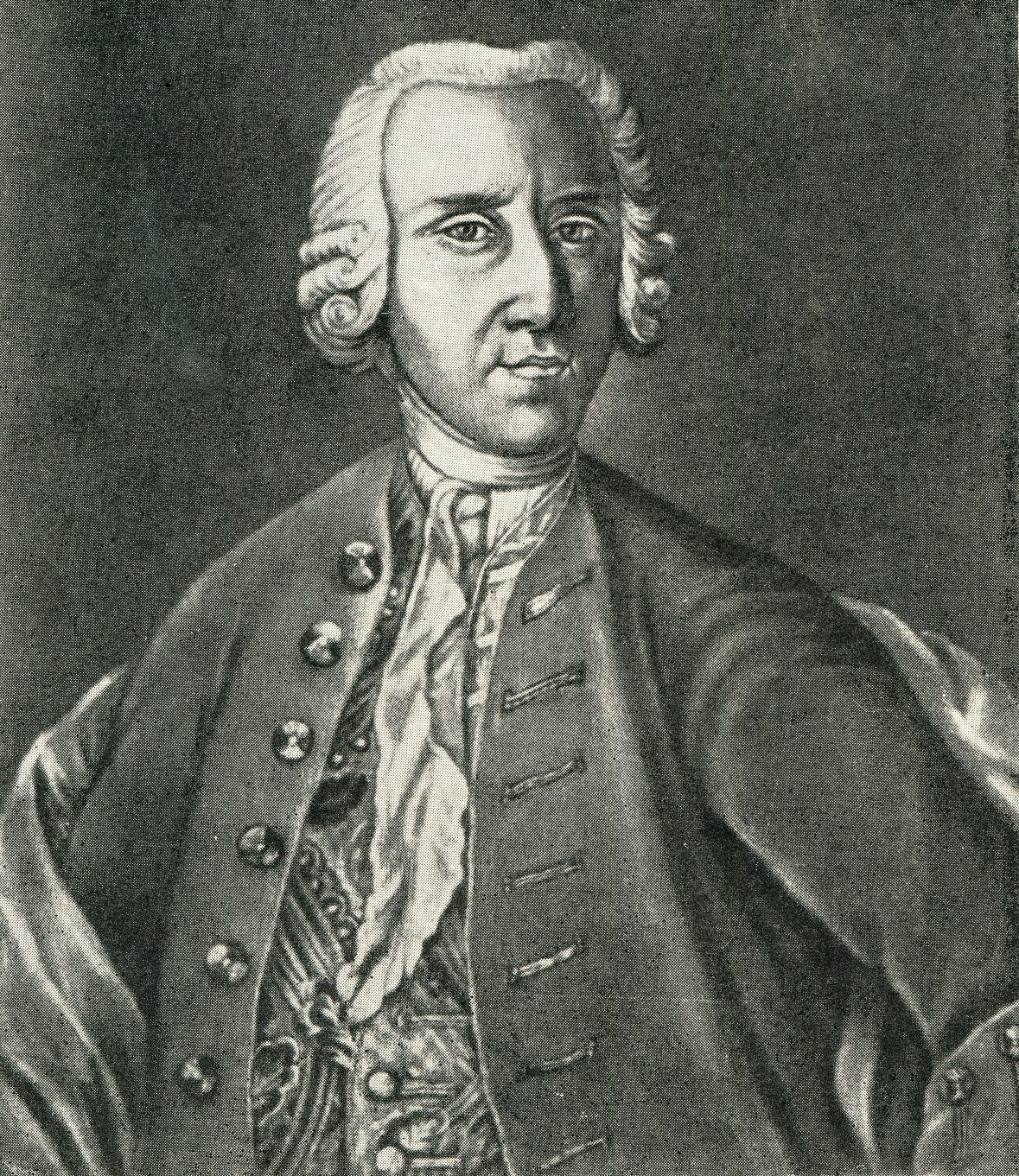
A year later, Georg Wilhelm Richmann, a Russian scientist trying to replicate the experiment, was killed instantly when a ball of lightning struck him in the forehead.
Franklin survived by luck as much as by skill.
But that was Franklin’s whole life. Impossible risks. Improbable success. A talent for making the dangerous look easy.
By the time he signed the Declaration of Independence in 1776, Franklin was already the best-known American in the world.
He was a celebrity in Europe before the word “celebrity” existed.
A bestselling author who became a pioneering scientist who became a diplomat who charmed kings and philosophers alike.
At the signing, he was the oldest man in the room, just a year older than Stephen Hopkins of Rhode Island. Some say his hand shook slightly as he signed.
After signing, Franklin reportedly offered the room a grim jest: “We must all hang together, or most assuredly we shall all hang separately.”
Whether he actually spoke those words, no one is sure. The quote appears in no account written at the time.
But everyone who knew Franklin believed he would have said exactly that. Such was the power of a reputation carefully built over fifty years.
He had made himself into the kind of man who would crack wise while signing what could have become his own death warrant.
The line, real or invented, was perfectly in character.
The Runaway
Benjamin Franklin was born on January 17, 1706, in Boston, the fifteenth of seventeen children. His father made soap and candles for a living. The family was respectable but not wealthy, and there was no money to send Benjamin to school beyond the age of ten.
At twelve, he was apprenticed to his older brother James, who ran a printing shop and newspaper.
Benjamin took to the trade immediately, but he and James could not get along.
James was harsh, sometimes violent. Benjamin resented taking orders from a brother only nine years older.
When Benjamin was seventeen, he made a decision that would shape the rest of his life. He broke his apprenticeship contract and fled Boston for Philadelphia, arriving in the city with little more than the clothes on his back and a few coins in his pocket.
He was a teenager, alone in a strange city, with no connections and no prospects.
From those humble beginnings, he would rise to become Philadelphia’s leading citizen: owner of its most successful print shop, publisher of the colonies’ most popular almanac, and eventually the scientist whose experiments with lightning made him famous across two continents.
The Printer
Franklin’s first career was in ink.
He worked as a printer in Philadelphia, then traveled to London to improve his skills, then returned to Philadelphia to start his own shop. By 1729, he owned the Pennsylvania Gazette, one of the most successful newspapers in the colonies.
But his masterpiece was Poor Richard’s Almanack.
Starting in 1732, Franklin published an annual almanac under the pseudonym “Poor Richard Saunders.” Almanacs were essential in colonial America, since farmers needed them for planting schedules and weather predictions, but Franklin added something extra: wit.
Poor Richard’s Almanack was packed with memorable sayings. “Early to bed and early to rise makes a man healthy, wealthy, and wise.” “A penny saved is a penny earned.” “Fish and visitors stink after three days.” These phrases entered the American language and stayed there.
The almanac’s print runs reached about 10,000 in peak years, making it one of the most popular publications in the colonies. It made Franklin wealthy, and more importantly, it made him a household name from Massachusetts to Georgia.
Franklin understood something most smart people miss: if you want ideas to spread, make them entertaining.
The Scientist
In 1746, Franklin attended a lecture on electricity in Boston. He was already successful and easily could have spent the rest of his life counting his money.
Instead, he became a scientist.
Franklin threw himself into electrical experiments with the same intensity he had brought to printing, working in his home laboratory, designing experiments, testing theories, and corresponding with scientists across Europe.
The kite experiment in 1752 is what everyone remembers. Franklin flew a kite into a thunderstorm, captured the charge in a jar, and proved that lightning is electricity.
What most people don’t know: a French scientist named Thomas-François Dalibard actually beat him to it by a few weeks, using Franklin’s own published theories.
But history doesn’t always remember who was first.
It remembers who tells the story best, and no one told stories better than Franklin.
Franklin didn’t only spend his science years discovering new things. He was also a master inventor.
The lightning rod, developed from his electrical research, saved countless lives protecting buildings from lightning strikes.
His bifocal glasses let people see both near and far without switching spectacles, and the Franklin stove heated homes more efficiently than open fireplaces.
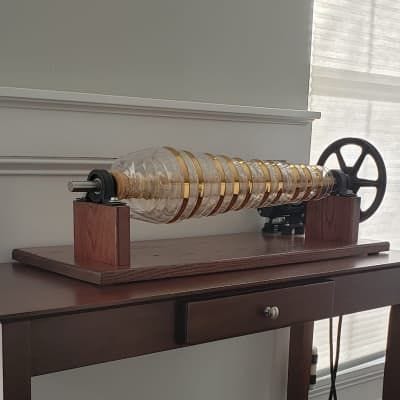
He created the flexible urinary catheter and the glass armonica, a musical instrument that Mozart and Beethoven later composed for.

He mapped the Gulf Stream and made observations about weather patterns that wouldn’t be fully understood for centuries.
For his scientific work, Franklin was elected to the Royal Society in London and awarded the Copley Medal, the eighteenth-century equivalent of a Nobel Prize.
He was the only American of his era with an international scientific reputation.
And he did all of this while running a business and holding public offices.
He also always found time for letter writing, building relationships with important people across Europe and America that would serve him for decades to come.
The Civic Leader
Franklin believed in improvement, not just self-improvement but civic improvement, and in Philadelphia he founded or co-founded more institutions than most cities see in a century.
The Library Company of Philadelphia (1731) was the first. Franklin noticed that books were expensive and most people couldn’t afford them. So he organized fifty subscribers who pooled money to buy books that any member could borrow.
The lending library, which seems obvious now, was revolutionary. It gave ordinary people access to knowledge that had been locked behind the doors of the wealthy.
That was just the start.
He went on to establish a volunteer fire department, a society for natural philosophers (now the American Philosophical Society), a hospital, a militia, and a college that became the University of Pennsylvania. He reorganized the colonial postal system and made it actually work. He paved and lit Philadelphia’s streets.
Franklin knew how to work with people.
He shared credit generously, even when he didn’t have to.
He never told anyone they were flat-out wrong; he asked questions instead.
These habits served him well in politics, and later, in building a nation.
The Politician
Franklin’s political career began locally and grew to influence the world.
He served in the Pennsylvania Assembly for years. In 1754, he proposed the first plan to unite the colonies. It failed, but it would help shape the Constitution.
His biggest role, though, was overseas.
Franklin spent nearly two decades in London as Pennsylvania’s man in Britain. The job was supposed to be straightforward: keep relations smooth, speak up for colonial rights.
Then things got complicated.
Franklin loved Britain. He had friends there, respect, a life he enjoyed. But Britain and the colonies were heading toward a break. The Stamp Act came, then the Townshend Acts. British officials treated the colonies with disgust, and no matter what compromises Franklin proposed, nothing worked. He was caught in the middle.
The turning point came in 1774.
Franklin had obtained letters from Massachusetts Governor Thomas Hutchinson that showed Hutchinson encouraging harsh measures against the colonists. Franklin leaked the letters. When their origin was discovered, he was summoned before the Privy Council, the king’s inner circle of advisors, to answer for it.
The hearing took place on January 29 in a room called the Cockpit. It had been designed for cockfighting, and on this day it lived up to its name. The chamber was packed. Thirty-six privy councillors sat in judgment. London’s elite filled every seat, craning to see the famous American brought low.
Franklin wore a suit of blue Manchester velvet. He stood motionless near the fireplace, saying nothing, as Solicitor General Alexander Wedderburn tore into him for a full hour. Wedderburn called Franklin a thief. A man of “the coolest and most deliberate malice.” A traitor who had betrayed the trust of gentlemen. The audience laughed and jeered. Wedderburn fed on their approval, his attacks growing more personal, more savage.
Franklin absorbed it all in silence. He was sixty-eight years old, one of the most celebrated men in the world, and he was being treated like a criminal in front of an audience that had come specifically to enjoy his humiliation.
When it ended, Franklin walked out without a word.
He said nothing publicly for months.
But the man who entered that chamber was not the man who left.
Whatever affection he had felt for Britain died in the Cockpit.
He left England in 1775, ready for revolution.
Four years later, when he signed the Treaty of Alliance with France, the treaty that would doom British hopes in America, he wore the same blue velvet suit.
The Declaration
Franklin arrived back in America just as fighting began at Lexington and Concord, the first shots of the Revolutionary War.
He was immediately elected to the Second Continental Congress. At seventy, he was by far the oldest delegate. Many of the others were young enough to be his grandchildren. But Franklin’s experience and reputation made him essential.
He served on the committee to draft the Declaration of Independence, alongside Thomas Jefferson, John Adams, Roger Sherman, and Robert Livingston. Jefferson did most of the actual writing, but Franklin contributed edits. More importantly, he contributed his presence.
The Declaration needed strength. It needed to be taken seriously by the world. Having Benjamin Franklin’s signature on it guaranteed that the world would pay attention.
When the document was ready for signing, Franklin reportedly made his joke about hanging together. But there was real fear in that room. The men signing the Declaration were committing treason. If they lost the war, they would be hanged.
Franklin had the least to lose since his life was mostly behind him, but he also had the most to sacrifice: his reputation, his fortune, his legacy.
He signed anyway.
The Diplomat
After America declared independence, Franklin faced his most challenging mission yet: securing French support for the Revolution.
He sailed for France in late 1776, traveling on a warship that evaded British patrols. He arrived in Paris in December, and what he found there surprised him.
The French loved him.
They’d already read his books. But their love went beyond fans meeting their favorite celebrity. To them, Franklin was the perfect American: plain, honest, wise. Everything the fancy French court was not.
Franklin leaned into the image.
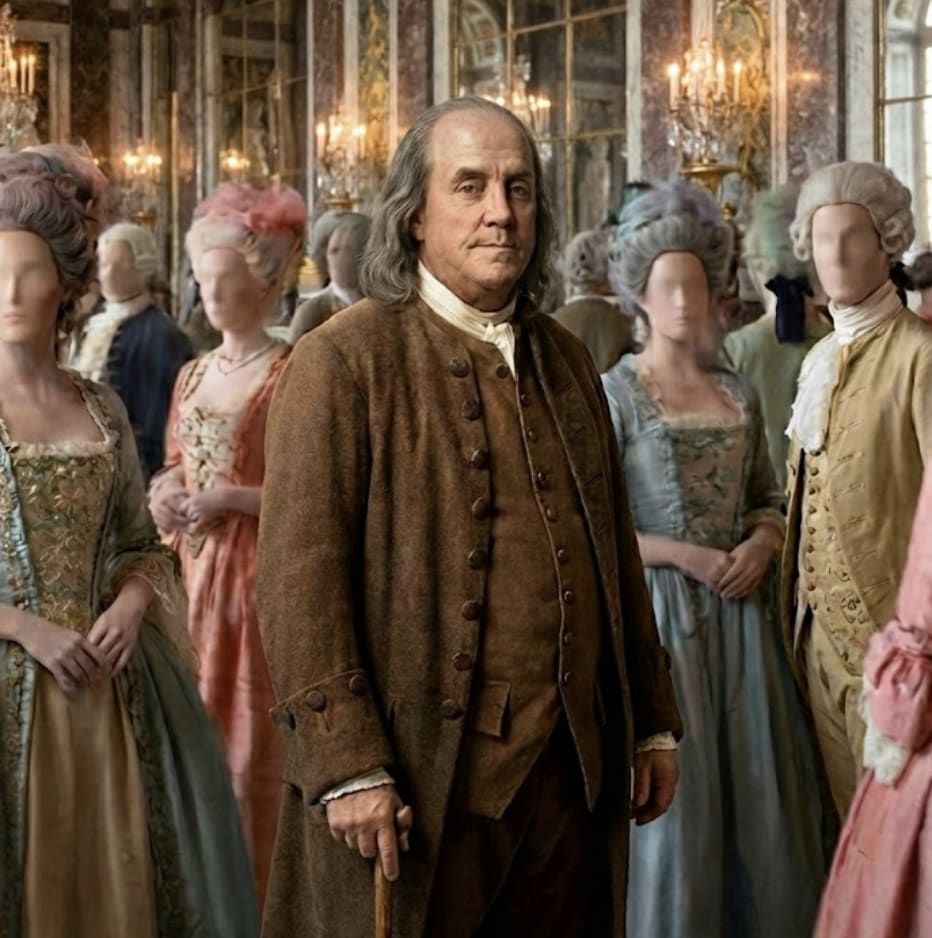
He wore simple brown clothes instead of fancy court dress. He let his gray hair flow naturally instead of wearing a powdered wig. He carried a walking stick instead of a sword. He looked like a Quaker farmer, not a diplomat.
It was all calculated. Franklin understood that the French wanted to believe in a virtuous America, so he gave them a virtuous American to believe in. He played the role to perfection.
The French court was enchanted. Women wore their hair in a style called “à la Franklin,” piled high with a white cap to resemble his fur hat. His image appeared on medallions and small decorative boxes. He was invited everywhere and celebrated as a living symbol of the Enlightenment.
But the flattery was a means to an end.
Franklin needed French money. French guns. Most importantly, he needed French troops.
That would require King Louis XVI to agree to an alliance that would bring France into a war with Britain.
It took years. Franklin negotiated patiently and cultivated relationships. He waited for the right moment. That moment came in 1778, after the American victory at Saratoga proved that the Revolution might actually succeed. France signed the Treaty of Alliance, committing troops and resources that would eventually prove decisive.
Without French support, America might have lost the war.
But without Franklin’s diplomacy, French support would never have come.
The Peace
After Yorktown, Franklin negotiated the peace.
He was one of three American commissioners (along with John Adams and John Jay) charged with ending the war and establishing terms with Britain.
It was delicate work.
The French had their own interests, and the British were bitter after their defeat. The Americans needed to secure not just peace but favorable boundaries and fishing rights.
Franklin, despite his age and failing health, was at his best.
He played the British and French against each other, extracted concessions, and helped craft the Treaty of Paris (1783), which recognized American independence and established generous boundaries for the new nation.
After the signing, having spent seven years in France, Franklin was ready to go home.
But there was one more task.
In 1787, Franklin was elected to represent Pennsylvania at the Constitutional Convention. Now eighty-one years old, he had to be carried into the hall on a sedan chair. He could no longer give his famous speeches. Instead, he wrote out his remarks for someone else to read.
Though his body was failing him, his presence was as strong as ever, helping to legitimize the proceedings.
His occasional interventions helped smooth disputes, and when the Constitution was finished, Franklin delivered a final speech that became one of the most quoted statements in American history.
He confessed that the Constitution wasn’t perfect. “There are several parts of this Constitution which I do not at present approve,” he said. But he had lived long enough to know that his own opinions might be wrong. A functioning government was more important than any individual’s objections.
“I agree to this Constitution with all its faults,” he concluded, “because I think a general Government necessary for us... I doubt too whether any other Convention we can obtain may be able to make a better Constitution.”
It was Franklin at his best: humble, practical, and wise.
The Costs
Benjamin Franklin was not a saint.
His personal life bore the marks of his ambition. He fathered an illegitimate son, William, who became the last royal governor of New Jersey. When the Revolution came, William chose the Crown. This created a rift between father and son that never healed.
In his will, Franklin left William almost nothing, explaining coldly that William’s loyalty to Britain had already cost him enough.
The rest of his family didn’t fare much better. His wife Deborah died while he was in London, and he had not seen her for years. He spent decades overseas, pursuing fame and diplomacy while his family got by without him.
And he was vain. For all his professed humility, Franklin loved attention.
He cultivated his image with the care of an artist. He enjoyed being famous and wanted to be remembered.
These were the costs of a life lived at full capacity. Franklin accomplished more than almost anyone in American history.
He also left wreckage in his wake.
The genius and the flaws were inseparable, two sides of the same relentless drive.
The Death
Benjamin Franklin died on April 17, 1790.
He was eighty-four years old, ancient by the standards of an era when the average American could expect to live into their mid-thirties.
He had been in declining health for years, suffering from gout and kidney stones. At the end, he was bedridden and dependent on opium to manage the pain.
But his mind remained sharp. He continued writing letters and receiving visitors. He offered opinions on public affairs until the end. He died surrounded by family, having outlived most of his contemporaries.
Twenty thousand people attended his funeral. It was the largest gathering Philadelphia had ever seen. The French National Assembly ordered three days of mourning. Across America and Europe, people marked the passing of a man who had shaped the century.
The words he wrote for his gravestone decades earlier were characteristically witty: “The body of Benjamin Franklin, Printer (like the cover of an old book, its contents torn out and stripped of its lettering and gilding) lies here, food for worms. But the work shall not be lost; for it will (as he believed) appear once more in a new and more elegant edition, revised and corrected by the Author.”
Even in death, he was making jokes.
The Legacy
What do we make of Benjamin Franklin?
He was a scientist who unlocked one of nature’s fundamental forces.
A diplomat who secured the alliance that won American independence.
A writer who gave the English language some of its most enduring phrases.
A civic leader who built institutions that endure two and a half centuries later.
He was also a self-promoter, an absentee husband and father, and a man whose ego sometimes outran his virtue.
These things are all true.
Franklin was both extraordinary and deeply flawed, a hero and a human.
He was, in the end, what he always claimed to be: a work in progress.
He believed in improvement: personal improvement, civic improvement, and perhaps most important, national improvement.
He believed that people and societies could become better over time, if they were willing to put in the hard work to make it happen.
The question for us is whether we can continue that effort.
Franklin showed what one person could accomplish through intelligence, persistence, and strategic thinking.
He also showed that even the greatest among us remain imperfect.
We inherited both his achievements and his failures.
What we do with that inheritance is up to us.
Next: William Whipple
From the elder statesman of Philadelphia, we turn to a New Hampshire merchant who became a general.
William Whipple made his fortune at sea before the Revolution. By 1776, he had traded his merchant’s ledger for a musket and was fighting for American independence. He served as a brigadier general at Saratoga, one of the turning points of the war.
What transforms a comfortable merchant into a man willing to risk everything for a cause?
Next week, we tell the story of the sailor who found his purpose on land.
This is Essay #7 of 56 in the “The 56” series, profiling every signer of the Declaration of Independence.
New essays every Friday and Sunday, culminating on July 4, 2026, the 250th anniversary of American independence.
Subscribe to follow the journey.
Sources: