

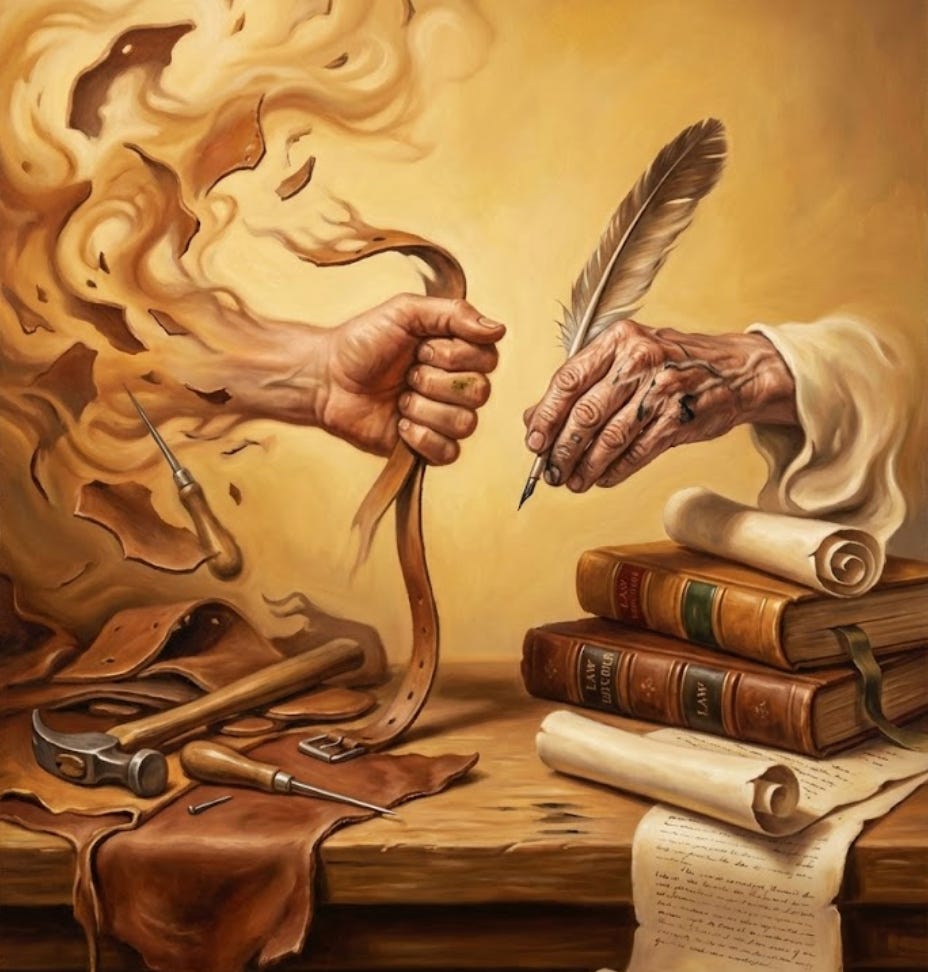
Roger Sherman signed his name to history four times.
The Continental Association in 1774.
The Declaration of Independence in 1776.
The Articles of Confederation in 1781.
The United States Constitution in 1787.
No other person in American history can claim this. Not Franklin, who signed the Declaration and Constitution but not the Association or Articles. Not Jefferson or Adams, who were abroad during the Constitutional Convention.
Only Roger Sherman, a self-educated cobbler from Connecticut, put his name on every founding document that created the United States of America.
How does a man who made shoes for a living end up in every room where a nation is founded?
By being the most useful person in the room.
The Cobbler
Roger Sherman was born in Newton, Massachusetts, on April 19, 1721, to a farmer who also made shoes.
Young Roger learned both trades, but he learned something else too: how to learn.
The Sherman family had no money for Harvard or private tutors. Roger’s education came from whatever books he could get his hands on, read by candlelight after the day’s work was done. Mathematics. Surveying (measuring land). Astronomy. Law. He taught himself all of it, one borrowed book at a time.
When Sherman was twenty-two, his father died. There was nothing left for him in Massachusetts, so he packed his cobbler’s tools and walked to Connecticut, more than one hundred miles, to join his older brother William in New Milford. He arrived with his tools and his books. That was the entirety of his inheritance.
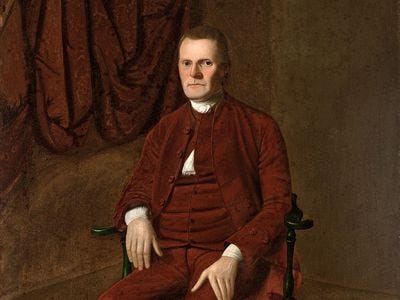
For the next several years, Sherman made shoes. But he also surveyed land for neighbors who needed boundaries marked. He kept a store. He published almanacs filled with astronomical calculations that farmers actually used. He was building a reputation as the man you went to when you needed something done right.
The law came next. Sherman read legal texts the same way he’d read everything else, systematically and thoroughly. In 1754, at age thirty-three, he was admitted to the Connecticut bar. There were no law schools in America yet. You learned by reading and observing, and Sherman had done plenty of both.
Within two years, he was a justice of the peace. Within a decade, a judge of the superior court. The man who had walked into Connecticut carrying cobbler’s tools was now deciding cases from the bench.
The Politician
Colonial Connecticut was small and everyone lived pretty much the same way. It had no wealthy ruling families, no vast plantations, no port cities like Boston or Philadelphia. What it had was towns: small communities where everyone knew everyone else.
Sherman thrived in this environment. He was elected to the Connecticut General Assembly in 1755 and served, on and off, for the next thirty years. He wasn’t a great speaker and he wasn’t charming, but Connecticut voters wanted someone who got things done. Sherman delivered.
John Adams, who served alongside Sherman in the Continental Congress, left a famous description: “Mr. Sherman was one of the most sensible men in the world. The clearest head and the steadiest heart. He was an old Puritan, as honest as an angel.”
Adams also noted Sherman’s awkwardness. Even the best artist, Adams wrote, couldn’t draw a motion “more opposite to grace.” Sherman moved stiffly, like starched fabric.
He spoke in a flat Connecticut accent. He had none of the polish of Virginia gentlemen or the wit of Philadelphia merchants. But when he spoke, people listened, because he was almost always right.
The Continental Congress
Sherman was fifty-three years old when he arrived at the First Continental Congress in 1774. He was already one of Connecticut’s most experienced politicians: a judge, a former treasurer, a longtime assemblyman.
The Congress was a gathering of colonial elites: wealthy planters, prominent lawyers, successful merchants. Sherman was none of these things. He had worked with his hands. He had walked to Connecticut with cobbler’s tools on his back.
Sherman was blue-collar before there was a word for it.
But he quickly made himself indispensable.
Sherman served on more committees than almost any other delegate. He helped draft the Continental Association (the agreement to boycott British goods), which he signed in October 1774. He returned for the Second Continental Congress in 1775 and plunged into the work of organizing a revolution.
When the Committee of Five was formed to draft a declaration of independence, Roger Sherman was one of the five. The others were Jefferson (who wrote the document), Adams (who argued for it), Franklin (who edited it), and Robert R. Livingston (who contributed little and didn’t sign).
The Committee kept no minutes, so we don’t know exactly what Sherman contributed. He wasn’t there to write. He was there to review, to judge, to make sure the document would survive debate on the floor.
In 2018, scholars found the the “Sherman Copy,” an early draft that Adams had copied out for Sherman to review. Sherman initialed his approval. That was his role. The practical check before the big speeches began.
On August 2, 1776, Sherman signed the Declaration of Independence. His signature is neat and modest, much like the man himself.
The Great Compromise
In 1787, the Constitutional Convention met in Philadelphia. The Articles of Confederation, America’s first attempt at a national government, wasn’t working. The country needed something stronger. Sherman, now sixty-six years old, was one of Connecticut’s delegates.
The convention faced a seemingly impossible problem: how to balance the interests of large states and small states.
Large states like Virginia wanted representation based on population. The more people you had, the more votes you got. Small states like Delaware wanted equal representation. One state, one vote, regardless of size. Neither side would budge. The convention was on the verge of collapse.
Sherman proposed a solution.
What if, he suggested, Congress had two chambers? The House of Representatives would have representation based on population, satisfying the large states. The Senate would have equal representation, with two senators per state, satisfying the small states.
This was the Great Compromise, and it saved the Constitution.
Sherman didn’t invent the idea entirely. Others had proposed similar arrangements. But he was the one who pushed it through, who built the coalitions, who made the deal work. The Connecticut Compromise, as it’s sometimes called, bears his state’s name for a reason.
On September 17, 1787, Roger Sherman signed the Constitution of the United States. He was one of only six men to sign both the Declaration and the Constitution.
The Final Years
After the Constitution was ratified, Sherman did what he had always done: he kept working. Connecticut sent him to the House of Representatives in 1789, where he served in the very first Congress under the government he had helped design. Two years later, the state legislature elevated him to the Senate.
It was there that Sherman played his final role in shaping the nation. James Madison had proposed a bill of rights, and the Senate debated every word. Sherman, now seventy years old, was in the thick of it. He argued, he compromised, he helped craft the language that would become the first ten amendments. Some historians believe he deserves credit as a co-author. Unlike the Declaration, no one signed the Bill of Rights. States voted to approve it instead.
Sherman never retired. On July 23, 1793, he died at the age of seventy-two, still serving in the Senate. He had spent nearly forty years in public service, from colonial assemblyman to federal senator.
A Connecticut newspaper noted in his obituary that Sherman had served his country “with a reputation for integrity and patriotism that few have equaled and none have excelled.”
The Invisible Founder
Here’s what’s strange about Roger Sherman: he was everywhere, and yet he’s nowhere.
He served in the Continental Congress longer than almost anyone, from 1774 to 1781, and again from 1783 to 1784. He signed every major founding document. He proposed the compromise that made the Constitution possible. He served in both houses of the new Congress.
And yet:
No state is named after him. No major city. No memorial in Washington, DC.
There’s no Roger Sherman musical, no HBO miniseries, no bestselling biography. For seventy-five years after 1938, no scholar wrote a major Sherman biography. Mark David Hall finally broke that silence in 2013. When Americans think of the founders, they think of Washington, Jefferson, Franklin, Adams, Hamilton. Sherman doesn’t make the list.
Why?
Part of the answer is personality. Sherman wasn’t flashy. He didn’t give memorable speeches. He didn’t write beautiful letters that could be quoted two centuries later. He was, as Adams said, “stiff” and “awkward,” a man of substance without style.
Part of the answer is class. The founders we remember tend to be wealthy: Virginia planters, Boston merchants, Philadelphia lawyers. Sherman was a cobbler’s son who walked to Connecticut with tools on his back. He didn’t fit the tale of gentlemen revolutionaries.
And part of the answer is simply the randomness of fame. Some people get remembered. Some people don’t. The selection process isn’t fair.
What Sherman Teaches Us
Roger Sherman’s story is proof that you don’t need credentials to matter.
He had no formal education.
He learned law by reading books.
He entered politics through diligence, not connections.
He rose because when there was work to be done, Sherman did it.
When there was a problem to solve, Sherman solved it.
When there was a committee that needed someone reliable, Sherman was already in the chair.
In an era when we obsess over credentials, Sherman offers a different model: be the person who gets things right.
Every successful venture has a Sherman. The co-founder who doesn’t give the TED talks. The executive who runs the meetings while someone else takes the stage. The person whose name you don’t know, but whose judgment held the whole thing together.
It’s not glamorous advice. It won’t get you a musical. But it might get you into every room where history is being made.
Sherman signed his name four times. Each time, he was there because he had earned it. Not because of who he knew or where he came from, but because of what he could do.
The cobbler’s son helped build a nation.
Next: Thomas Lynch Jr.
If Roger Sherman represents the quiet persistence of the self-made man, Thomas Lynch Jr. represents something else entirely: promise cut short.
Lynch was one of the youngest signers of the Declaration, just twenty-six years old when he added his name in August 1776. His father, Thomas Lynch Sr., had been a delegate to the Continental Congress before suffering a stroke that left him incapacitated. Young Thomas took his father’s place.
After signing, Lynch’s own health began to fail. Doctors recommended a sea voyage to restore his strength. In late 1779, Thomas Lynch Jr. and his wife boarded a ship bound for the West Indies.
The ship was never seen again.
No wreckage. No survivors. No explanation. Thomas Lynch Jr. simply vanished from history, leaving behind nothing but a signature on a document and a mystery that has never been solved.
Next Friday, we’ll tell the story of the signer who disappeared.
This is Essay #5 of 56 in the “The 56” series, profiling every signer of the Declaration of Independence. New essays every Sunday and Wednesday, culminating on July 4, 2026, the 250th anniversary of American independence.
Subscribe to follow the journey.
Sources: