

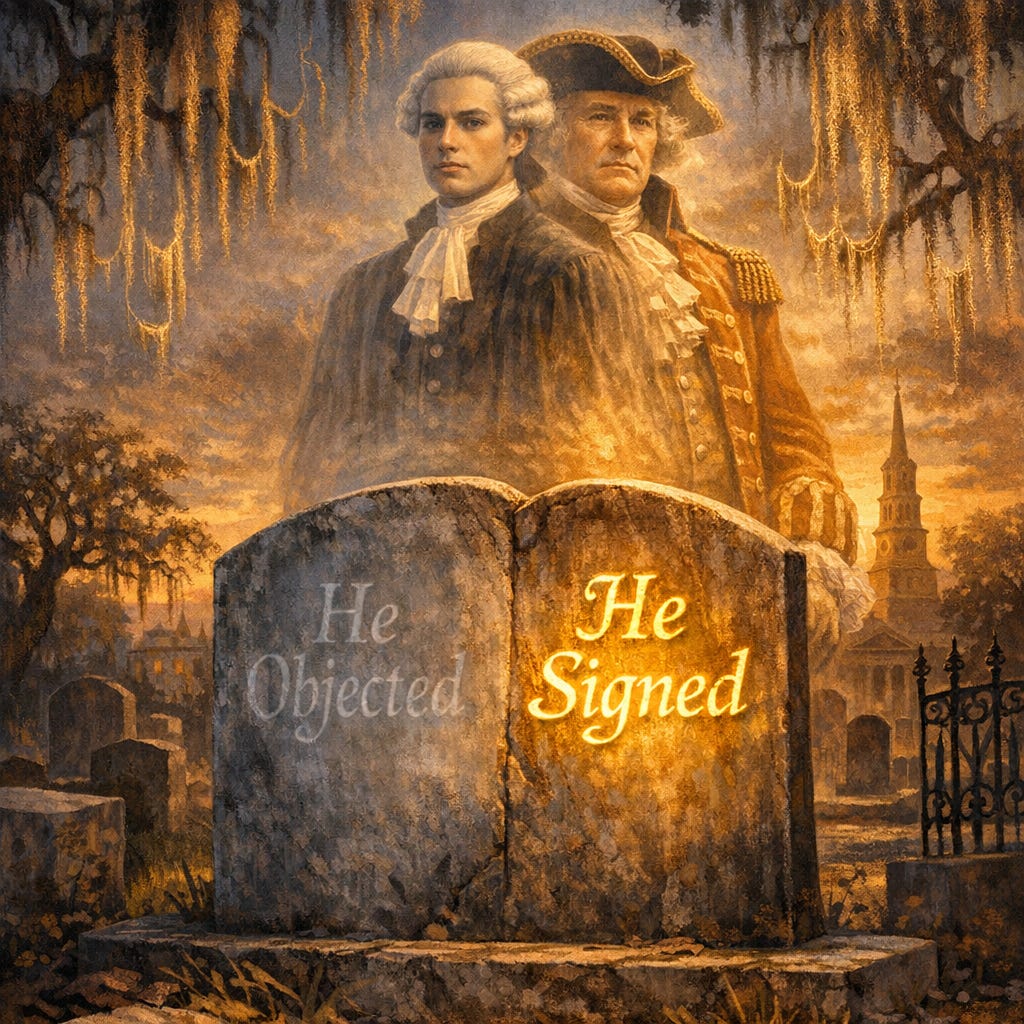
Edward Rutledge was twenty-six years old when he walked into the Pennsylvania State House in the summer of 1776.
He was the youngest delegate in the room, and he was there to argue against it.
Rutledge thought independence was a mistake.
He was no Loyalist, and he did not support British rule. He believed the colonies should be free. But the timing was wrong.
The Continental Army was untested, foreign support uncertain. The colonies had no navy and no real currency. They barely had a government.
Rutledge wanted to wait. Build strength and secure alliances, then act.
He was outvoted.
The London Education
His father, a physician of Scots-Irish descent, died when Edward was an infant. He was born in Charleston, South Carolina, in 1749, into a family that was prominent but fractured. His older brother John Rutledge, eleven years his senior, became a surrogate father. John was already practicing law and building a political career that would eventually lead to the governorship and a nomination as Chief Justice.
At seventeen, Edward was sent to England to study law. He enrolled at the Middle Temple, one of the four Inns of Court that trained English lawyers. For six years, he studied English law and watched Parliament debate. He saw the British Empire’s political machinery up close.
Then he came home.
In 1773, Rutledge returned to Charleston as a twenty-three-year-old lawyer. His brother John had already established the Rutledge reputation in South Carolina politics. Edward followed him in.
He built a law practice and married Henrietta Middleton, daughter of Henry Middleton, who had served as president of the First Continental Congress. Her brother Arthur Middleton would also sign the Declaration. By twenty-five, Rutledge was among the leading men of Charleston.
The Young Politician
At twenty-four, Rutledge took his seat at the First Continental Congress.
Most of the other delegates were a generation older. John Dickinson was forty-one. John Adams was thirty-eight. Rutledge sat among them barely old enough to vote in some colonies.
But he did not behave like a newcomer. He opposed British taxation without representation and supported the boycott of British goods. On the question of colonial rights, he was firm. On the question of independence, he was cautious.
The Continental Congress dragged on through 1775 and into 1776. British troops occupied Boston. Fighting broke out at Lexington and Concord. The war had started, officially or not. By June 1776, the question could no longer be avoided: declare independence, or keep seeking reconciliation?
Rutledge still thought reconciliation was worth pursuing.
The Debate
The debates of early July 1776 have become American scripture. We know the lines about life, liberty, and the pursuit of happiness. We know that Thomas Jefferson wrote the draft and Benjamin Franklin edited it. We know that Congress voted for independence on July 2.
Most people forget how many delegates agreed with Edward Rutledge.
John Dickinson of Pennsylvania argued furiously against independence. He warned that the colonies were not ready, that foreign support was uncertain, that the British Empire was too powerful to defy openly. Other delegates shared these fears. Many had built their lives within the British system, studying English law and trading with English merchants. Some still thought of themselves as Englishmen overseas.
Rutledge stood with this cautious faction. He had seen Parliament up close during his years in London. He understood what they were up against.
But the momentum was against him. Richard Henry Lee of Virginia introduced the resolution for independence on June 7. John Adams seconded it. The debate raged for days. On July 1, a preliminary vote was called.
South Carolina was divided. Rutledge, leading the cautious side, requested a one-day delay. He wanted time to bring the delegation together, even if it meant accepting a result he opposed.
The Change of Mind
What Rutledge did next is what makes him worth remembering.
He could have walked away. He could have resigned his seat and returned to Charleston to watch the revolution from a distance. Some Loyalists fled to England; some moderates simply withdrew from politics, unwilling to commit to either side.
Rutledge did not withdraw.
On the night of July 1, with the final vote scheduled for the next morning, Rutledge went to work on his own delegation. The details of what he said that night are lost. But the task was clear: South Carolina had to vote as one.
He had lost the argument.
He knew it.
What he could still control was whether South Carolina walked into independence divided or united. A fractured vote would signal weakness to Britain and to the world. So the man who had argued most forcefully against independence spent the night persuading his colleagues to vote for it.
On July 2, 1776, South Carolina voted for independence on the final roll call. Edward Rutledge cast his vote with the majority. On August 2, he signed his name to the finished document.
He was twenty-six years old. The youngest signer.
He left no diary explaining his conversion.
But a lawyer knows when a case is lost.
The vote meant the debate was over. Once independence was declared, there was no going back. If South Carolina was committing treason, then Edward Rutledge would commit treason with it.
And like many converts, he threw himself in harder than those who had always believed. Rutledge served in the Continental Congress through 1777, working on committees and managing the unglamorous paperwork of revolution. He proved his loyalty not with words but with work.
The Soldier
Rutledge did not just vote for independence. He fought for it.
In 1779, British forces threatened Charleston. Rutledge joined the South Carolina militia as a captain of artillery. He was thirty years old, a lawyer with no military training, commanding a battery of cannons.
The British captured Charleston in May 1780. It was the worst American defeat of the war. Nearly 5,000 Continental soldiers surrendered. The South seemed lost.
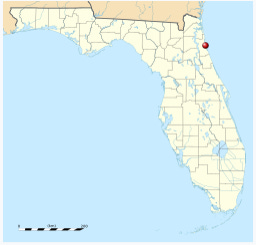
Rutledge was taken prisoner and sent to St. Augustine, Florida. Three signers of the Declaration were held there together: Rutledge, his brother-in-law Arthur Middleton, and Thomas Heyward Jr.
They spent eleven months in captivity near the old Spanish fortress of Castillo de San Marcos, in a climate where tropical fevers killed prisoners faster than the war did. The royal governor of East Florida wrote that “sickness and disease have made more havoc in the neighboring colonies than the sword.”
Rutledge survived. His health did not.
He was exchanged in July 1781 and returned to South Carolina weakened, but alive. The war continued, but his days as a soldier were over.
The Governor
He returned to the state legislature and the constitutional convention, working to rebuild a Charleston that the British occupation had left scarred.
In 1798, at age forty-eight, Rutledge was elected Governor of South Carolina. The country was divided over the Alien and Sedition Acts, federal laws that criminalized criticism of the government. Thomas Jefferson and James Madison wrote the Kentucky and Virginia Resolutions, arguing that states could reject federal laws they considered unconstitutional.
Rutledge proposed resolutions asserting South Carolina’s right to judge the constitutionality of federal acts. The state legislature declined to adopt them. It was a foreshadowing of battles that would consume the South for decades. But Rutledge did not live to see them play out.
The Death
He was fifty years old and still governor when a stroke killed him on January 23, 1800. The fevers from St. Augustine had never fully left him. The young man who had argued against the Declaration ended his life as the governor of his state.
He was buried in Charleston. His gravestone noted his service in the Revolutionary Congress and his governorship. It did not mention that he had opposed the Declaration before he signed it.
Why would it?
In the end, he signed.
What Rutledge Teaches Us
Rutledge was twenty-six. He thought the most powerful men in the room were making a mistake. He said so, publicly, and he was outvoted.
What happened next is the interesting part.
He did not sulk.
He did not quit.
He picked up the pen, signed the document he had argued against, and then spent the rest of his life proving he meant it. He fought. He was captured. He governed.
If you are young and outvoted, that is worth remembering.
You can disagree with a decision and still commit to it fully. The commitment is what people remember. Not the objection.
Sometimes the right thing is to sign anyway.
Next: Robert Morris
From the youngest signer who hesitated, we turn to the richest signer who paid for everything.
Robert Morris of Pennsylvania was the “Financier of the Revolution.” He was not a soldier. He did not write stirring declarations. He managed money. And through sheer financial genius, he kept the Continental Army from starving while the colonies fought for independence.
Morris signed the Declaration, the Articles of Confederation, and the Constitution. He was one of only two men to sign all three founding documents. He would also die in debtor’s prison, ruined by his own generosity to the cause he served.
Next time, we’ll tell the story of the man who bankrolled the revolution and lost everything in the process.
This is Essay #12 of 56 in the “The 56” series, profiling every signer of the Declaration of Independence. New essays every Friday and Sunday, leading up to July 4, 2026, the 250th anniversary of American independence.
Subscribe to follow the journey.
Sources: