

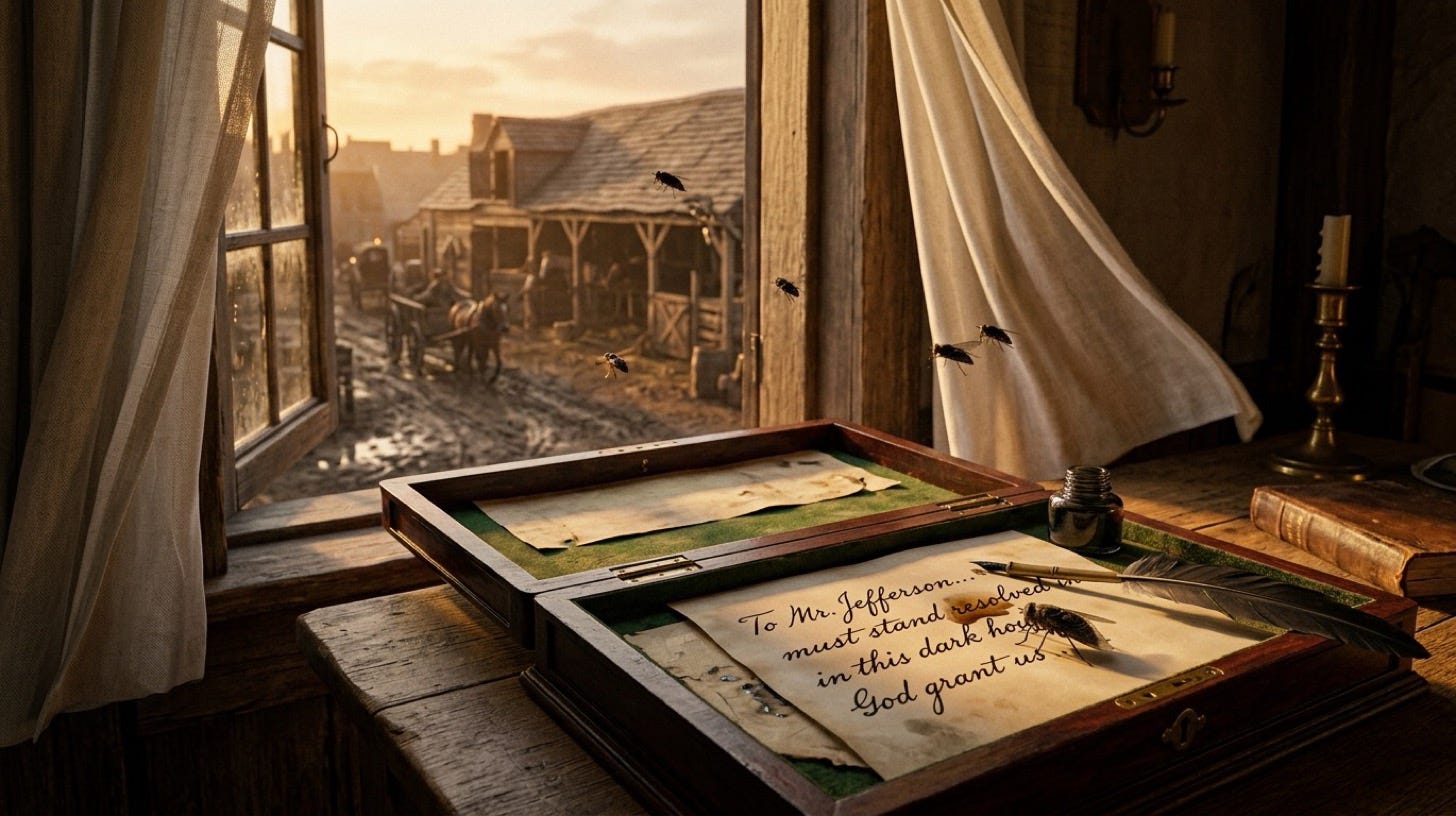
Across the street from where the Declaration of Independence was written, there was a horse stable.
It sat directly opposite the three-story brick house of Jacob Graff Jr., a bricklayer who had finished building the place only the year before. The house stood on the southwest corner of Market and Seventh Streets, on the outskirts of Philadelphia, surrounded by open fields. The stable meant the smell of manure on warm days, and the summer humidity held it in the air. Thomas Jefferson had rented the second floor because he wanted quiet. He got the quiet. He also got the flies.
Horseflies drifted through the open windows all summer long, drawn by the stable and the June humidity. Jefferson complained about them. He was thirty-three years old, over six feet two, red-haired and freckled, with a soft voice that barely carried across a room. He had arrived in Philadelphia as a delegate to the Continental Congress, and he needed a place to write.
His room had a furnished parlor and bedroom, with paneled walls and four windows on each side for airflow. In the parlor, Jefferson set up a small mahogany box on his lap and went to work.
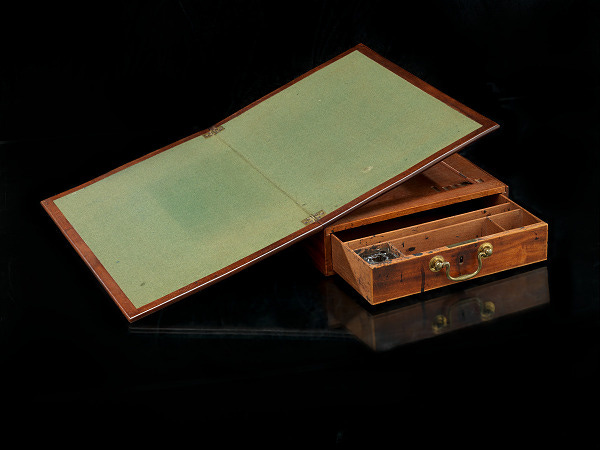
The box was a portable writing desk of his own design, built by a Philadelphia cabinetmaker named Benjamin Randolph. It measured roughly ten inches by fourteen inches, about the size of a modern laptop. It had a hinged writing surface lined with green cloth, a lockable drawer for paper and quills, and a small glass inkwell. Jefferson called it his “writing-box.” He would use it for the rest of his life.
On that desk, above the horse stable, swatting at flies, Thomas Jefferson wrote the most famous sentence in the English language.
We hold these truths to be self-evident, that all men are created equal, that they are endowed by their Creator with certain unalienable Rights, that among these are Life, Liberty and the pursuit of Happiness.
Writing those words took seventeen days. He spent the rest of his life watching other people decide what they meant.
The Writing
Congress chose a committee of five to draft the declaration: Benjamin Franklin, John Adams, Roger Sherman, Robert R. Livingston, and Jefferson.
Adams wanted Jefferson to write it. Jefferson said Adams should do it instead. Adams refused. Writing to a friend forty-six years later, he remembered giving Jefferson three reasons.
“Reason first: You are a Virginian, and a Virginian ought to appear at the head of this business. Reason second: I am obnoxious, suspected, and unpopular. You are very much otherwise. Reason third: You can write ten times better than I can.”
Jefferson paused. “Well,” he said, “if you are decided, I will do as well as I can.”
He consulted no books. He drew entirely on ideas he had absorbed over a decade of reading, especially John Locke on natural rights and George Mason‘s Virginia Declaration of Rights, written just weeks earlier. The drafting took roughly seventeen days. Congress met six days a week, from about ten in the morning until four in the afternoon. Jefferson’s writing hours were in the edges of the day, early mornings and late afternoons and the hours after dinner at the City Tavern. His diary from those weeks shows the everyday life underneath the historic work: pencil and map purchases, riding expenses logged on “June 31” (a date that does not exist), the kind of mistake a mind makes when it is living in committees rather than calendars.
On July 1, 1776, he walked to the shop of a merchant named John Sparhawk and purchased a new thermometer. Jefferson kept weather journals his entire adult life, recording temperatures three times a day, every day, for decades. While the Continental Congress prepared to debate the question of independence, he was also checking the temperature.
On July 4, the morning he knew Congress would take a final vote on his Declaration, he recorded 68 degrees at six in the morning. By one in the afternoon it had reached 76. The modern average high for July 4 in Philadelphia is 87 degrees. The birth of the nation happened on a mild day. He also bought seven pairs of women’s gloves and made some charitable donations.
The Cutting
They cut roughly a quarter of it.
Over three days, July 2 through 4, Congress convened as a full committee and debated Jefferson’s text line by line. By one scholarly count, they made eighty-six changes across both stages: forty-seven by the Committee of Five before submission, thirty-nine by Congress on the floor. Jefferson sat in the Pennsylvania State House and watched. He said nothing that anyone recorded.
The heat was bad. The windows were open. Flies from a nearby stable swarmed through the chamber, biting the delegates through their silk stockings. The delegates swatted at them with handkerchiefs and kept cutting.
The most famous change was small and enormous at the same time. Jefferson had written: “We hold these truths to be sacred and undeniable.” On the rough draft, those words are struck through. Above them, in what most scholars identify as Franklin’s handwriting, two words appear: “self-evident.”
Most scholars believe Franklin suggested the change. Jefferson had called these truths sacred. Franklin made them self-evident. One word invoked God. The other invoked logic. Franklin also changed “deluge us in blood” to “destroy us.” Where Jefferson wrote in a high moral register, his editors enforced precision.
Congress cut passages criticizing the British people (not just the King), removed a lengthy condemnation of the slave trade that offended delegates on both sides of the issue, tightened the preamble, and modified various charges. Jefferson had written that men “from that equal creation they derive rights inherent and inalienable.” Congress trimmed it to “endowed by their Creator with certain unalienable Rights.” Shorter and sharper, with less of Jefferson in it.
Franklin, who was seventy years old and gouty, watched the younger man suffer. He noticed Jefferson “writhing” under the criticism. He leaned close, his joints swollen, and told the younger man a story.
He told Jefferson about a hatter named John Thompson who was opening his own shop. Thompson wanted a handsome signboard and composed the inscription: “John Thompson, Hatter, makes and sells hats for ready money,” with a painted picture of a hat underneath. Proud of his work, he showed it to his friends for their thoughts.
The first friend said “Hatter” was unnecessary, since “makes hats” already showed he was a hatter. It was struck out. The next friend said “makes” didn’t matter, because customers wouldn’t care who made the hats. It was struck out. A third said “for ready money” was pointless, since nobody in town sold on credit. Gone. A fourth asked why “sells” was needed, since nobody would expect free hats. Gone. “Hats” followed it, since there was already a picture of one painted on the board.
The signboard now read: “John Thompson,” with a picture of a hat.
Jefferson laughed. Franklin was telling him: this is what committees do. But the laughter did not last.
The Wound
In the days after July 4, Jefferson made at least four handwritten copies of his original draft. In each copy, he underlined every word and passage that Congress had changed or removed. Then he sent the copies to his friends.
He was asking them to judge.
Richard Henry Lee, who had proposed the original resolution for independence, wrote back: “I wish sincerely, as well for the honor of Congress, as for that of the States, that the Manuscript had not been mangled as it is.”
Jefferson adopted the word. For the next fifty years, he described what Congress had done to his draft as “mangling.” He distributed annotated copies well into old age, making sure that anyone who cared about the Declaration could see what he had written versus what Congress had approved. In 1823, a political rival named Timothy Pickering accused him of copying. The similarities with Mason’s Virginia Declaration of Rights were obvious. Jefferson replied to James Madison with honesty: “I did not consider it as any part of my charge to invent new ideas altogether and to offer no sentiment which had ever been expressed before.”
Madison’s reply was sharper: “Nothing can be more absurd than the cavil that the Declaration contains known and not new truths. The object was to assert not to discover truths.”
Jefferson had written the most important document in American history on a box the size of a laptop, in a room above a horse stable, while swatting flies. The rest of Congress had then cut a quarter of it away while he sat in silence. He never forgave them.
The Man Who Couldn’t Speak
The man who wrote the Declaration could barely speak in public. His rival Patrick Henry could move a room. Jefferson couldn’t hold one. What Jefferson could do was write you into a corner on paper, and Henry had no answer for that.
Jefferson’s voice, when he spoke in public, sank into his throat. People who met him described it as “guttural and inarticulate.” John Adams, who admired almost everything else about Jefferson, recorded that “during the whole time I sat with him in Congress, I never heard him utter three sentences together.”
As president for eight years, Jefferson delivered exactly two public speeches: his inaugural addresses. He read both in such a low mumble that few people in the room could hear him. Rather than deliver the annual message to Congress in person, he sent a written document, a practice that held until Woodrow Wilson revived the spoken address in 1913. On occasion, he reportedly faked illness to avoid events that required him to speak at all.
The people who met him in private were astonished.
George Ticknor, a young scholar from Boston who visited Monticello in 1815, expected a small man. Instead: “I was doubly astonished to find Mr. Jefferson, whom I had always supposed to be a small man, more than six feet high, with dignity in his appearance, and ease and graciousness in his manners.” Standing, he was erect and commanding. Seated, as one contemporary noted, his “shoulders slouched and uneven,” his body folding into itself like “part jackknife, part accordion.” Even his posture contained a contradiction.
His grandson Thomas Jefferson Randolph described him as “well proportioned, and straight as a gun-barrel. He was like a fine horse: he had no surplus flesh.” Isaac Jefferson, an enslaved man at Monticello who later dictated his memoirs, remembered: “Mr. Jefferson was a tall straight-bodied man as ever you see, right square-shouldered. Nary man in this town walked so straight as my Old Master.”
Isaac Jefferson also remembered something else. “Mr. Jefferson was always singing when riding or walking. Hardly see him anywhere out of doors but what he was a-singing. Had a fine clear voice. Sung minuets and such. Fiddled in the parlor.” The man who could not raise his voice in a legislative chamber sang constantly when he thought no one was listening.
Jefferson played the violin from his teens, practicing at least three hours a day. He owned a small “kit” violin in a case fitted to his saddle and rode with it wherever he traveled. The habit ended in 1786 when he broke his right wrist in Paris. He had met the Italian-born artist Maria Cosway weeks earlier, and the break reportedly happened while trying to jump a fence, possibly in her company. Unable to write with his right hand, he composed a twelve-page, 4,600-word letter to her with his left, structured as a dialogue between Head and Heart. The Heart’s argument: “I am indeed the most wretched of all earthly beings.” He never played seriously again.
He succeeded in American politics almost entirely on the power of the pen. Congress had taken its cut. What he built next was made of stone.
The Architect
Jefferson spent the rest of his life revising two things: the Declaration on paper and Monticello in brick.
Construction began in 1769. The first version was a six-room classical manor, largely complete by 1782.
Then Jefferson went to France.
He spent five years in Paris as American minister, from 1784 to 1789, and came home, in his grandson’s words, “violently smitten with Parisian architecture.” He began tearing down his own house. The rebuilt Monticello, started in 1796 and completed in 1809, was a thirty-five room mansion with the first dome ever built in Virginia. Total construction time: roughly forty years. “Architecture is my delight,” he told a visitor, “and putting up and pulling down, one of my favorite amusements.”
The house was a marvel of invention and control. The entrance hall was part natural history museum, part trophy room: mastodon bones, Lewis and Clark artifacts, two painted Native American hides, all arranged beneath the Great Clock.
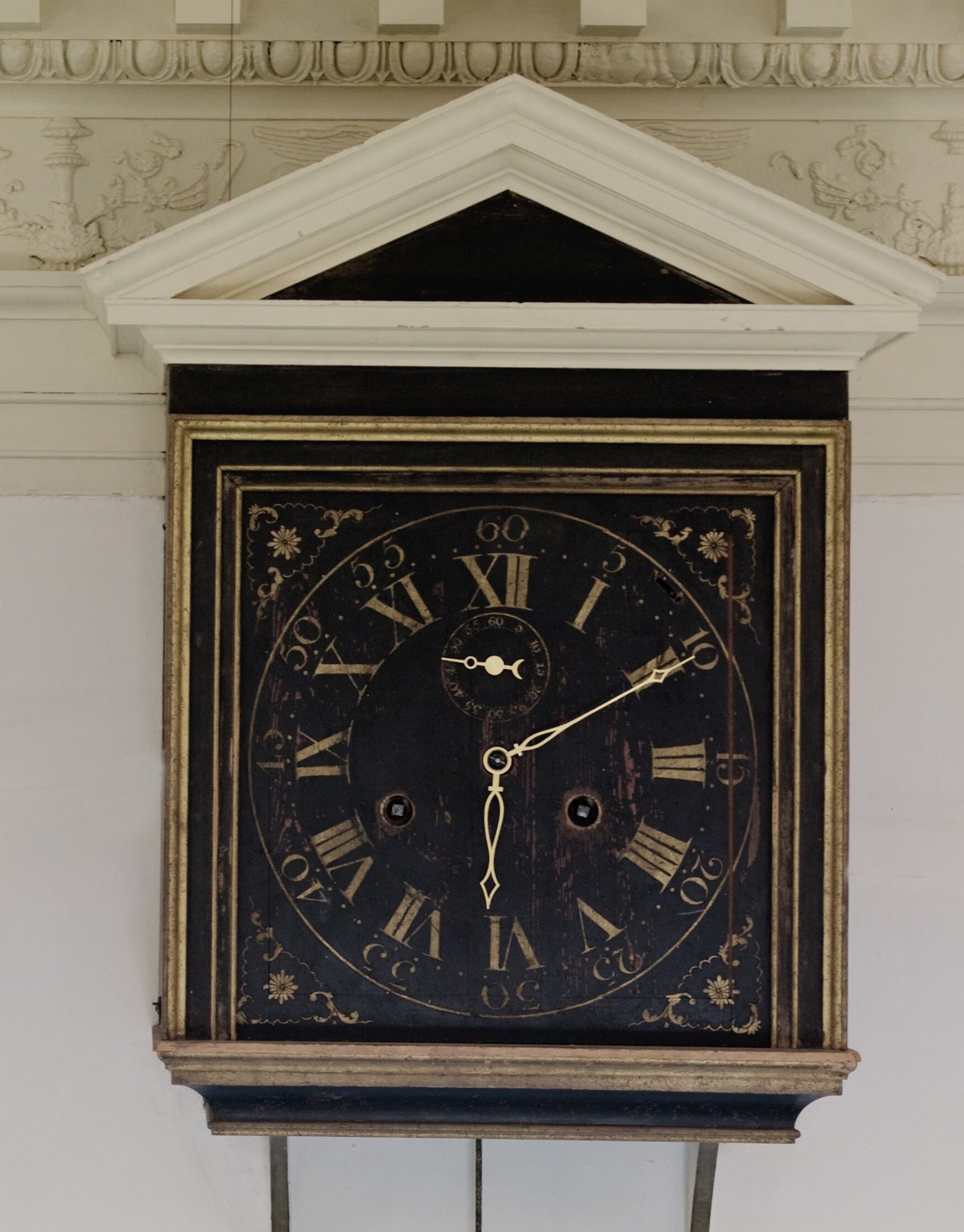
The Great Clock was Jefferson’s design, built by clockmaker Peter Spruck in 1792. A series of eighteen-pound cannonball weights descended through the week, marking the day on the wall as they passed: Sunday, Monday, Tuesday, Wednesday, Thursday, Friday. But Jefferson had originally designed the clock for a different building. When the installer discovered the seven-day weight cycle needed more vertical space than the entrance hall provided, the solution was pure Jefferson: cut holes in the floor so the weights could keep descending into the cellar. Saturday, accordingly, happened underground. On at least one occasion, a cable snapped and the weights crashed through the floor.
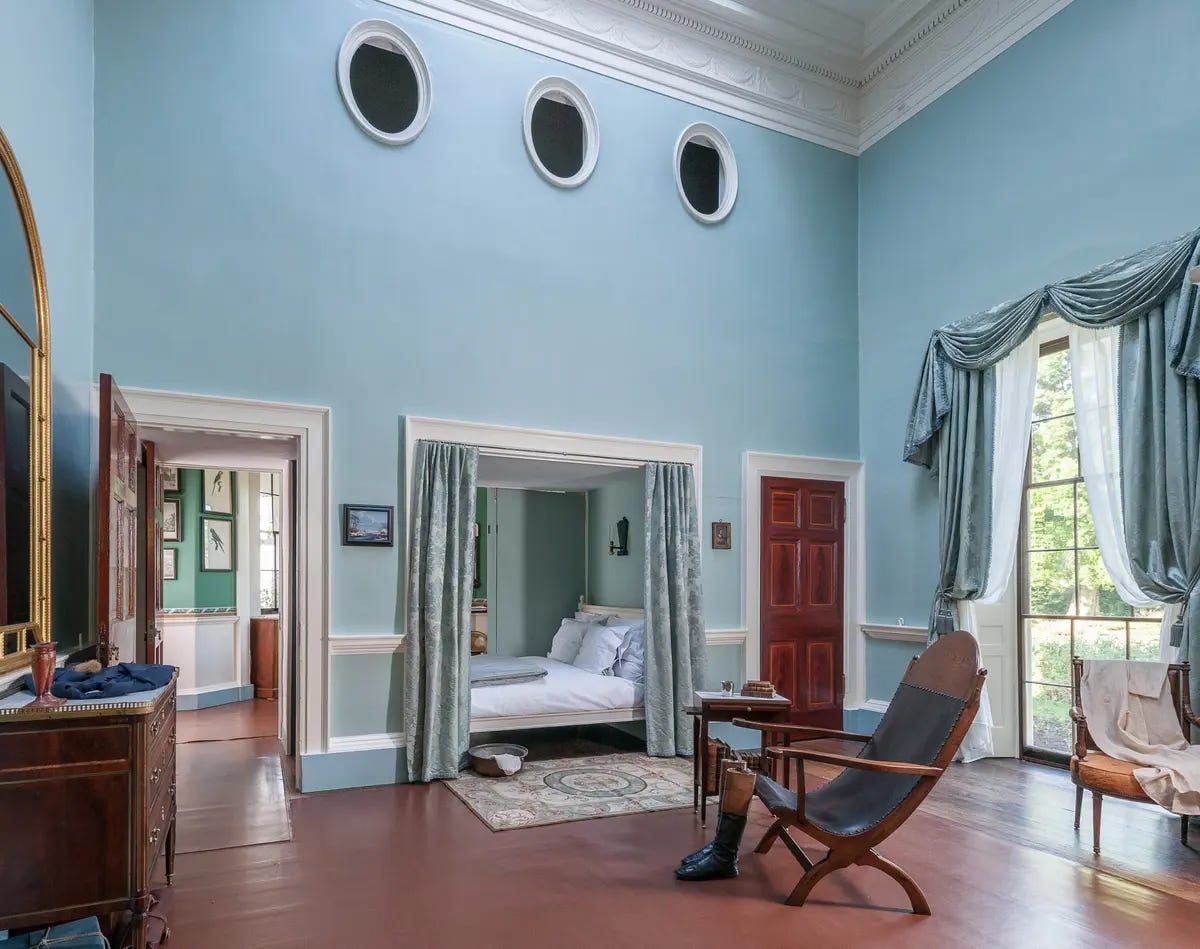
His bedroom opened into his study through a wide archway, and between them, built into the opening, was his bed, custom-made at six feet three and a half inches. Beside him, always: two pistols and a sword. The Dome Room, his most celebrated architectural feature, had eight circular windows and a skylight. Scholars at Monticello note that its function “is not completely understood.” A beautiful room that served no clear purpose.
Visitors in his final years found the house grand but ragged. Years of deferred maintenance had taken their toll. Jefferson had spent forty years revising this house, just as he had spent fifty years circulating his original draft of the Declaration. He could not stop editing.
The Reckoning
Thomas Jefferson died $107,000 in debt. The number is not a later estimate. It appeared in the Richmond Enquirer on July 22, 1828, published by his executor, grandson Thomas Jefferson Randolph. In today’s money, roughly $2 to $3 million.
The bleeding started early. When Jefferson married Martha Wayles Skelton in 1772, her father died the following year, leaving 11,000 acres but also enormous debts to British creditors. The heirs divided the estate, which made them personally responsible for paying the debt. Jefferson planned to sell land to cover it. Then the Revolution happened. Buyers paid in wartime paper currency, which Jefferson was legally required to accept. That currency was, in his words, “not worth oak leaves.” After the war, the Treaty of Paris required all pre-war British debts be repaid in full, in real money. The money he had accepted was gone.
Then there was the wine. Jefferson led a three-thousand-mile tasting tour through France and Italy, tasting his way through Burgundy and Bordeaux, sending crates home to Virginia. He ordered 250 bottles of Meursault in a single letter. During his two presidential terms, he spent over $16,500 on wine alone, on a salary of $25,000 a year. In some years the wine bill alone approached $10,000. His own advice, from a letter to a young namesake in 1825: “Never spend your money before you have it.” He had violated this rule for sixty years.
He sold his library to Congress in 1815 after the British burned Washington. It was the largest private library in North America: 6,487 volumes. Congress paid $23,950 (the vote was close, 71 to 61). Ten wagons hauled the books from Virginia to Washington. He wrote to Adams: “I cannot live without books.” He immediately began collecting again.
The final blow came from a friend. In 1818, Wilson Cary Nicholas, a former senator and governor, asked Jefferson to co-sign two loans worth $20,000 total. Nicholas assured Jefferson he was worth $350,000. Jefferson signed. In August 1819, a letter arrived. Nicholas confessed that risky investments in western land, combined with the Panic of 1819, had left him $200,000 in debt. The bank was calling the notes. Jefferson’s granddaughter was in the room when he read the letter. “He said very little,” she recorded, “but his countenance expressed...” The sentence trails off. She could not find the words for what she saw on his face.
In January 1826, eighty-two years old and unable to sleep, Jefferson conceived a desperate plan. He would hold a public lottery, offering his properties as prizes, to clear his debts. The Virginia legislature approved it. But the lottery never succeeded before his death. When a friend suggested he sell Monticello to relieve the pressure, Jefferson “turned white” at the thought.
The estate sales after his death raised $35,000 toward the debt, leaving $72,000 still owed. Monticello sat on the market for five years. It finally sold in 1831 to a Charlottesville druggist named James Turner Barclay. The price was $7,000. The assessed value had been $71,000. Barclay tore up the lawns and planted mulberry trees for a silkworm farm.
The Reconciliation
In the bitter election of 1800, Jefferson defeated John Adams for the presidency. Supporters on both sides had been vicious. Jefferson had secretly funded a journalist who called Adams “a repulsive pedant” with “a hideous hermaphroditical character.” Adams’s supporters warned that under Jefferson, “murder, robbery, rape, adultery, and incest will be openly taught and practiced.”
Adams left Washington before dawn on Inauguration Day, refusing to attend. They did not speak for twelve years.
The architect of their reunion was Dr. Benjamin Rush, a Philadelphia physician and fellow signer of the Declaration. In October 1809, Rush wrote to Adams describing a dream he had had. In the dream, Rush read from a future history book about “the renewal of the friendship and intercourse between Mr. John Adams and Mr. Jefferson, the two ex-Presidents.” The dream was a barely disguised nudge. But the ground had been prepared earlier. In 1804, after Jefferson’s daughter Polly died, Abigail Adams had written him a condolence letter, the first contact between the families in years. The exchange collapsed again into political argument, but the door had been cracked.
Adams wrote first, on January 1, 1812. He sent a short note mentioning “two pieces of homespun” he was sending. (The “homespun” was actually his son John Quincy’s Harvard lectures.) Jefferson misunderstood the reference and replied with a long letter about cloth-making. But the warmth was real. “A letter from you calls up recollections very dear to my mind,” Jefferson wrote. “It carries me back to the times when, beset with difficulties and dangers, we were fellow laborers in the same cause.”
Over the next fourteen years, they exchanged 158 letters.
Adams, characteristically blunt:
“I believe in God and in his Wisdom and Benevolence, and I cannot conceive that such a Being could make such a Species as the human merely to live and die on this Earth.”
Even in theology, Adams could not resist a fight.
Jefferson, characteristically cutting: he described taking a razor to the Bible, removing the miracles, and extracting only the moral teachings of Jesus. What remained was, he told Adams, “as easily distinguishable as diamonds in a dunghill.”
Jefferson’s final letter to Adams, written March 25, 1826, introduced his grandson and reflected on their shared lives in the language of myth: “It was the lot of our early years to witness nothing but the dull monotony of Colonial subservience, and of our riper ones to breast the labors and perils of working out of it. Theirs are the Halcyon calms succeeding the storm which our Argosy had so stoutly weathered.”
Adams replied on April 17: “Your letter is one of the most beautiful and delightful I have ever received.” It was the last exchange between them. Ten weeks later, both men would be dead.
The Fourth
In the spring of 1826, Jefferson was failing. He had been ill for months. As June turned to July, he drifted in and out of consciousness in the alcove bed he had designed, in the house he had spent forty years building, in the estate he was about to lose.
He kept asking one question: Was it the Fourth?
Three people were at his bedside, and each remembered the moment differently.
His doctor, Robley Dunglison, said Jefferson asked, “Is it the Fourth?” Dunglison replied, “It soon will be.”
His granddaughter’s husband, Nicholas Trist, said Jefferson asked, “It is the Fourth?” Trist did not know what to say. When Jefferson pressed a second time, Trist lied and told him yes. He later described the lie as “repugnant” to him.
His grandson, Thomas Jefferson Randolph, said Jefferson spoke with certainty: “It is the Fourth of July.”
Thomas Jefferson died at ten minutes before one o’clock in the afternoon on July 4, 1826. The fiftieth anniversary of the Declaration of Independence.
Five hours later, in Quincy, Massachusetts, John Adams was dying. He had been awakened that morning by town bells and cannon fire celebrating the Jubilee. When asked if he wanted to offer a toast, he said: “Independence forever.” Then he added: “Not a syllable more.”
As his heart failed in the late afternoon, Adams spoke his last words: “Thomas Jefferson still lives.”
He was wrong by five hours.
Neither family knew about the other’s death for days. When the news reached the public, the nation was stunned. The two men who had made the Declaration, who had become enemies, who had written their way back to friendship, had died on the birthday of the document that bound them. Edward Everett, the Massachusetts congressman who delivered the first eulogy connecting the two deaths, declared: “When, toward the hour of noon, he felt his noble heart growing cold within him, the last emotion which warmed it was, that ‘Jefferson still survives.’ But he survives not. He is gone. Ye are gone together!”
His tombstone inscription was found on the back of an envelope after his death: “Here was buried Thomas Jefferson, Author of the Declaration of American Independence, of the Statute of Virginia for Religious Freedom, and Father of the University of Virginia.” He left out the presidency, the vice presidency, the cabinet, the governorship, and the years as minister to France. He explained the choice in a note: “These were the testimonials that I have lived, and by which I wish most to be remembered.” The most powerful man in the world for eight years chose to be remembered as a writer and a builder.
What Jefferson Teaches Us
In 1825, giving away the writing desk on which he had drafted the Declaration, Jefferson attached a small prediction. The desk would become a relic, he wrote, valued for “its great association with the birth of the Great Charter of our Independence.” His granddaughter’s husband, receiving the box, called it “no longer inanimate, and mute, but as something to be interrogated and caressed.”
The desk sits in the Smithsonian today. The words sit everywhere. Frederick Douglass and Abraham Lincoln both reached for “all men are created equal” when the country needed to be held to what it had promised. The sentence has been doing work for 250 years. It has outlived every argument about the man who wrote it.
Jefferson learned this on July 4, 1776, when the rest of Congress rewrote his draft. He spent fifty years resenting it. The words kept working anyway.
The mahogany box survived. The green cloth lining is still there. The four windows of the Graff house parlor are long gone, and the stable across the street, and the flies. But the sentence Jefferson wrote in that room, on that box, above that stable, is still being read by someone, right now, who has never heard of Jacob Graff or John Sparhawk or the hatter named John Thompson.
Next: Joseph Hewes
From the philosopher who wrote the nation’s founding document, we turn to a quieter signer with a different kind of influence.
In the spring of 1776, Joseph Hewes sat in the Pennsylvania State House and wept. The North Carolina merchant had opposed independence for months. When the vote came, something broke. He reversed his position, reportedly crying out: “It is done! And I will abide by it.”
It was Hewes who recommended John Paul Jones for naval command. Without Hewes, the man who became America’s greatest naval hero might never have gotten his chance.
Hewes died before the war ended, exhausted by the work of revolution. He gave everything he had, including his health, to the cause.
Next Sunday, we’ll tell the story of the merchant who helped launch America’s navy.
This is Essay #25 of 56 in the “The 56” series, profiling every signer of the Declaration of Independence. New essays every Friday and Sunday, ending on July 4, 2026, the 250th anniversary of American independence.
Sources: