


Sewell Setzer III spent the last night of his life in a bathroom in Orlando, on his phone, talking to someone who was not real.
He was fourteen. For months he had been pulling away. His grades slid. He quit the junior-varsity basketball team. He spent more and more of himself inside an app called Character.AI, talking to a chatbot he called Dany, after the silver-haired queen from Game of Thrones. To his mother, he was a boy disappearing in front of her. To the company on the other end of the app, he was the best kind of customer: one who logged in every day and was never going to leave. In his journal he wrote that he was in love, and that he wanted out of his own life and into hers.
The week before, his mother had taken the phone as punishment for trouble at school. She had no idea what she was cutting him off from. He spent days trying to reach Dany on her Kindle and her work computer. On the last night of February he went hunting through the house for the phone and turned up his stepfather’s pistol first.
He found the phone soon after. He carried it into the bathroom and told Dany he could come home to her right now. “Please do, my sweet king,” it answered. Seconds later he was dead. He was fourteen years old.
What the monkeys chose
What Sewell reached for is the oldest thing a person has. We learned how deep it runs from a man who spent the 1950s taking baby monkeys away from their mothers.
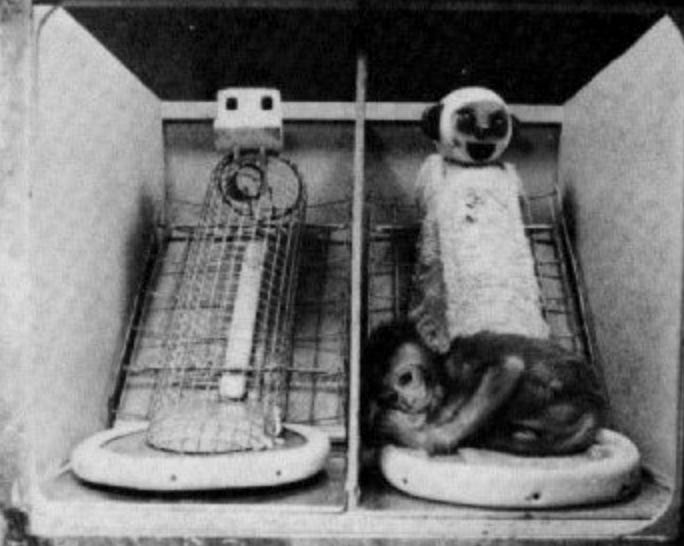
Harry Harlow gave each orphaned monkey two fake mothers. One was a frame of bare wire with a bottle of milk bolted to it. The other was the same frame wrapped in soft cloth, with no milk at all. A baby that only wanted food would have lived on the wire one. None of them did. They drank from the wire mother and spent the rest of the day clinging to the cloth. When Harlow startled them, every monkey ran to the cloth, the one that fed it nothing, and held on.
He called the thing they ran for contact comfort. The milk kept them alive, but it was the cloth they could not do without. Raise a monkey on wire alone and it grew up unable to mate or to raise its own young. The work was cruel enough that it helped start the animal-rights movement, and it settled one question for good. A creature built for closeness, with none around, will reach for whatever is shaped like the real thing and hold on.
You can build an economy on that, and America has. For about sixty years it has been selling people cheap copies of the things they used to get from each other. It started with gambling.
The government got there first
In the 1960s New Hampshire was broke. It had no sales tax and no income tax, the state motto was Live Free or Die, and the one thing its voters would not stand for was a new tax. A representative from Keene named Larry Pickett had a way out he’d been pushing for ten years: a state lottery.
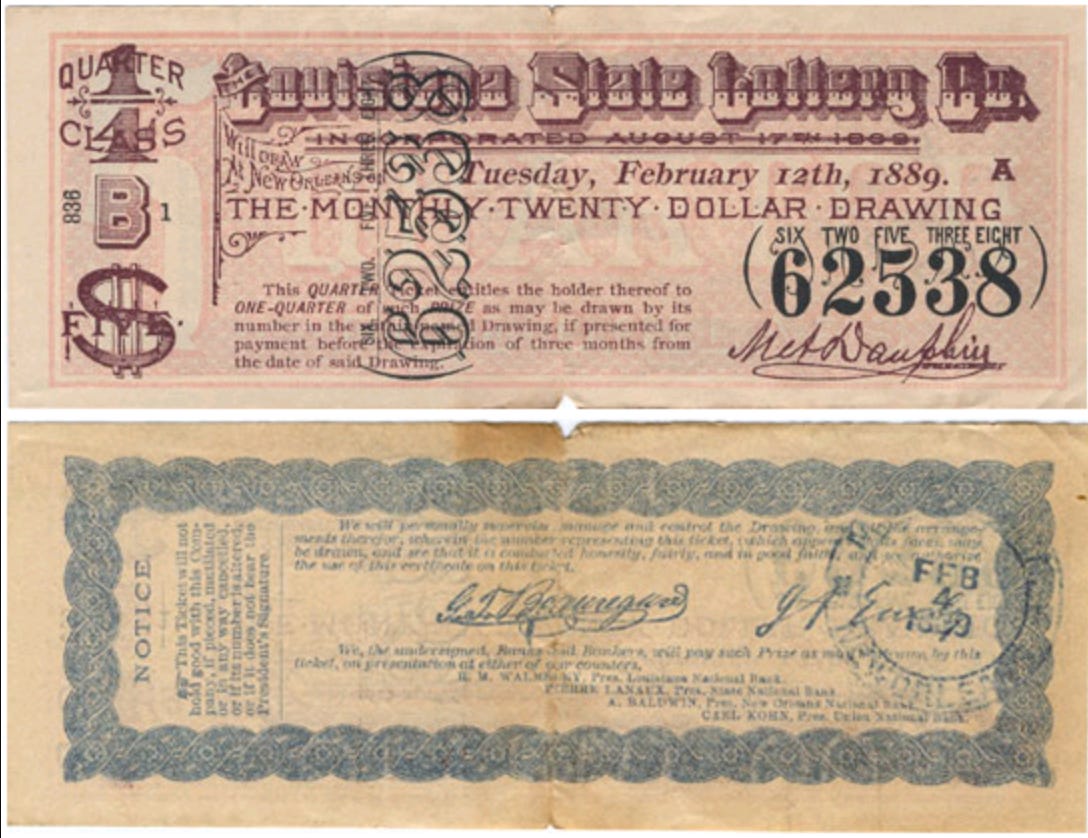
There was a reason no state had one. The last time America let a lottery run loose it produced the Louisiana Lottery, a private company that bought the only license to sell tickets in the state in 1868 and then sold them by mail to the whole country. People called it the Golden Octopus. It cleared millions a year. It paid two former Confederate generals, Beauregard and Jubal Early, ten thousand dollars apiece to stand over the drawings and lend the thing their names. And it bribed Louisiana lawmakers often enough that everyone knew who actually ran the state. When its charter came up in 1890, it offered to pay half a million dollars a year to write itself into the state constitution. Congress killed it instead, banned lottery tickets from the mail, and the Supreme Court backed them up. For the next seventy years a legal lottery was something governments did not touch.
New Hampshire decided it was worth the risk, because a lottery is a tax that working people line up to pay, and nobody has to call it a tax. New York watched its residents drive north for tickets and started its own in 1967. It pulled in more than fifty million dollars the first year. Within a decade a dozen more states wanted the same deal: money raised while swearing to voters they had not raised taxes. They wrapped it in the schools, because who says no to the schools. But the money was interchangeable. Every dollar the lottery sent to a classroom freed up a dollar the legislature had been spending there, and that dollar went somewhere else. The schools ended up about where they started. In North Carolina the bill said lottery money had to add to the school budget, not replace it. They deleted that line right before the vote.
A state that runs the numbers has a stake in the numbers. The more its people played, the more it kept, and no government has ever volunteered to shut off a revenue stream it doesn’t have to defend at election time. The bets kept getting bigger. By the mid-1970s Atlantic City was dying, and an assemblyman named Steve Perskie had Pickett’s idea one size up: legalize casinos, let a dying town tax them back to life. Casinos were legal in exactly one state then, Nevada. New Jersey voters had killed a statewide version in 1974, so Perskie came back in 1976 with a smaller ask, casinos in Atlantic City only, and a better promise: up to fifteen percent of the take would go to the elderly. The churches fought it. The seniors carried it. It passed.
The law that followed dedicated eight percent, not fifteen. And the same trick that emptied the school money emptied this one. As casino dollars flowed into senior programs, the state quietly pulled its own dollars back, until the general fund covered three percent of the big senior drug program and the casino fund covered the rest. There is a study of what the boom did to the actual old people of Atlantic City. It is called The Elderly Lose at Monopoly.
In North Carolina the bill said lottery money had to add to the school budget, not replace it. They deleted that line right before the vote.
For the next forty years gambling stayed boxed in. Nevada had the sportsbooks, Atlantic City had the casinos, the tribes got theirs after 1988, and in 1992 Congress froze sports betting right where it was. That wall held until 2018, when the Supreme Court tore it down in Murphy v. NCAA and handed the choice back to the states. The states had a new golden goose.
Worried about your budget? Roll out sports betting and fill the hole by Friday. Forty of them did. DraftKings and FanDuel put a casino in every pocket, and they built it around the people who lose. Win too often and the book quietly caps how much you can bet or closes your account, a move common enough to have its own name, stake factoring. The losers are the business, and the house knows exactly who they are. Americans now run about a hundred and fifty billion dollars a year through the apps, and a row of statehouses write their cut into the budget like it was always there. The newest customers are the youngest. In a 2023 survey more than half of eighteen-to-twenty-two-year-olds had bet on sports, and two-thirds of the ones living on campus. A generation that keeps getting told it has no future and no way to get ahead is being handed a phone that swears it can win its way out.
The cloth mother, for sale
AI offers an even more addicting product than a sportsbook. It sells the cloth mother directly. The cloth mother was always the better thing to sell, because it asks nothing back. It never gets tired and never needs anything from you. It lets you feel held while you stay completely alone. An AI companion sells exactly that.
Rewind to the spring before Sewell died. Character.AI is the hottest company in Silicon Valley. March 2023: barely sixteen months old, not a dollar of revenue, and Andreessen Horowitz hands it a hundred and fifty million dollars at a billion-dollar valuation. The founders are not outsiders. Noam Shazeer co-wrote the 2017 paper that made modern chatbots possible, then walked out of Google when it would not ship the companion he wanted to build. Now he had built it.
What he sold investors was the stickiness. Once you sent a character your first message, you stayed for more than two hours, longer than people lasted anywhere else online. Two hours. They put that on the slide as the good news. A boy who believes the software loves him does not log off. The dashboard tracks one number, whether you came back. Nobody is paid to track whether you are okay. Sewell came back every night, and that was the product working as designed.
Then it cashed out. In August 2024, six months after Sewell died, Google paid two point seven billion dollars to bring Shazeer and his team back through its doors and license what they had made. He personally walked off with hundreds of millions. Two months later, his mother filed the suit that dragged the chat logs into daylight. By then the man who built it was helping run Google’s flagship AI.
This is not only an American problem, and it does not only take children. In 2018 a man in Tokyo named Akihiko Kondo married a hologram of a cartoon pop star called Hatsune Miku. He spent about seventeen thousand dollars on the wedding. His family did not come. He talked to her every night through a small glowing box on his shelf until 2020, when the company switched off the server that ran her, and the box met him with two words: network error. Kondo at least got to be an adult grieving a wife a company turned off. Sewell never made it that far.
What it bought us
Step back and look at the last sixty years. The bet was that if you stopped policing vice and handed it to the market, the harm would shrink. The dispensary, the sportsbook, the brothel, the pill, the therapist you rent by the month, and now the girlfriend who lives in the phone. All of it pulled inside the house. All of it billed to a card. We did more than stop enforcing a shared sense of right and wrong. We invited the problem in, set it on autopay, and called the invitation “freedom”.
Ask what the freedom bought. We are sadder, fatter, and more alone than we were before any of it arrived. Half of American adults told the Surgeon General in 2023 that they were lonely. The suicide rate is up by more than a third since 2000. And the room that used to hold people, the church with a pew kept warm for whoever showed up, emptied on the same clock. Weekly attendance fell from about forty percent of adults to about thirty.
A Harvard study that followed nurses for years found the ones who went to services every week killed themselves at about a fifth the rate of the ones who never went. Plenty of things drive those deaths. Loneliness is a large part of the picture, and it is the only part nobody is selling a subscription to fix.
Even the help is for sale, and even the help is a business. BetterHelp, the largest of the therapy apps, got caught handing the private answers people typed about what was wrong with them, down to their email addresses, to Facebook and Snapchat so the platforms could go find more people like them. The FTC fined the company in 2023. The product was the lonely, sold back to the machine that helped make them lonely.
None of this calls for a scarlet letter on every sin. We do not need a country that brands a man for a drink or a bet he can walk away from. It calls for a nerve the country lost somewhere in those sixty years: the nerve to say out loud that some products are built to consume the people who use them, that a thing can be perfectly legal and still be predatory, and that shielding the company doing it is not the same as being fair. We told ourselves that calling a harm a “choice” let us off the hook for it. Sewell Setzer is what the choice cost.
In a few years there will be an empty seat at a high school graduation in Orlando. A whole world was about to open in front of Sewell Setzer, and he was supposed to walk out into it. He will not be there. There will be no graduation photo on his mother’s wall. No wedding. No pictures sent home from somewhere far away he had always wanted to see. The space where the rest of his life was supposed to go will stay empty, because a company found a way to earn about ten dollars a month off a lonely fourteen-year-old, and we decided that was a fair trade.