

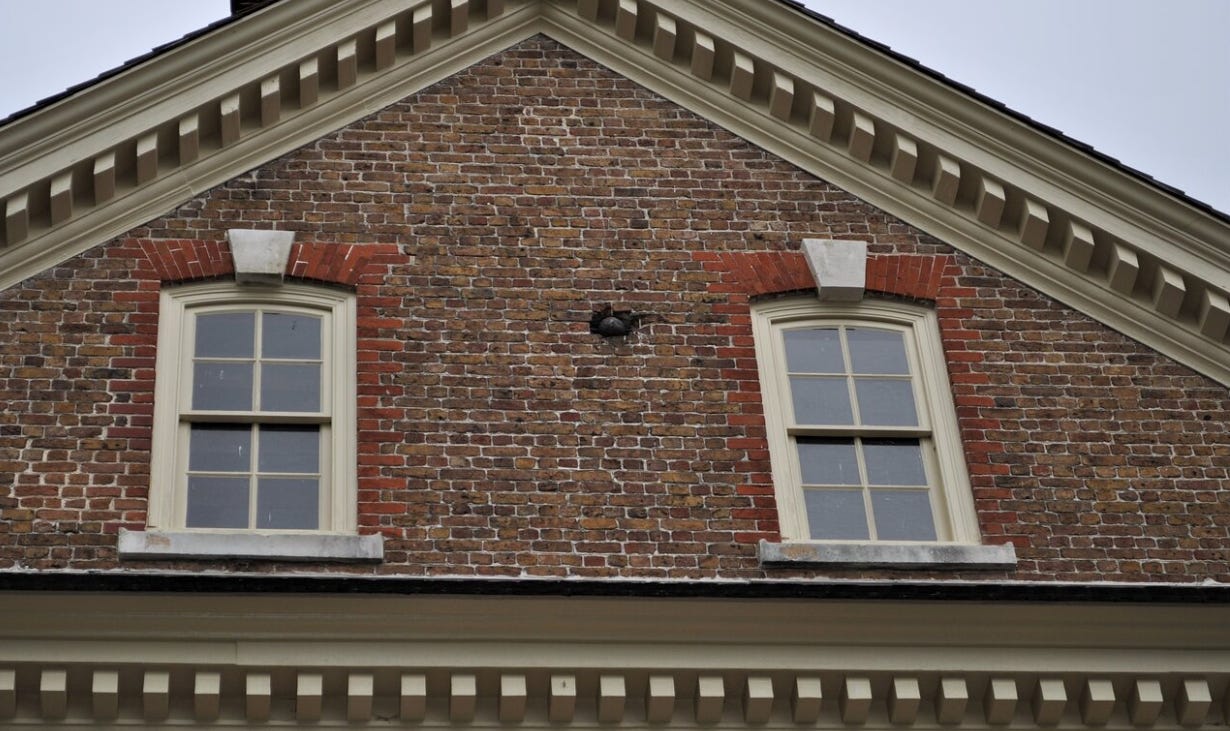
The most famous story about Thomas Nelson Jr. goes like this: during the siege of Yorktown in October 1781, American guns faced the British lines. The gunners avoided civilian homes. One mansion in particular was off limits. A large brick house that dominated the skyline.
Then Nelson, the governor of Virginia, rode up and demanded to know why they weren’t firing at it.
The officers explained it belonged to a prominent citizen.
“That house is mine,” Nelson said. “The British are using it as their headquarters. Open fire. Five guineas to the first gunner who strikes it.”
They fired. The cannonballs tore through the walls. The house still stands in Yorktown today, with damage visible in the brickwork. Tourists photograph it. Park rangers point to it.
There’s one problem.
The “five guineas” detail first appears in print in 1881, a hundred years after the siege. No diary or military record from 1781 records Nelson giving that order. The earliest visitor account comes from historian Benson Lossing in 1848. He noted “marks of the iron hail” on the house but said nothing about Nelson personally ordering the fire. A 1939 National Park Service memo admitted its own files on the subject were “incomplete” and “not adequate for preparing a general statement.” Even the park didn’t know for sure.
The legend is clean. One dramatic moment, one perfectly timed sacrifice.
The real story is messier. And worse.
The Fortune
To understand what Nelson lost, you have to see what he started with.
Thomas Nelson Jr. was born on December 26, 1738, in Yorktown, Virginia, into a fortune built on tobacco and Atlantic trade.
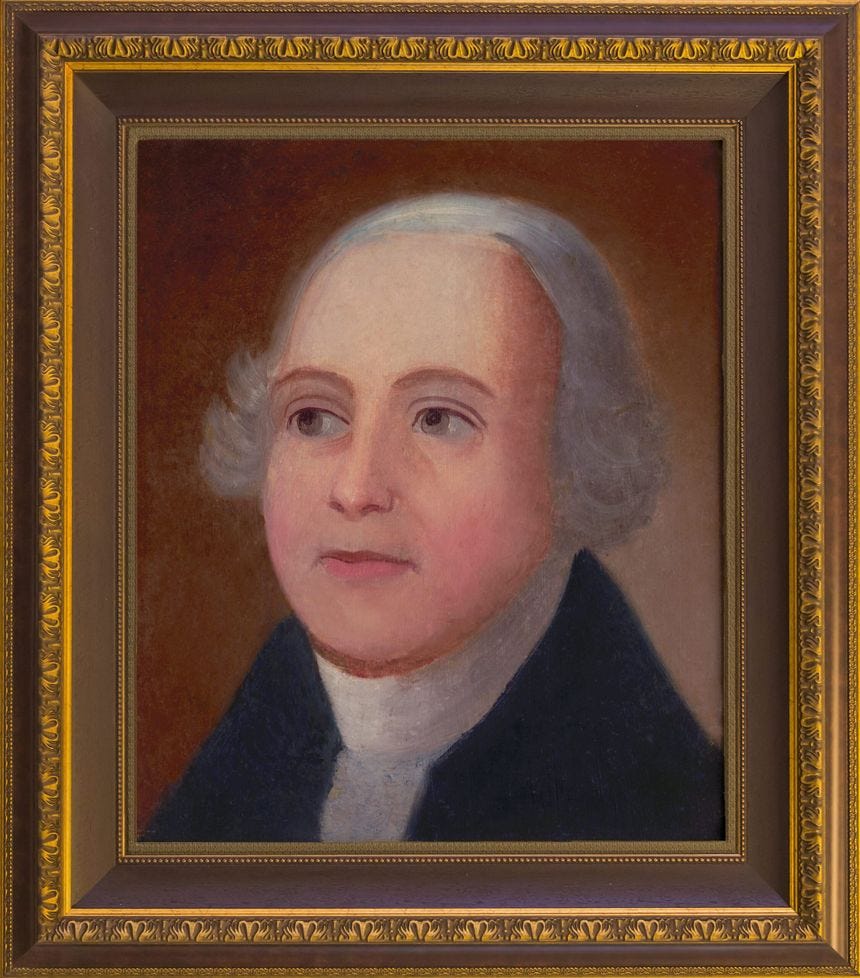
His grandfather, Thomas “Scotch Tom” Nelson, came over from Cumberland, England around 1705 and built a trading empire on the York River. The Nelsons shipped cured Virginia tobacco to England and agricultural products to Barbados.
Nelson’s father, William, served as president of the Virginia Council, the highest office in colonial Virginia. He made the family even richer. When it came time to educate young Thomas, the family did what ultra-wealthy Virginia families did: sent him across the Atlantic. He went to school in Hackney, then Eton, then Cambridge. He spent eight years in England learning the manners and philosophy of the British ruling class.
He returned to Virginia in 1761. While he was still aboard the ship home, the House of Burgesses elected him to represent York County. He hadn’t even stepped off the ship.
The following year he married Lucy Grymes, a young widow. Through her, he married into Virginia’s most powerful families. Jefferson was a cousin by marriage. His father’s wedding gift: 20,000 acres of land and £30,000 in capital.
When William died in 1772, Thomas inherited the rest. He was thirty-four years old and controlled an estate worth over £40,000. In today’s money, roughly eight to ten million dollars.
One historian called him a “jovial fat man whose affability and fund of off-color stories hid an inner core of steel.” He had an open face and a way with people. He could move between the richest planter families and the rough militia soldiers he would later command. Big, generous, the kind of man who laughed easily and never hesitated.
He had every reason to stay loyal to the Crown. The British system had made his family one of the richest in the colony. Unlike the lawyers in Philadelphia or the merchants in Boston, Nelson had nothing obvious to gain from independence.
And yet, he was among the first to act.
The Yorktown Tea Party
Virginia’s break with Britain came fast. In May 1774, the Royal Governor, Lord Dunmore, dissolved the legislature for protesting the Boston Port Act. Eighty-nine delegates refused to quit. They met at the Raleigh Tavern in Williamsburg and banned all commerce with Britain.
Six months later, on November 7, the merchant ship Virginia docked at the Yorktown waterfront carrying tea. That broke the ban.
Nelson boarded it.
He personally led members of the York County Committee of Safety onto the vessel and threw two half-chests of tea into the York River. Virginia’s own tea party. Less famous than Boston’s, but the same message.
While other planters talked about supporting the cause, Nelson spent his own money buying and shipping supplies to the blockaded citizens of Boston.
In mid-1775, Nelson took George Washington’s seat in the Second Continental Congress. Washington had left Philadelphia to command the army.
By May 1776, Nelson was done waiting. At the Virginia convention, he pushed through resolutions telling the colony’s delegates in Philadelphia to propose independence. He carried those resolutions to Congress himself. Richard Henry Lee read them on the floor on June 7.
Weeks later, Nelson signed the Declaration, putting his name and his fortune on the line. The cost of that signature would take a decade to add up.
The Cavalry Debacle
Nelson’s ruin didn’t start at Yorktown. It started in 1778, with horses.
Congress put out an appeal for new troops of light cavalry. Nelson personally financed and outfitted a full cavalry troop from his own pocket. In July, he marched them north to Philadelphia.
Congress took one look at the cavalry and sent them home. Nelson and his men made the long ride back to Virginia with nothing to show for it.
It got worse. Virginia’s tobacco economy was already in a credit crunch. The state government was struggling to borrow. Nelson started using his own property to back the state’s paper money. When the Assembly tried to raise a two-million-dollar loan in Continental currency for the war effort and couldn’t find enough willing lenders, Nelson stepped in. He put his own estates on the line, promising that if the state couldn’t pay, he would.
The state would default. Nelson would cover the losses.
His chronic illness made the whole thing harder. By May 1777, he had already been forced to resign his Congressional seat after what people at the time described as a “severe asthma attack.” Doctors couldn’t tell the difference between respiratory disease and what we’d now call a stress-related collapse. The multi-week carriage rides between Yorktown and Philadelphia wore him down. He was organizing a defense and watching his fortune disappear at the same time. It broke something in him. Every time he tried to serve, his body gave out. But Virginia wasn’t done with him.
The Governor
In early June 1781, a British cavalry detachment rode hard for Charlottesville, Virginia, where the state legislature was meeting. Their target was Governor Thomas Jefferson. A young militia captain named Jack Jouett rode through the night to warn him, and Jefferson escaped Monticello just ahead of the British. The legislature scattered into the Blue Ridge Mountains.
When the delegates reassembled, they had two items of business. The first was to elect a new governor. The second was to investigate the old one. Jefferson was brilliant on paper. But he had hesitated to seize civilian supplies or force militia drafts, worried about overstepping his authority. Virginia was paying for that caution. Richmond had been burned. British forces under Benedict Arnold had been rampaging along the James River. Cornwallis was marching north from the Carolinas with a battle-hardened army.
Virginia didn’t need caution anymore. On June 12, 1781, the Assembly elected Thomas Nelson Jr. and gave him extraordinary wartime powers.
He used them immediately. He ordered the forced seizure of food and livestock from civilian farms and authorized the forced removal of suspected loyalists without jury trials. He drafted militiamen without limit. When supply chains collapsed entirely, he paid for the state’s supply orders out of his dwindling personal fortune.
His actions were outside the law. His fellow planters hated him for it. The Assembly later passed an indemnity act to shield him from the lawsuits his own emergency orders had triggered.
He held the office for five months. It was enough.
Yorktown
The siege of Yorktown lasted from September 28 to October 19, 1781. Washington’s army, combined with a French force under Rochambeau, closed in from land while the French fleet sealed the Chesapeake Bay from the sea. Cornwallis had nowhere to go.
Nelson commanded nearly a third of the American ground force on the right flank. About 3,700 Virginia militia. But his real job wasn’t fighting. It was keeping the army fed. Feeding and supplying over 16,000 men fell on his shoulders. He stripped the Virginia countryside of grain and livestock, often making permanent enemies of his neighbors. Without those supplies, the siege lines would have collapsed.
On the night of October 10, French gunners fired “hot shot” at the British fleet in the York River. Hot shot meant solid iron cannonballs, heated in special furnaces until they glowed red. The HMS Charon, a 44-gun frigate, caught fire. It broke loose from its anchor lines, set fire to nearby transport ships, and drifted across the river toward Gloucester Point, burning to the waterline before it sank. The inferno lit up the night over Yorktown.
The bombardment devastated the town and the Nelson properties with it. Two Nelson houses stood in Yorktown: the governor’s mansion and the home of Nelson’s uncle, Secretary Thomas Nelson. Cornwallis set up headquarters in the uncle’s house first. Allied artillery destroyed it. Cornwallis then relocated to the governor’s mansion. It was hit too.
Nobody recorded at the time whether Nelson personally ordered the bombardment of his own home. The house was damaged and the British were inside. Nelson didn’t object. The legend came later, as legends do, and it made for a better story than the truth.
On October 19, Cornwallis surrendered. The British army marched out and laid down their arms. Washington rode to accept the surrender on a light sorrel charger that didn’t flinch at cannon fire.
The horse’s name was Nelson. A gift from the governor himself, sent to Washington in 1778.
The Ruin
Nelson resigned as governor on November 22, 1781, less than six months after taking office. He was exhausted and violently ill, facing threats of lawsuits from the very planters whose supplies he had seized.
Unable to afford repairs on his war-damaged Yorktown mansion, he retreated to Offley Hoo, a modest estate in Hanover County. The Marquis de Chastellux visited in 1782 and found a family trying to hold itself together. They still had an extensive library. Even when fifteen or twenty guests were trapped indoors by weather, they read and talked rather than playing cards or gambling. Chastellux noted this would have been unthinkable in Europe.
The state owed Nelson for supplies and troops he had personally financed. He petitioned for repayment. The state acknowledged the debt. Payment came slowly, then not at all.
His creditors did not wait. Creditors sold or mortgaged the estates that had made the Nelson family wealthy for generations. In 1786, Nelson filed a lawsuit against Carter Braxton, another signer of the Declaration, also drowning in debt, trying to recoup what he could. Two men who had pledged their lives, their fortunes, and their sacred honor were now suing each other over money that didn’t exist.
By 1788, he was selling off everything he could. Land that had been in the family for generations went to creditors. The Nelson name, which had once meant wealth across the Virginia tidewater, now meant debt.
Lucy had given him thirteen children. Eleven survived. He had almost nothing to leave them.
The Exquisite Tortures
The physician who attended Nelson in his final illness was a Dr. Smith. What he wrote tells you exactly how the story ends.
Nelson had been one of the richest men in Virginia. Now he had nothing. He believed he had doomed his wife and a dozen children to the same.
Dr. Smith wrote: “From his unexampled patriotick exertions during the late war he had exhausted a fortune... He cou’d not bear it. I attended him in his last illness and saw that the exquisite tortures of the mind were the disease that destroyed his body.”
Thomas Nelson Jr. died on January 4, 1789, at his son’s home in Hanover County. He was fifty years old. George Washington would be inaugurated as president four months later.
Nelson didn’t live to see it.
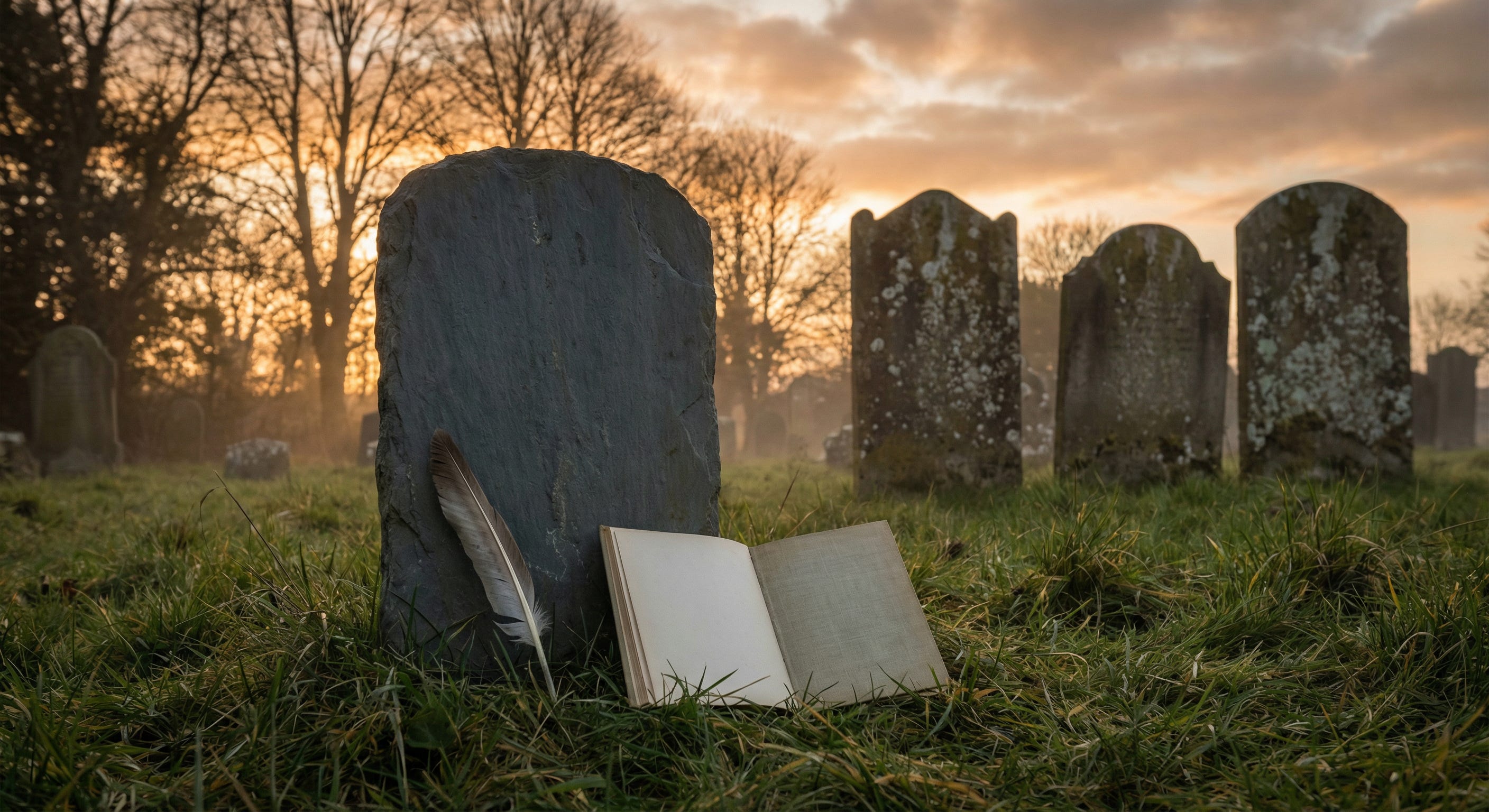
Under Virginia debtor law, inherited from English common law, creditors could legally seize a dead person’s body until outstanding debts were settled. The practice was called “arrest of the dead body.” Nelson’s family knew this. They transported his body back to Yorktown in secret and buried him in an unmarked grave in the yard of Grace Episcopal Church. No headstone. No name.
They hid a founding father from the country he had bankrupted himself to create.
He lay there, anonymous, for decades. Historian Benson Lossing visited in 1848 and found “nothing marks the spot but a rough stone.” In 1822, Nelson’s heirs petitioned the Virginia Assembly for repayment. Virginia never paid.
What Nelson Teaches Us
We tell the clean version. A governor on horseback, ordering cannons at his own house. One perfect moment of sacrifice. That story showed up in print a hundred years after it supposedly happened.
The real sacrifice took a decade. Nelson pledged his fortune to back a state that couldn’t pay him. He seized his neighbors’ property to feed an army. He sold off land his grandfather had built an empire on. And when it killed him, his family hid his body in an unmarked grave so creditors couldn’t take it.
That is the distance between the story we tell about the founding and what it actually cost.
Next: Francis Hopkinson
From the Virginia planter buried in an unmarked grave, we turn to the New Jersey wit who claimed credit for everything, including America’s flag.
Francis Hopkinson was a lawyer and judge with a sharp creative streak. He wrote songs mocking the British and helped design public symbols for the new nation. He also submitted a bill to Congress claiming he had designed the American flag.
Congress refused to pay. They said Hopkinson hadn’t worked alone, and besides, he was already being compensated for other work.
Did Francis Hopkinson design the Stars and Stripes? The answer is complicated. The story reaches into the Betsy Ross legend and into records historians still debate.
Next time, we tell the story of the signer who may or may not have given America its flag.
This is Essay #17 of 56 in the “The 56” series, profiling every signer of the Declaration of Independence. New essays every Friday and Sunday, ending on July 4, 2026, the 250th anniversary of American independence.
Subscribe to follow the journey.
Sources:
Virginia Chronicle, 1881 (earliest “five guineas” print source)
Journal of the House of Delegates, May 29, 1781 | Encyclopedia Virginia
Election of Governor Nelson, June 12, 1781 | Encyclopedia Virginia
Marquis de Chastellux, Travels in North America in the Years 1780, 1781, and 1782 (1787)