

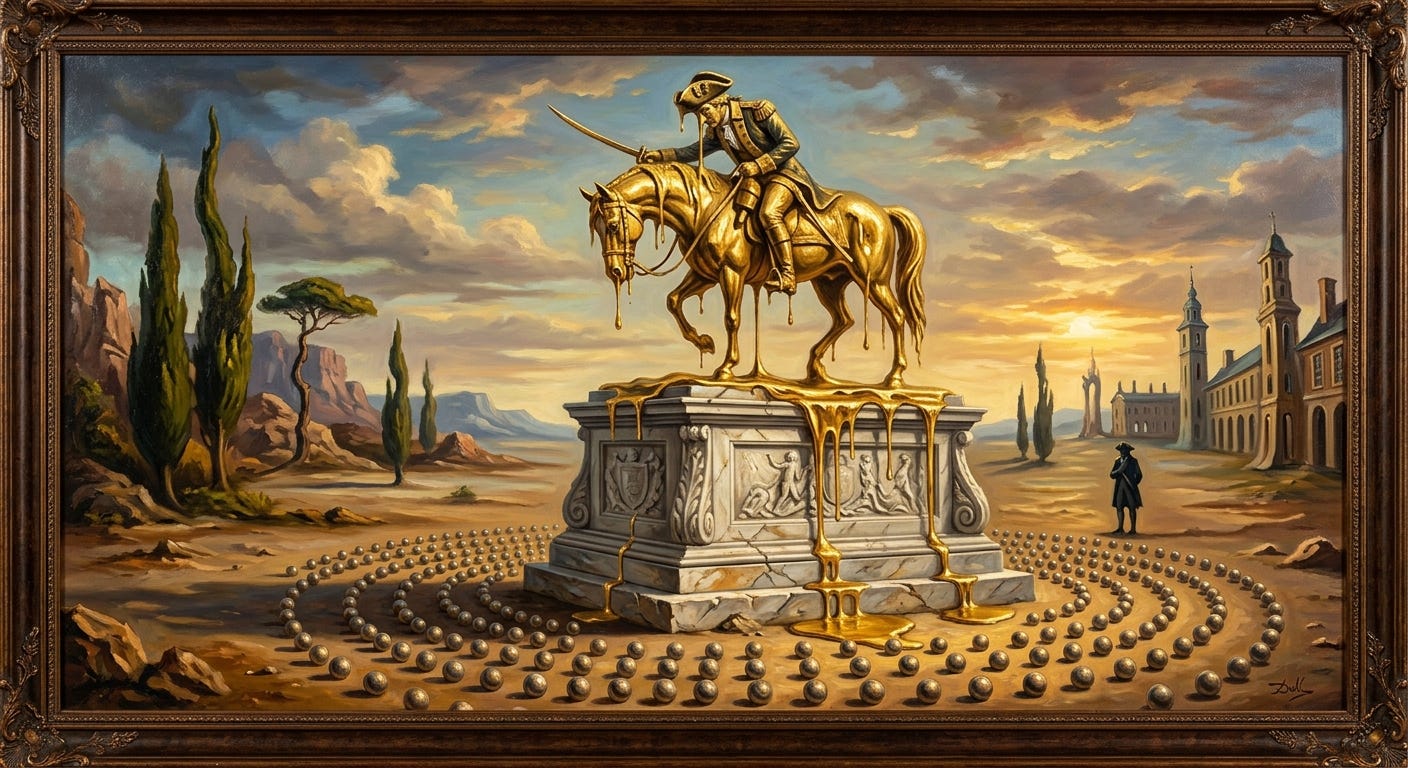
On July 9, 1776, a crowd in New York City pulled down a four-thousand-pound equestrian statue of King George III from its pedestal at Bowling Green. They hacked off the head and dragged the body through the streets. British Captain John Montresor later recovered the severed head and shipped it to England, where it disappeared into a private collection. The rest of the king lay in chunks on the cobblestones.
Oliver Wolcott, a Connecticut delegate to the Continental Congress, saw four thousand pounds of lead that the Continental Army desperately needed.
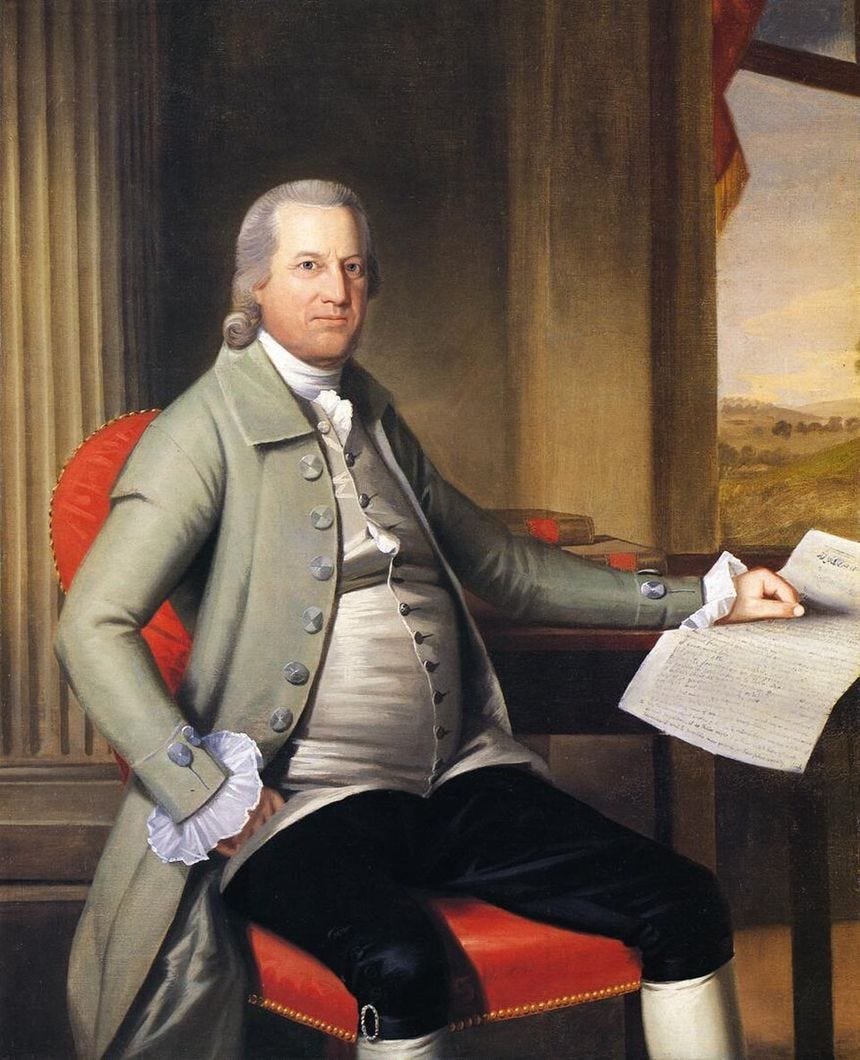
He arranged for the remains to be loaded onto barges, shipped up Long Island Sound to Norwalk, and hauled by oxcart a hundred miles inland to his home in Litchfield, Connecticut. Then he went back to Philadelphia, because Congress still had a war to argue about.
The melting happened in a shed behind the Wolcott house. Oliver’s wife Laura ran the operation with their daughters and neighbors. For weeks that summer, they heated lead over open fires, poured the liquid metal into iron molds, and packed the cooled musket balls into crates for the front lines. Oliver’s papers include a tally of what they produced: forty-two thousand and eighty-eight bullets, cast from the body of the king.
Ebenezer Hazard wrote to General Horatio Gates that British troops would soon have “melted Majesty fired at them.”
The rest of Oliver Wolcott’s life would take him places far stranger than a shed full of melted royalty.
The Sheriff’s Son
Oliver Wolcott was born in 1726 in Windsor, Connecticut. His father, Roger Wolcott, had been governor of Connecticut until 1754, when a dispute over a captured Spanish merchant ship brought accusations of corruption and cost him the next election. Roger became the first Connecticut governor ever voted out of office. He was later cleared of the charges, but the damage was done. The Wolcott name carried weight in the colony, and now it carried a stain.
Oliver graduated first in his class at Yale in 1747 and studied medicine with his older brother, but never opened a practice. He moved to Litchfield, took the job of county sheriff, and held it for twenty years.
A county sheriff in eighteenth-century Connecticut collected taxes, ran the jail, and settled everything from property disputes to public fights across a large rural county. Court records from Litchfield show lawsuits tied to Wolcott’s time in office, including a prisoner escape and accusations of mistreating a servant. It was messy, thankless, constant work.
By the time the Revolution arrived, Wolcott knew how to organize people, move supplies, and make hard decisions under pressure. Nobody in Connecticut could match that experience.
The Spy
In the summer of 1779, Major General William Tryon burned New Haven and Fairfield. Danbury had already been hit two years earlier. The British were raiding the Connecticut coast at will, torching entire towns, and vanishing before anyone could respond.
Wolcott was the top militia commander in Connecticut. His forces were too slow. By the time word reached inland and the militia assembled, the British ships were already gone.
So he built a spy network.
Volume III of the Oliver Wolcott Sr. Papers at the Connecticut Historical Society contains a ledger, dated August 4 through August 13, 1779, recording payments for intelligence services. The entries show coordination with Colonel Andrew Ward, a veteran who managed informants along the coast and Long Island Sound. Wolcott paid people to watch British ship movements and track suspected loyalists operating inside Connecticut. The intelligence let him position his militia where the British were likely to land, instead of scrambling after the fact.
The ledger is a small, quiet document. It records amounts paid, dates, contacts. Nothing dramatic about it on the page. But it means that the man remembered for melting a statue into bullets was also funding a covert intelligence operation along the Connecticut coastline, out of his own pocket, while the towns around him burned.
The General
Two years before the spy ledger, in the autumn of 1777, Wolcott marched north with several hundred Connecticut volunteers to join the fight at Saratoga.
British General John Burgoyne was pushing south from Canada, trying to split the colonies in half by capturing the Hudson River Valley. Wolcott’s militia joined General Horatio Gates and helped surround Burgoyne’s army at Freeman’s Farm and Bemis Heights. The American victory at Saratoga brought France into the war.
Wolcott was not a famous general. No one painted his portrait at the battle. But according to tradition, some of the musket balls his Connecticut soldiers carried to Saratoga were the same ones Laura had cast in their backyard from the body of King George III. Nobody can confirm that for certain. But the timing fits, and the image is hard to let go of: the king’s own lead, fired back at the army he sent to keep the colonies.
After the war, Wolcott served seventeen years as lieutenant governor, then governor of Connecticut.
In 1788, he spoke at the state’s convention to approve the Constitution, warning that the agreement holding the states together was too weak and that the country could fall apart. When the sitting governor died in 1796, Wolcott stepped into the same office his father had lost forty years earlier.
The Wolcott name, damaged in Oliver’s twenties, was restored by the time he was seventy. His son, Oliver Wolcott Jr., would go even further, replacing Alexander Hamilton as Secretary of the Treasury and eventually becoming governor himself.
Oliver Wolcott Sr. had spent fifty years in public service. He had melted a king into bullets, fought at the battle that turned the war, and run a spy network to protect his coastline. By any measure of his time, he had done enough.
He did not think so.
The Prayer
Oliver Wolcott died in office on December 1, 1797. He was seventy years old.
His pastor, Azel Backus, preached the funeral sermon. What Backus recorded about the governor’s final days caught people off guard.
Wolcott did not die giving orders or settling accounts. He spent his last days in what Backus described as quiet torment. The governor expressed “a deep sense of his personal unworthiness and guilt.” For several days before his death, Backus wrote, “every breath seemed to bring with it a prayer.”
Wolcott was raised in a strict Calvinist household, the kind of faith that teaches no amount of human achievement can earn a place in heaven. You cannot work your way there. You cannot build enough or sacrifice enough. Everything you accomplish is, in the final accounting, a debt you can never repay.
The man who melted a king into forty-two thousand bullets spent his last breaths feeling that none of it had been enough.
The Statue’s Afterlife
Not all of the statue made it to Litchfield. Loyalists in Wilton, Connecticut stole fragments during transport and buried them on their property. The pieces were recovered decades later, and several are now held at the New-York Historical Society.
The head, as noted earlier, was recovered by Captain Montresor and sent to England. It ended up in the hands of Lord Townshend. No museum has confirmed having it since. It has never been found.
In 1935, the people of Litchfield reenacted the melting to celebrate Connecticut’s 300th anniversary, creating souvenir bullets for visitors. In 1991, a twenty-pound piece identified as part of the horse was pulled from a swamp in Wilton. It is now on display at the New-York Historical Society.
The statue stood on its pedestal at Bowling Green for six years. It has been remembered for 250.
What Wolcott Teaches Us
Oliver Wolcott spent his entire adult life climbing. Sheriff, militia commander, congressman, spy master, general, governor. Each accomplishment led to the next. Each mountain revealed another one behind it.
That is how most of us are taught to live. One more goal. One more achievement. The next thing will be the thing that makes it feel complete.
Wolcott reached the top. He held the same office his father had lost. He rebuilt a family name that had been ruined before he turned thirty. He fought in the battle that won the war. He melted a king.
And on his deathbed, none of it was enough. His faith told him that a lifetime of service was still a debt unpaid. Every breath was a prayer for something he could not earn.
Maybe the lesson is not about doing more. Maybe it is about learning to sit with what you have already done and accepting that it was enough, even if it never feels that way. Because no one gets to the end and thinks they checked every box. The question is whether you spent the time doing work that mattered, not whether you finished.
Wolcott did. He just never believed it.
Next: Richard Stockton
From the man who melted a king, we turn to the most controversial signer of all.
Richard Stockton of New Jersey signed the Declaration of Independence. Then he was captured by the British. And then, according to some accounts, he signed something else: a loyalty oath to the Crown.
Did Richard Stockton betray the Revolution? The evidence has been argued for 250 years.
Next Friday, we tell the story of the signer accused of treason.
This is Essay #23 of 56 in the “The 56” series, profiling every signer of the Declaration of Independence. New essays every Friday and Sunday, ending on July 4, 2026, the 250th anniversary of American independence.
Subscribe to follow the journey.
Sources: