

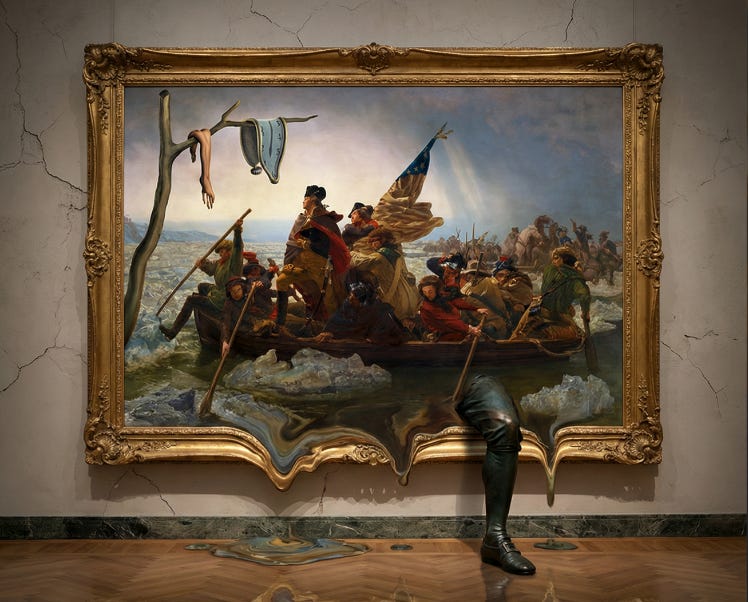
There’s a painting on the second floor of the Metropolitan Museum of Art that most Americans have seen.
Emanuel Leutze’s Washington Crossing the Delaware is enormous, twelve feet tall and twenty-one feet wide, and it shows the scene you already know.
Washington standing in a boat.
Ice on the river.
Christmas night, 1776.
If you look closer, you may notice something that surprises you.
A Black man pulling an oar.
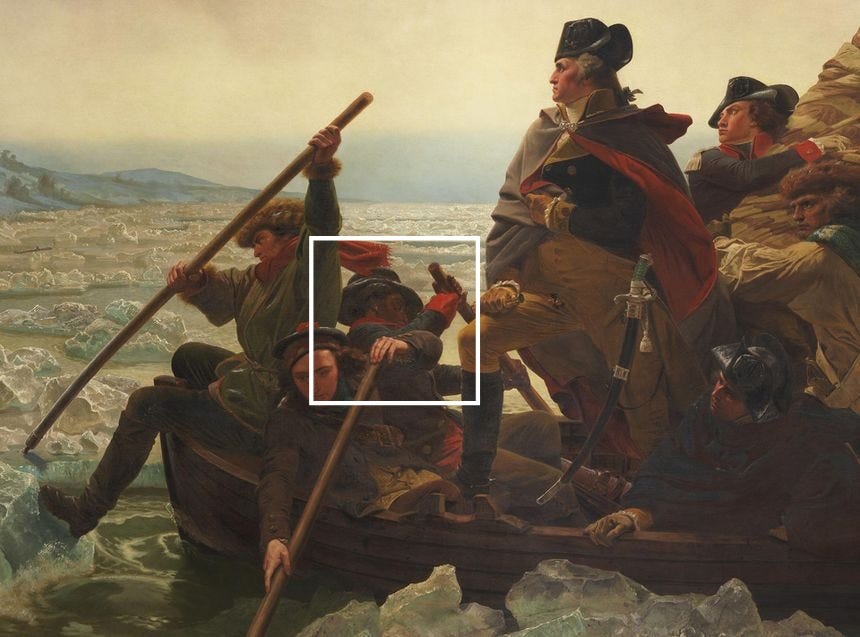
For more than a century, people said that man was Prince Whipple, an enslaved aide to one of the signers of the Declaration of Independence.
The story was that Prince had gone to war alongside his owner, William Whipple of New Hampshire, and ended up in the boat with Washington himself on the most famous night of the Revolution.
It’s almost certainly wrong.
William Whipple wasn’t at the Delaware crossing. He was back in New Hampshire.
Leutze painted the scene in 1851, seventy-five years after it happened, working from a studio in Germany.
The identification came from a writer named William C. Nell in 1855. Not from anyone who was there.
But the mistake stuck. Americans wanted to believe the Revolution included everyone.
This is a story about the man who owned Prince Whipple, and about what we choose to remember.
From the Sea to the Shore
William Whipple was born on January 14, 1730, in Kittery, Maine, which was then part of Massachusetts. His family had enough money to give him a decent education, but young William didn’t go to college or study law.
He went to sea.
By twenty-one, he was captaining his own ships across the Atlantic, running goods between the colonies, the Caribbean, and Europe. It was dangerous work.
Storms could sink you.
Pirates could take everything.
Disease could empty a crew in days.
Plenty of captains never came home. Whipple kept coming home.
By his late twenties, he had saved enough to retire from sailing. He moved to Portsmouth, New Hampshire, and started a trading business with his brother Joseph. The Whipple brothers became leading merchants in town, well-connected and well-off.
It was a comfortable life. Most men in Whipple’s position would have stayed put.
But the 1770s changed everything for merchants like Whipple.
New Hampshire was a small colony, but its merchants felt every new British tax like a personal insult.
The Stamp Act. The Townshend Acts. The Tea Act.
Each one made it harder and more expensive to do business. For men who had spent years building trade networks across the Atlantic, British interference wasn’t abstract politics. It was money out of their pockets.
By 1775, Whipple was serving on New Hampshire’s Committee of Safety, the unofficial group that coordinated resistance to British rule.
The following year, the colony sent him to the Continental Congress in Philadelphia.
Whipple wasn’t one of the big voices. That role belonged to men like John Adams and Thomas Jefferson. But he was a reliable vote. When the Declaration came up, New Hampshire voted yes. William Whipple signed his name.
Then he did something most signers didn’t do. He went to war.
Congress put Whipple’s background to work immediately. While twenty-three of the signers were lawyers and twelve were merchants, Whipple was the only man in the room who had actually captained a ship.
They appointed him to the Marine Committee, charging him with building a navy from scratch to challenge the British blockade.
The ships and crews organized under that committee would become the foundation of the U.S. Navy and Marine Corps.
The young nation needed ships and the men to sail them; in Whipple, they found both.
The Captain in the Woods
But Whipple didn’t stay in Philadelphia building the Navy.
By 1777, the war was heading straight for New England.
The British had launched a massive campaign to split the colonies in half. General John Burgoyne was marching south from Canada with over 7,000 soldiers.
If he could control the Hudson River Valley, he would cut New England off from the rest of the country. New Hampshire needed leaders who could fight, not just vote. So Whipple traded his committee chair for a saddle. He was appointed brigadier general of the New Hampshire militia and ordered to march west to stop the invasion.
It was this moment, that brings Prince Whipple back into the story.
According to Portsmouth oral history, Prince challenged William as they prepared to leave. “You are going to fight for your liberty,” Prince reportedly said, “but I have none to fight for.”
The legend says Whipple promised him freedom on the spot.
The legal record is slower, Prince didn’t receive his official freedom papers until 1784, but the reality of 1777 was simple: When General Whipple rode north to face the British, Prince rode with him.
Saratoga
Whipple and his men joined the American forces gathering under General Horatio Gates near Saratoga, New York.

It was a chaotic, brutal campaign. The two armies clashed in the dense forests where visibility was often less than fifty yards. Musket fire erupted from behind trees; units lost contact in the thick underbrush. It wasn’t the open-ocean warfare Whipple knew, but the stakes were the same.
The Americans held. Then, they pushed.
By mid-October, Burgoyne’s massive army was surrounded, starving, and out of options.
On October 17, 1777, the British surrendered.
General Gates had to choose officers to negotiate the final terms of surrender, the “Convention of Saratoga.” He picked the man who knew how to close a deal. William Whipple, the former merchant and ship captain, sat across the table from the British command. He helped dictate the terms that took an entire British army off the board.
After the papers were signed, Whipple was given a final honor. He was one of two officers tasked with marching the captured British troops to their detention camps near Boston.
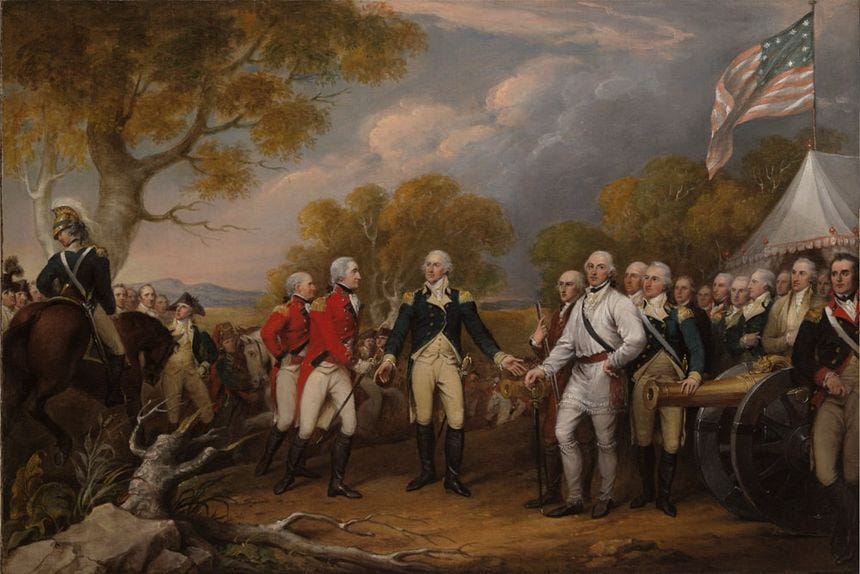
The victory at Saratoga changed everything.
It proved the Americans could fight a European army and win.
It convinced France to finally enter the war.
It was the moment the expected outcome of the war changed.
And standing there, watching the British lay down their arms, were the merchant from Portsmouth and the formerly enslaved man who had ridden to war with him.
What We Choose to Remember
The impulse that put Prince in that boat in 1851 is the same one that cast Mel Gibson as a non-slaveholder in 2000.
Gibson’s The Patriot is a Revolutionary War movie. He plays a South Carolina farmer who joins the fight against the British.
In the film, his character isn’t a slaveholder; instead, he employed free Blacks to work on his farm.
It was a deliberate choice by the filmmakers.
Spike Lee called it “a complete whitewashing of history.” and Gibson later admitted it felt like a cop-out.
We want the founding story to be clean.
We want everyone in the boat.
The truth is messier.
Enslaved people were part of the Revolution, but mostly on terms they didn’t choose. Almost none left written accounts of their own experience.
One of the earliest widely read narratives by a formerly enslaved person, Olaudah Equiano’s The Interesting Narrative, wasn’t published until 1789.
The one most Americans know, Frederick Douglass’s, came in 1845.
What we know about people like Prince Whipple comes from the records of the men who owned them.
Prince lived as a free man in Portsmouth after the war. He married, had children, and became a leader in the city’s small Black community. His descendants still live in New Hampshire today.
He probably wasn’t in that boat on the Delaware. But he was at Saratoga.
The Short Ending
Whipple’s health declined in the years after the war. He served as a state legislator and then as a judge, but heart disease was wearing him down.
On November 28, 1785, William Whipple died at his home in Portsmouth. He was fifty-five years old.
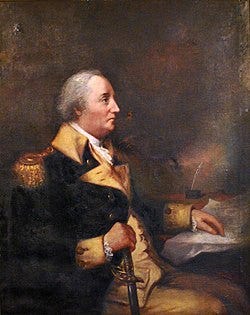
Whipple is one of the only signers who put down a pen, picked up a sword, and actually fought.
He negotiated a British surrender.
He freed a man during the war and served alongside him as his aide.
Many of the 56 signed the Declaration and went back to their lives.
Whipple signed it and went looking for a battle.
What Whipple Teaches Us
If you’ve ever left a comfortable career because something bigger called you.
If you’ve ever walked away from safety because staying felt worse than the risk.
Whipple’s story will feel familiar.
He had everything a man of his era could want.
Nobody in Portsmouth would have blamed him for sitting out the war and plenty of wealthy men did exactly that.
Whipple took a different path.
He put on a uniform, led men into the woods at Saratoga, and sat across the table from British officers to accept their surrender.
He was one of the first in a long line of Americans who dropped everything to fight when the moment demanded it.
After Pearl Harbor, men lined up at recruiting offices the next morning.
After September 11, they did it again.
Whipple and his generation were the original version of that impulse.
The merchant who becomes a soldier because the country needed soldiers more than it needed merchants.
Next: Charles Carroll
From New Hampshire’s merchant-general, we turn to Maryland’s most unlikely signer: Charles Carroll of Carrollton.
Carroll was the only Catholic to sign the Declaration of Independence.
In a time when anti-Catholic laws kept Catholics from voting or holding office in many colonies, Carroll put his name on a document that made him a target of the world’s greatest power.
He was also one of the richest men in America.
His fortune, built on tobacco and land, may have made him the wealthiest signer of all.
When he wrote “of Carrollton” after his name, he wasn’t being modest.
He was making sure nobody confused him with his father or grandfather, both also named Charles Carroll.
Most importantly, he outlived every other signer, the last man standing from the day America declared itself free.
On Sunday, we’ll tell his story.
This is Essay #8 of 56 in the “The 56” series, profiling every signer of the Declaration of Independence. New essays every Friday and Sunday, culminating on July 4, 2026, the 250th anniversary of American independence.
Subscribe to follow the journey.
Sources: