

There was a time when the American trucker was a hero. In the 1970s, they were the modern-day cowboys, rebels on the open road, their CB radios crackling with a language of defiance against "Smokey Bear" and the establishment. This was the era of "Smokey and the Bandit" and "Convoy," a time when the trucker was a romantic figure of freedom, the undisputed king of the highway.
There was a time when the American trucker was a hero. In the 1970s, they were modern-day cowboys. Their CB radios crackled with a language of defiance against "Smokey Bear" and the establishment.
Their resistance was coordinated over the airwaves. They spoke in a unique slang of "10-4s" and "Smokey" alerts. This captured the public imagination. They were the little guys fighting an unfair system. They were the last defenders of American individualism on the endless highways.
But these last defenders of freedom were soon on their way out. Their time in the sun wasn't over yet, though.
Hollywood seized upon this story with excitement. "Smokey and the Bandit" (1977) wasn't just a movie. It was a cultural event. It was the second-highest-grossing film of its year. It turned Burt Reynolds' charming outlaw into a national icon.
A year later, Sam Peckinpah's "Convoy" (1978) came out. It was based on the chart-topping song by C.W. McCall. This film cemented the trucker's status as a movie legend. These weren't just stories about transportation. They were modern Westerns. Big rigs replaced horses. Highways replaced dusty trails.This image reached its peak for me in one of my favorite films. "Big Trouble in Little China" showed the perfect trucker hero. Kurt Russell's Jack Burton was a wise-cracking, blue-collar warrior. He stumbled into a world of ancient magic but never lost his down-to-earth charm. He was tough, capable, and deeply human. He faced down demons with the same practical grit he'd use to fix a flat tire.
But looking back, I can't think of another major film since then where a trucker was the hero. Jack Burton was, in many ways, the last of his kind.That cultural shift wasn't an accident. The Motor Carrier Act of 1980 changed everything. It deregulated the industry. In doing so, it destroyed the economic foundation that supported the trucker's middle-class lifestyle.
Before this change, life was good for truckers. A Teamster like Larry Heine was profiled in a 2020 Business Insider article. He could work eight hours a day. He could see his family every night. He could own his home and send his kids to college. He could retire at 51 with a pension. After 1980, everything changed. A flood of new, non-union competition drove wages down by as much as 50%. The stable, desirable career became a grueling, low-paying job.
The romantic image of the trucker cowboy was replaced by a far grimmer reality. The hero of the highway became a ghost. He became a forgotten figure in the American consciousness.
It is from this cultural void that Silicon Valley's dream was born. Tech companies saw the world as a series of problems to be solved. To them, the American trucker wasn't a hero. They were a high labor cost. They were a complex variable in a math problem that could be solved with enough code and money.
The promise was appealing. A driverless revolution would create endless convoys of self-driving trucks. It would be a perfectly efficient, computer-controlled system of logistics. But this vision was built on a basic misunderstanding. They didn't understand the very human role they were trying to replace.
What Silicon Valley Never Understood
Before building a solution, you need to understand the problem. Silicon Valley saw it simply: get a truck from Point A to Point B.
They never asked the most important question: "What does a trucker actually do?"
The answer is far more complex than just steering. This complexity is where the entire premise of easy automation falls apart.
A trucker is five jobs in one.
Mobile logistics manager
Safety inspector
Mechanic
Diplomat
Problem-solver.
Their "non-driving" duties are massive.
Take cargo management. It's both art and science. An improperly balanced 80,000-pound load can be catastrophic. The driver is legally responsible for keeping it secure.
Then there's vehicle safety. Drivers are the final checkpoint. They must perform rigorous pre-trip inspections of brakes, tires, and steering systems. This requires deep, hands-on understanding of the machine.
Drivers are also the human face of the company. They handle customer interactions. They navigate complex paperwork. They solve problems on the fly at loading docks. These places are often chaotic and unpredictable.
An AI can't sweet-talk a warehouse foreman into loading a trailer an hour early. It can't diagnose a strange noise coming from the engine.
This complex reality was ignored. Not just by tech companies, but by popular culture too.
As truckers' economic status declined, so did their cultural image. The heroic figures of the 70s became caricatures on reality TV in the 2000s and 2010s. Shows like "Ice Road Truckers" and "Big Rig Bounty Hunters" found commercial success. But they often portrayed truckers as reckless cowboys or bumbling fools. Drama manufactured for entertainment.
"Ice Road Truckers" was heavily criticized by actual professionals. They called out its misleading portrayal of danger. One veteran of the same ice roads featured on the show noted, "I do not watch the show because it is infuriating to see the drivers intentionally ignore safety guidelines and otherwise act completely without reason while implying that this is commonplace."
"I do not watch the show because it is infuriating to see the drivers intentionally ignore safety guidelines and otherwise act completely without reason while implying that this is commonplace." - Ice Road Trucker
The show used dramatic sound effects for routine ice crossings. This created false peril while ignoring real dangers. Bad weather. Treacherous mountain roads.
Similarly, "Big Rig Bounty Hunters" was widely dismissed by the trucking community. Completely staged, they said. "Bad actors" in "fake situations."
This "bozo effect" was dangerous. It reduced a complex profession to manufactured drama and incompetence. This reinforced the idea that trucking was low-skill work.
The cultural caricature perfectly aligned with Silicon Valley's worldview. If truckers were just bozos, how hard could it be to replace them with an algorithm?
The Gold Rush Begins

And so began a modern race. A tech story of hares and a tortoise.
While traditional truckers kept working steadily on America's highways, two groups of eager hares appeared to challenge them. American hares, startups fueled by venture capital and Silicon Valley dreams. Chinese hares, backed by state power and national strategy. Both groups believed they could sprint past the slow, steady tortoise of human drivers.
Silicon Valley's charge into autonomous trucking started with three things. Technological optimism. Economic incentive. And well-funded belief that AI had finally reached a tipping point.
By the mid-2010s, the tech world was buzzing with deep learning. Google's self-driving car project (later Waymo) had been running since 2009. It could navigate complex city streets. The narrative was powerful, if misleading. If AI could handle city chaos (pedestrians, cyclists, four-way stops), surely it could master highway driving. Highways seemed monotonous and structured by comparison.
The economic argument was almost impossible to ignore. The U.S. trucking industry was worth $800 billion. Its biggest cost? Labor.
For an industry obsessed with optimization, 3.5 million American truckers weren't just people. They were a massive, inefficient, expensive variable.
An autonomous truck could operate 24/7. No sleep. No breaks. No salary. No Hours of Service regulations. The potential savings were astronomical. Some analysts predicted 30-40% cost reduction per mile.
This wasn't just a new product. It was the key to a multi-trillion-dollar global logistics market.
Venture capital was flowing like water in the 2010s. It was ready to fund this gold rush. Between 2014 and 2017 alone, investment in autonomous vehicles surpassed $80 billion globally.
High-profile demonstrations supercharged this optimism.
In October 2016, Otto staged a masterful publicity stunt. The startup was founded by ex-Google engineers, including Anthony Levandowski. An autonomous truck hauled 50,000 cans of Budweiser beer for 120 miles on a Colorado highway. A safety driver monitored from the sleeper cab.
The event was a sensation. Headlines worldwide. The driverless future seemed imminent. Two months later, Uber bought Otto for $680 million. The race was officially on.
From this frenzy, key players emerged. Each had a different path to the automated promised land.
TuSimple was the industry's "moonshot." Founded in 2015, it promised a camera-based system that could "see" 1,000 meters. This was farther than LiDAR or any human. The pitch: safer, faster, fully driverless trucks on long-haul routes.
TuSimple built its own fleet and freight network, chasing full autonomy ("Level 4") from day one. Investors bought in. By 2018, it was valued at over $1 billion. By 2020, TuSimple had raised $650 million and was running daily autonomous trips for clients like UPS in Arizona.
Hot on their heels was Embark Trucks, founded in 2016 by two young entrepreneurs, Alex Rodrigues and Brandon Moak.
Embark pursued an "asset-light" model. They aimed to be the "Windows" of autonomous trucking. Instead of building their own trucks, they developed the Embark Universal Interface. This was a standardized set of components. It could theoretically be installed on trucks from any major manufacturer. Peterbilt, Freightliner, or Volvo.
This was incredibly attractive to investors. It suggested a more scalable, less capital-intensive path to market. In 2017, they made headlines. They completed what they claimed was the first coast-to-coast journey by an autonomous truck. A 2,400-mile trip from Los Angeles to Jacksonville, Florida.
Then there was the all-star team at Aurora Innovation. Founded in 2017 by Chris Urmson, Sterling Anderson, and Drew Bagnell. Urmson was the former head of Google's self-driving project. Anderson was the former director of Tesla's Autopilot. Bagnell was a co-founder of Uber's autonomous division. Aurora had the most impressive pedigree in the industry.
Their goal was the most ambitious. They wanted to create "The Driver." A single, generalized AI platform that could be the brain for any vehicle. From a Class 8 truck to a local delivery bot or a passenger taxi. Their vision and the founders' reputations attracted massive funding. They partnered with giants like Amazon and FedEx.
A fourth, more pragmatic approach was pioneered by Starsky Robotics. Co-founder Stefan Seltz-Axmacher believed that full, Level 4 autonomy was still decades away.
His solution was a hybrid model. It combined autonomy with "tele-operation." A Starsky truck would drive itself on long, simple highway stretches. But when it came to the complex "first and last mile," things changed. Navigating a truck stop. Backing into a crowded loading dock. For these tasks, a human operator would take control. The operator sat in a remote office, potentially hundreds of miles away. They drove the truck via a command center that looked like a sophisticated video game setup.
In 2019, Starsky successfully conducted the first-ever fully unmanned end-to-end trip on a public highway in Florida, a major milestone that seemed to validate their more cautious approach.
Meanwhile, the second group of hares was preparing its own sprint. Across the Pacific, an entirely different experiment was unfolding. Where Silicon Valley saw a startup opportunity, Beijing saw a matter of national industrial strategy.
As part of the "Made in China 2025" initiative, the Chinese government identified autonomous logistics as a critical technology for securing its future as a global trade superpower.
The cultural context was key: China has no romantic mythology of the trucker as a cowboy. It is a functional, unglamorous, but vital role in the country's economic machine. This perspective made a top-down, state-coordinated approach a natural fit.
The Chinese philosophy was fundamentally different. Instead of trying to build a truck smart enough to handle a chaotic world, China focused on building a world that was easy for a truck to handle.
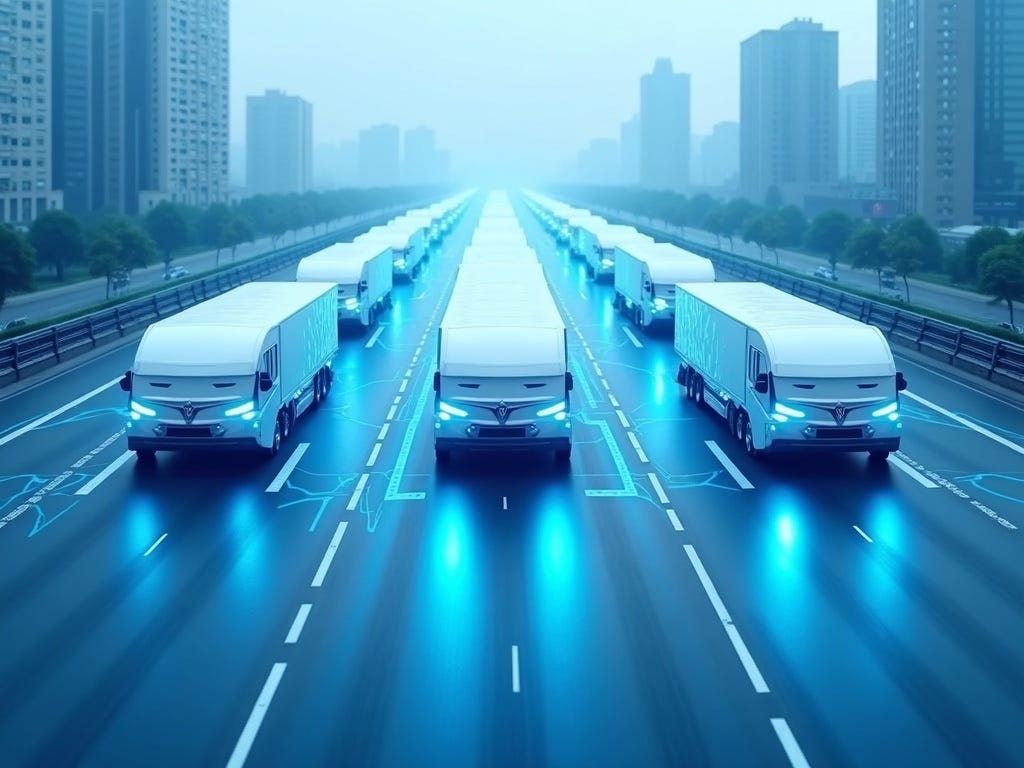
The government poured billions into creating "smart" infrastructure, retrofitting entire highway corridors with high-speed 5G networks and Vehicle-to-Everything (V2X) communication systems. This technology allows vehicles to communicate directly with each other (V2V), with the infrastructure itself (V2I), and with a central network (V2N).
A truck could be warned of an accident five miles ahead by the road itself, or a traffic light could signal its intention to change, dramatically reducing the computational burden on the vehicle's onboard AI.
It was a "greenhouse" strategy: start in a controlled, perfect environment and gradually expand outward. This allowed for commercial deployment at a scale that dwarfed American efforts. Companies like Pony.ai, Plus.ai (now Zhijia Technology), and Inceptio Technology began operating fleets of autonomous trucks on fixed, point-to-point expressway routes between major logistics hubs and ports. These weren't just demonstrations. They were revenue-generating commercial operations.
At the massive Yangshan Deep-Water Port in Shanghai, the world's largest automated container terminal, a fleet of autonomous trucks began moving thousands of containers 24/7, operating in a completely controlled, human-free environment.
By early 2020, both groups of hares appeared ready to sprint past the tortoise. The American approach and the Chinese approach both looked promising. Industry publications were breathlessly optimistic.
A 2019 Deloitte report predicted mass commercialization of autonomous trucks in controlled environments by 2025, scaling to widespread deployment by 2030. McKinsey projected a staggering $405 billion market for autonomous trucking by 2035.
The COVID-19 pandemic, which crippled global supply chains, only seemed to accelerate the race. It highlighted the supposed fragility of relying on human drivers.
As American startups began going public via SPAC mergers at multi-billion-dollar valuations and Chinese companies expanded their operational domains, the hares looked unbeatable. The tortoise of traditional trucking seemed doomed to be replaced.
The stage was set for a revolution.
Hitting the Wall
By 2021, autonomous trucking was riding a wave of hype.
Investors were ecstatic. Embark Trucks went public via SPAC. It briefly hit $5 billion with its "asset-light" approach. Aurora raised money at $7.25 billion. Star founders. Big partners like Amazon and FedEx.
The message was clear: highway self-driving was solved. The "easy" part: long, straight roads. The revolution was here.
But cracks were forming under the surface. The first warning sign came over a year earlier. Few noticed.
In March 2020, Starsky Robotics quietly shut down. The company was the pioneer of remote-controlled, hybrid autonomy. It couldn't raise more money. Co-founder Stefan Seltz-Axmacher wrote a brutally honest post-mortem. It should have been a wake-up call for the whole industry. Instead, most dismissed it as sour grapes.
“The space was too overwhelmed with the unmet promise of AI to focus on a practical solution,” Seltz-Axmacher wrote.
“It isn’t actual artificial intelligence akin to C-3PO. It’s a sophisticated pattern-matching tool.”
He argued that supervised machine learning wasn't true intelligence. It was the backbone of every self-driving system. AI could recognize patterns, like stop signs or lane markings, but it couldn’t reason or handle the unexpected.
This led to the industry’s biggest unsolved problem: the “one-percent situations,” or edge cases. Seltz-Axmacher put it bluntly:
“The biggest challenge is that supervised machine learning doesn’t live up to the hype... the jump from ‘sometimes working’ to statistically reliable was 10–1000x more work.”
A human driver faces weird situations. A mattress in the road. A cop waving traffic through a red light. A flock of geese. Humans draw on common sense and experience.
An AI seeing something new can only guess. These edge cases weren't rare bugs. They were the heart of the job. The industry was building advanced pattern-matchers. Calling them drivers.
The technical wall was higher than anyone wanted to admit. Automating 99% of highway driving was easy. The last 1% was a canyon.
How does AI handle a construction zone at night in the rain? Debris from a blown tire? A construction worker's hand signal? These aren't rare events. They're daily reality for truckers. Humans handle them without thinking. For AI, each is a potential disaster.
The "driver-out" demos were impressive but staged. Familiar routes. Clear weather. Often a "shadow" vehicle clearing the way. These were lab experiments, not real-world tests.
On top of technical hurdles, regulation was a mess. The U.S. had no unified federal rules for autonomous vehicles. Instead, a patchwork of state laws.
Arizona welcomed testing. Cross into California and rules changed. Maybe you needed a special license. Maybe "driver-out" testing was banned. The dream of coast-to-coast autonomous freight became a legal nightmare. How do you scale when your tech is legal in Texas but not New Mexico?
Economic winds were shifting too. The era of "free money" was ending. Ultra-low interest rates. Easy venture capital. All going away.
High-profile flops like WeWork made investors wary. Cash-burning startups with no clear profit path? Suspicious. Autonomous trucking companies burned hundreds of millions yearly on R&D. They fit that mold perfectly.
Investors wanted more than flashy demos. They wanted revenue. A real business.
Even China's approach hit trouble. The state-led, infrastructure-heavy model worked for isolated pockets of automation. Shanghai's Yangshan Port autonomous trucks were a real success.
But the "greenhouse" strategy had limits. V2X infrastructure was expensive. It couldn't be built everywhere. A truck that worked perfectly on a smart expressway became just a regular truck once it left the grid. It couldn't deliver to a new warehouse. Couldn't handle a detour through a non-"smart" town.
China had automated the route, not the truck. The Chinese hares were stuck in their carefully tended garden. Unable to venture into the wild.
By early 2022, the stage was set for a reckoning. The industry had promised a revolution just around the corner. In reality, it faced a technical wall.
When the Wheels Came Off
The collapse of that round of autonomous trucking dream started with one shocking moment on a sunny April afternoon in 2022.
A TuSimple truck was cruising at 65 miles per hour on Interstate 10 near Tucson.
Two human safety engineers sat inside.
This was supposed to be routine.
Just another test run on a familiar stretch of highway.
Then something went terribly wrong.
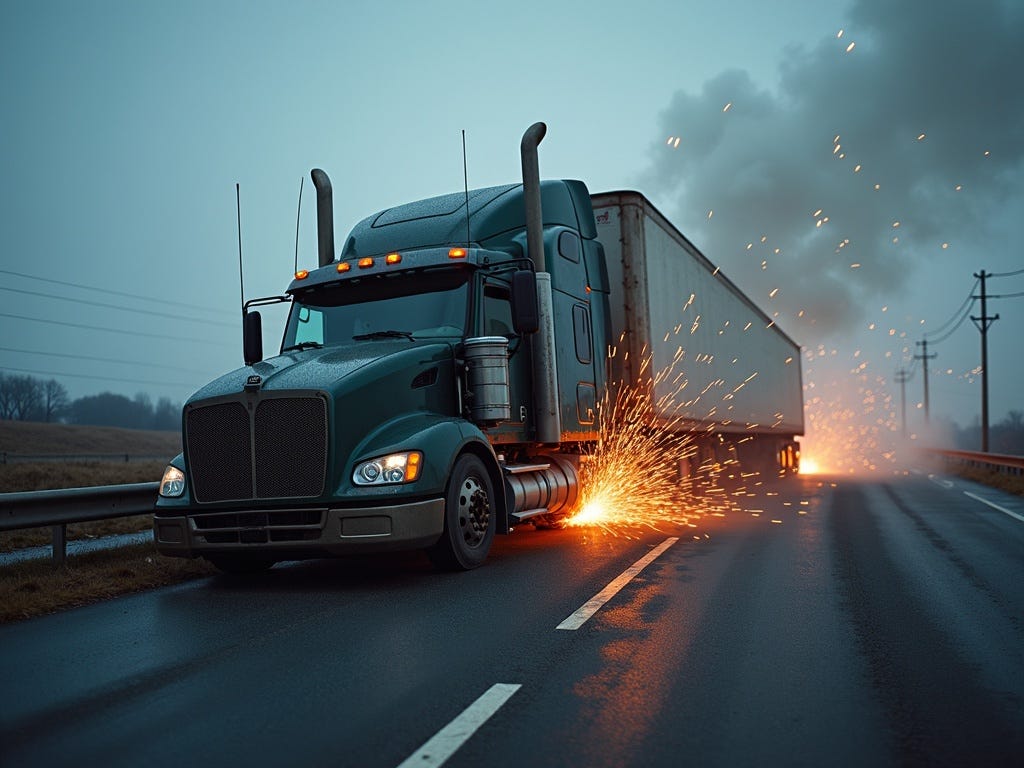
The truck jerked violently to the left. The autonomous system ripped the steering wheel from the safety driver's hands. The 80,000-pound semi veered across a lane of traffic. It barely missed a pickup truck before its front tire slammed into the concrete median.
Sparks flew.
Dust filled the air.
The truck scraped along the barrier. Only the human operator's quick reflexes prevented a multi-vehicle disaster.
The crash lasted mere seconds. But its impact would shake the entire industry to its core.
TuSimple first blamed "human error." Then a whistleblower leaked internal documents and video footage to federal regulators and the press. The real cause was far worse than anyone imagined. This was a glaring software flaw.
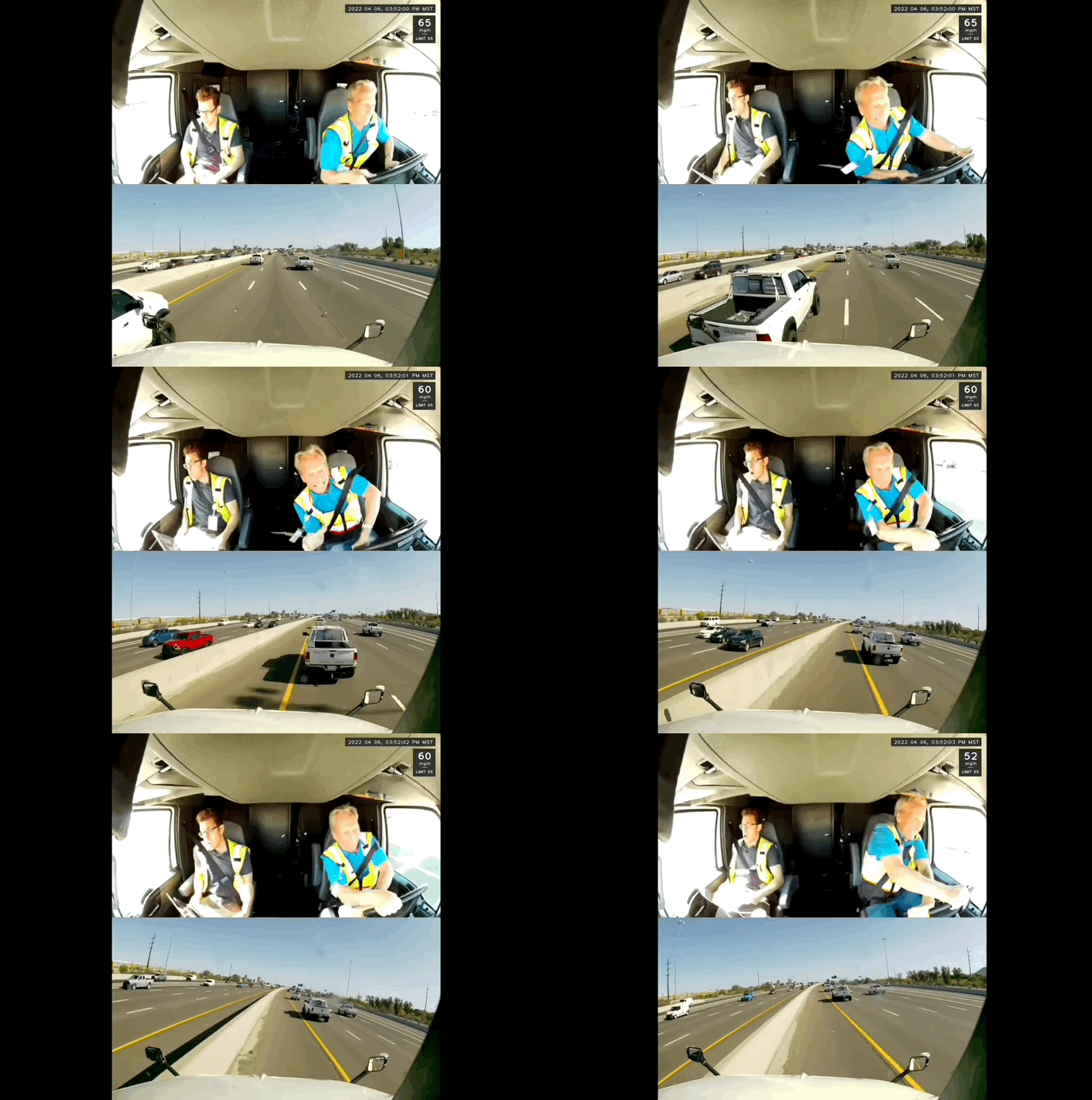
According to The Verge, the truck's AI tried to execute a "left turn" command. But this command was over two and a half minutes old. In autonomous driving terms, that's an eternity. An engineer had rebooted the system before the test run, but the software had failed to clear the old command from memory.
This wasn't some rare "edge case." It was a basic failure. The AI could supposedly handle trillions of calculations per second. Yet it didn't know that making a hard left at highway speed was deadly. Researchers discovered the system lacked even the simplest safeguards.
It couldn't block old commands.
It couldn't prevent sharp turns at high speeds.
This wasn't a freak accident. It was a self-inflicted wound.
If TuSimple couldn't prevent this disaster, who could? TuSimple was the best-funded company in the space. It had the most advanced technology. Yet here they were, scraping along concrete barriers on a public highway. Trust evaporated overnight.
The fallout was swift and brutal.
Federal regulators launched investigations. TuSimple's stock was already falling. Now it went into freefall. Investors filed lawsuits. They claimed they'd been misled about the technology's readiness. The river of venture capital that had fueled the industry dried up. Almost instantly. The era of easy money was over.
The "startup graveyard" began to fill with casualties.
Embark Trucks was next.
Its business model depended on convincing big truck makers to adopt its technology. But no one wanted to bet on a single, unproven system anymore. With investors fleeing, Embark couldn't keep burning cash. In March 2023, it laid off 70% of its staff. The company began winding down operations. By May, it sold its assets for just $71 million. The company that once promised coast-to-coast driverless runs was gone.
The crash investigation into TuSimple spiraled into a corporate meltdown. Founder and CTO Xiaodi Hou was fired by the board over allegations he’d shared company secrets with a Chinese hydrogen trucking startup. The board reversed itself, then Hou resigned anyway.
In early 2024, TuSimple delisted from Nasdaq and shut down its U.S. operations, laying off most of its American staff to focus on projects in Asia. The American hares hadn't just stumbled. They had crashed, burned, and been sold for scrap.
The financial wreckage was staggering. Between their 2021 peaks and the end of 2022, TuSimple, Embark, and other public autonomous trucking companies lost over $40 billion in combined market value.
So who won this race?
In this modern fable, there were two groups of hares racing toward the autonomous future. The American hares were fueled by venture capital and a "move fast and break things" mindset. They ran straight into a wall.
The Chinese hares took a different approach. State-led and infrastructure-heavy. But they also stumbled. Their trucks worked only in tightly controlled "greenhouse" environments. Building and maintaining V2X infrastructure was enormously expensive. This limited expansion to just a few key routes. The Chinese hares were stuck in their carefully tended garden.
Meanwhile, the tortoise just kept trucking along. Literally. The traditional human driver never stopped working. Never stopped adapting. While both groups of hares stumbled in their race toward automation, the tortoise simply kept doing the job.
Steady. Reliable. Human.
The great collapse of 2022-2023 revealed a humbling truth. The industry had misunderstood the problem from the start. Replacing a human driver was never going to be easy. Humans are flexible, adaptable thinkers, while the AI systems were brittle pattern-matching machines. The "edge cases" that stumped the AI weren't rare occurrences.
They were the actual job.
As the dust settled, a new story began to take shape, one that would bring truckers back into the culture.
The Trucking Renaissance
While both groups of hares stumbled and fell, the tortoise had never stopped moving. As the noise around self-driving trucks faded, something unexpected happened. The COVID-19 pandemic was supposed to push automation over the edge. Instead, it made everyone notice the people behind the wheel. Suddenly, truckers went from invisible to essential.
At the same time, the old "bozo" reality shows lost their grip. They looked mean-spirited and out of touch. Most got canceled or just faded away. In their place, a new kind of trucking culture grew online. Video games like Euro Truck Simulator 2 and American Truck Simulator exploded in popularity. These games didn't treat trucking as a joke or a grind. They turned it into something peaceful. Even meditative. Millions of players found community and calm on the virtual open road.
This digital revival didn't stop with games. On Twitch, streamers like Trucker Dylan built big audiences. They shared the real, unfiltered day-to-day of life on the road. Viewers tuned in for honest talk about the job. The challenges. The freedom of the highway.
This is the new face of trucking culture.
Authentic, community-driven, and deeply human.
So where does automation fit in now? The dream of fully driverless trucks has changed. Now we have a more realistic "hub-and-spoke" model. In this system, autonomous trucks handle the long, boring highway stretches. That's the "middle mile." Human drivers take over for the tricky "first and last mile."
Automation isn't a job killer. It's becoming a lifeline for an industry with a massive labor shortage. The U.S. is short more than 80,000 drivers today. That gap could double by 2030.
The American trucker has survived thus far by proving how essential and adaptable they are.
Technology may help truck drivers, but it hasn't replaced them. For now, and for the years ahead, the knights of the road are still in the driver's seat.
Thank you for reading.
Below you will find some of the articles mentioned in the esssay along with “Where are they now” updates from the major trucking startups.
Resources
Seltz-Axmacher, Stefan. "The End of Starsky Robotics." Medium, March 19, 2020.
Korosec, Kirsten. "Embark sells autonomous trucking assets to Knight-Swift for $71M." TechCrunch, May 25, 2023.
"Self-Driving Truck Company TuSimple Faces Federal Probes After Crash." The Verge, August 4, 2022.
“How a little-known 1980 law slashed pay for millions of truck drivers and created big-box retail as we know it” Business Insider. July 25, 2020
Wikipedia. "Motor Carrier Act of 1980."
Steam. "American Truck Simulator."
Steam. "Euro Truck Simulator 2."
Where are they now?
TuSimple
TuSimple was once at the center of autonomous trucking optimism, known for its camera-based approach and high-profile industry partnerships. However, it faced increasing scrutiny over technology transfer, commercial challenges, and regulatory investigations. By late 2023, TuSimple wound down its U.S. operations and pivoted entirely to China. In 2024, the company rebranded as CreateAI, moving away from trucking to focus on AI gaming technology. After massive layoffs, ongoing legal trouble, and delisting from NASDAQ, TuSimple is now searching for a buyer and no longer pursues autonomy on American roads.
Embark Trucks
Embark’s modular “plug-and-play” software attracted major industry interest by offering an asset-light path to truck automation. However, the commercial ramp proved difficult. Throughout 2022 and 2023, Embark struggled to both raise capital and prove the scalability of its model. In early 2023, the company was acquired by Applied Intuition, a vehicle simulation and autonomy tooling startup. The Embark brand and team largely faded from public view after this acquisition and Embark’s approach is now part of a broader portfolio in simulation and test services rather than operating trucks on highways.
Aurora Innovation
Aurora Innovation remains one of the most recognizable players in the advanced driverless space. Backed by partnerships with Amazon, FedEx, and other automotive giants, Aurora continued testing and building its “Driver” platform for Class 8 trucks and other vehicle types. In 2025, Aurora still operates pilot driverless freight routes in Texas and works on limited, but growing, commercial deployments. The company has pivoted to focus on fewer, deeply-integrated partnerships and measures progress toward profitability, as detailed regulations and technical hurdles (especially for safety) remain.
Starsky Robotics
Starsky Robotics’ hybrid, tele-operation solution stood out, but the company couldn’t survive the capital-intensive arms race or the long regulatory timeline. In 2020, Starsky shut down after failing to secure new financing and amid ongoing doubts about the near-term commercial viability of remote-controlled trucking. Its legacy lives on in industry debates about hybrid models, but Starsky itself no longer operates.
Pony.ai
Pony.ai has established itself as a major force in both robotaxi and robotruck services in China. The company adopted a "hub-to-hub" strategy, focusing first on L2+ systems to get trucks on the road quickly while advancing development toward full Level 4 autonomy. As of April 2025, Pony.ai operated 190 robotrucks, logging over 35 million miles in cumulative autonomous driving, both in test and commercial environments. The company partners closely with leading logistics firms like Sinotrans and has already rolled out revenue-generating services, especially in highly trafficked corridors between major cities such as Beijing and Tianjin. Pony.ai became the first firm in China approved for driverless truck platooning, letting one driver lead a convoy of autonomous trucks—marking a significant step toward commercial scale.
Plus.ai (now Zhijia Technology)
Plus.ai, recently rebranded as Zhijia Technology in China, is a global player known for its AI-driven “SuperDrive” platform. The company focuses on building factory-installed autonomy into new trucks, partnering with major manufacturers like TRATON, Hyundai, and IVECO. Plus emphasizes advanced AI models and strong global alliances, pushing the boundaries on robust, generalizable software for Level 4 trucks. While the company remains a few years away from true driverless commercial launches, it has run successful pilots in China and Europe, and continues to forge OEM and fleet partnerships with companies like Amazon and DSV. Its hybrid L2+ and L4 technology is already in daily use on major Chinese freight corridors, combining real-world testing with international deployments.
Inceptio Technology
Inceptio Technology stands out as the “scale leader” in China, with its trucks surpassing 200 million commercial kilometers—over 35 times more than its nearest competitor. Working with top logistics companies and OEMs, Inceptio deploys thousands of trucks equipped with proprietary full-stack autonomous systems on daily commercial routes across China. Their solution covers L2+, L3, and L4 technology, offering significant improvements in safety, fuel efficiency, and labor costs. Independent studies confirm its superior performance over human drivers, including reduced accident rates, lower emissions, and increased driver comfort. Inceptio’s technology is continuously refined with real-world data, and its growing presence in both domestic and global industry groups signals sustained advancement and influence in the autonomous freight sector.