

There is a “ghost economy” haunting Thailand.
You can’t see it in the bright markets or at the ancient temples. It’s an invisible empire of online scams, run from the shadows, that is draining the country’s energy and money.
These are not small-time operations.
They are massive, international fraud networks that steal billions of dollars. And while their main call centers and server farms might be hidden in neighboring countries, their pipelines run straight through Thailand.
Money is laundered through Thai banks.
Thai citizens are used to help recruit new workers or to move the stolen cash.
The Thai government can only run publicity campaigns talking about the problem, but is unable to do much to slow its impact.
All of this has a negative effect on Thailand’s main source of tourists…China.
So, from time to time, the police will conduct high-profile raids. They will storm a condo complex on an island, arrest a few foreigners who have overstayed their visas, and seize a room full of computers.
These dramatic arrests are filmed and put on the nightly news.
It looks like a real crackdown.
It gives the impression that the authorities are fighting the problem. But almost everyone watching closely knows that this is mostly for show.
These raids are like pruning the leaves of a dead tree. The real problem is at the root. The people getting arrested are the low-level, easily replaced workers. They are not the ones in charge.
The real bosses, the ones with power, money, and political connections, are almost never touched.
Why?
Because truly fixing the problem would mean going after those powerful people. It would mean investigating banks that look the other way, or powerful political figures who protect these operations.
It would be difficult, messy, and dangerous to the people in charge.
So, they don’t do it.
They persecute the small, visible players and protect the powerful, invisible ones. And so, the ghost economy keeps humming, draining the country’s energy and, just as importantly, its reputation.
This hidden rot is weakening the country from the inside. But the scary part is that it’s not even the only crisis. It’s just one of several. At the same time that this shadow world is growing, the visible economy, the one Thailand is famous for, is in serious trouble.
In the third quarter of 2025, Thailand’s economy actually shrank.
This contraction was a shock because the government had spent the first half of the year celebrating what looked like growth. But that growth was just an illusion, created by temporary cash handouts and companies rushing to export goods before new tariffs hit.
The only bright part of economy is the housing market for the super-rich, luxury segment. As rich Burmese and Middle Easterners look for a relatively safe area to park extra cash.
For everyone else, the market is collapsing.
More than half of all unsold homes are low-cost units for regular people.
This is creating a generation of renters, as young people with debt and stagnant wages are completely locked out of ownership.
In response the government has announced a massive, desperate emergency program called “Clear Debt, Move Forward.”
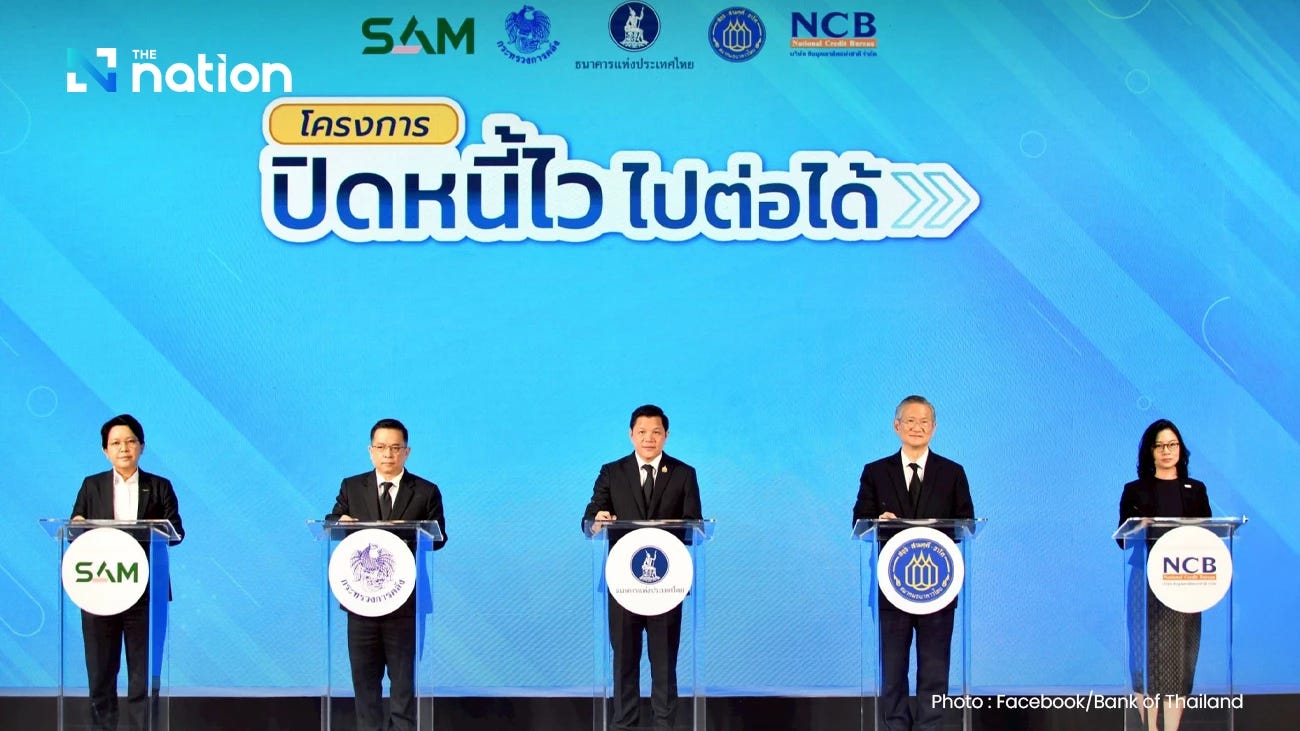
The plan is essentially a giant bailout.
The government is going to use billions of dollars to buy up all the bad, toxic debt from the 3.4 million people who are in the most trouble.
They are targeting the smallest, most vulnerable debtors and just... clearing their debt.
They are waiving all the interest, waiving all the fees, and even reducing the main principal.
It’s a huge, risky experiment.
On the one hand, it could be a miracle for those 3.4 million people. It could literally “melt down” the chains of debt that have trapped them.
But on the other hand, what message does this send?
Does it teach everyone else that you don’t actually have to pay your bills, that if you just wait long enough, the government will bail you out?
It’s a massive gamble, and it’s a clear sign of how desperate the situation has become.
The Frozen Government
At this point, you might be asking a very logical question: Why doesn’t the government fix these huge problems?
Why don’t they fix the ghost economy, or the debt, or the stalled engine?
The simple, terrible answer is that the government itself is the most broken part of all. The economic rot is deep, but it’s the political paralysis that makes it fatal.
You can’t fix a “ghost economy” or a “debt bomb” if you don’t even have a stable leader.
In the span of just one year, Thailand has changed prime ministers twice.
First, in August 2024, Prime Minister Srettha Thavisin was sacked. Then, just one year later, in August 2025, his successor, Paetongtarn Shinawatra lost her job primarily due to a phone call with the ex-PM of Cambodia.
This constant political chaos is the real root of the problem. It means no one is really in charge. The government is “frozen.”
It is too busy with short-term fights for survival to make the hard, long-term decisions needed to fix the country. How can a prime minister focus on a ten-year economic plan when they’re worried about being fired by a court next week?
International rating agencies like Moody’s and Fitch have seen this chaos and have all downgraded the country’s outlook to “Negative,” sending a clear signal to the world that Thailand is a risky and unstable place to invest.
This chaos led to a bizarre and fascinating political moment in late 2025.
After the second prime minister was fired, there was no clear leader.
The “new” version of the reformist party, whose earlier iteration was banned, called the People’s Party, now held the deciding votes.
They were the “kingmakers.”
And they did something that stunned the entire nation. They made a deal to help install their worst enemy, a royalist, conservative, pro-military politician named Anutin Charnvirakul, as the new prime minister.
Why would they do this?
It was a high-stakes “political gambit,” a risky chess move born from desperation.
They didn’t do it for free.
They gave their support in exchange for three binding conditions: a weak “minority” government, a national vote on drafting a brand-new constitution, and a promise to dissolve the entire government in early 2026, triggering a new election.
But this “clever” deal has solved nothing.
It has just created a weak, “transitional” government that is paralyzed from day one.
This new prime minister is already trapped.
He is facing a “no-win” dilemma with the United States over a trade deal.
To appease his nationalist supporters, he has to act tough on Cambodia, but doing so risks the trade deal and the entire export economy.
He is a prime minister in name only, with no power to fix the real crises.
The promise of a new election in early 2026 isn’t a silver lining. It’s just another dark cloud.
It guarantees that the next year will be spent on political campaigning, fighting, and uncertainty, not on fixing the debt bomb or the ghost economy. Thailand is being thrown into another cycle of chaos, and it seems all but certain that things are going to get worse.
This is the central, maddening contradiction of modern Thailand. It is a country full of potential, trapped in a broken system.
The “rot” in the economy is real, but it is the “frozen” political system that prevents any hope of a cure.
More than anything, Thailand feels like it is waiting.
The people are waiting for the government to do something real.
They are waiting for the courage to clean up the shadow economy at its roots, not just trim the branches.
The plans for the future are ready.
The technology is ready.
The only thing missing is the stability and the will to move forward together.
All of this makes the waiting, the hardest part.