

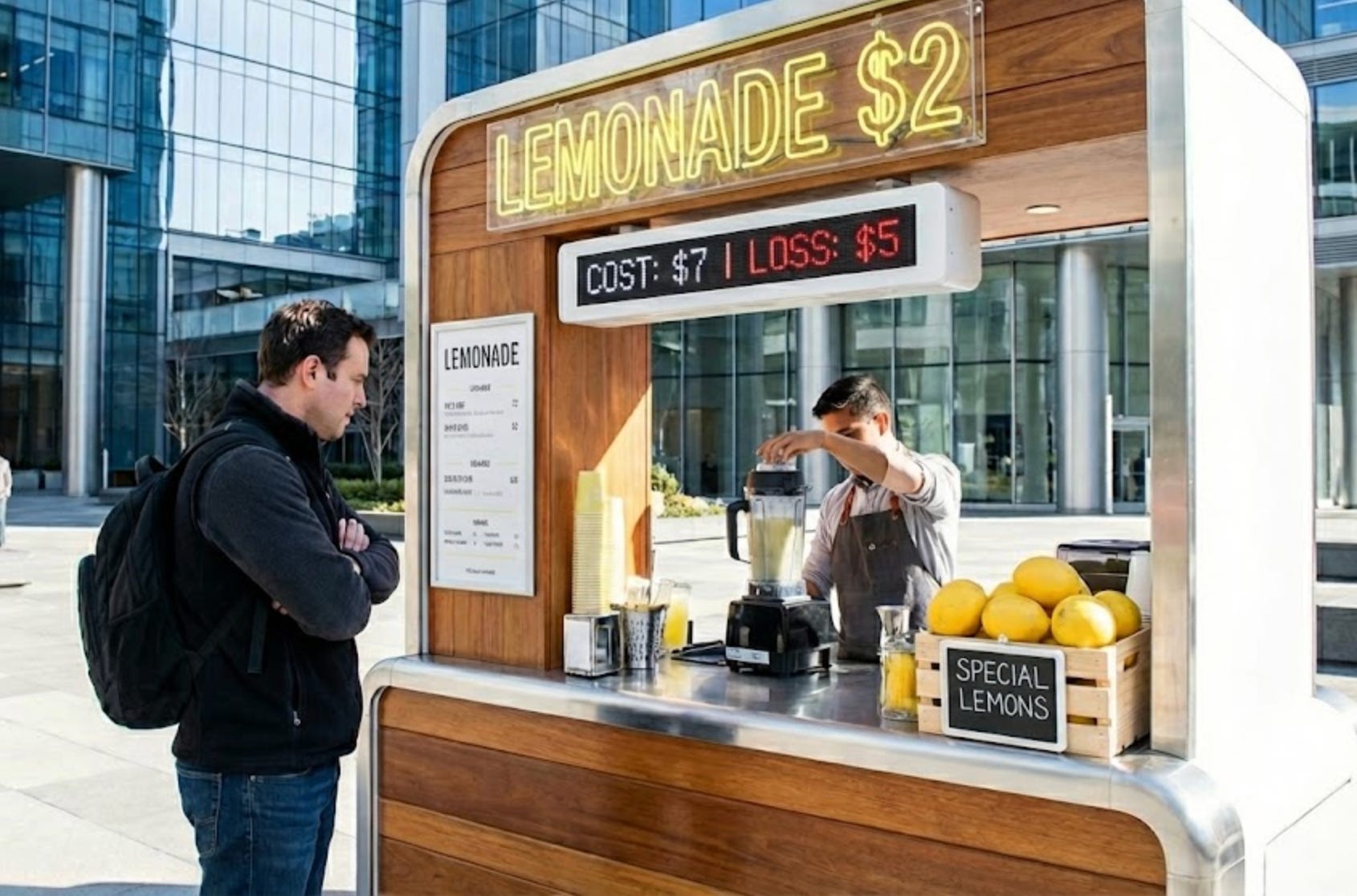
Imagine a lemonade stand. It’s a nice stand. Shiny wood, fresh paint, maybe a little neon sign buzzing in the window.
Now, let’s look at the math of this lemonade stand.
To make a single cup of lemonade, the owner has to buy special lemons that cost $5 each. Then they need to pay for the sugar, the cups, and the electricity to run the blender. All in, it costs the owner about $7 to make one cup.
But here is the catch: They are selling that cup of lemonade for $2.
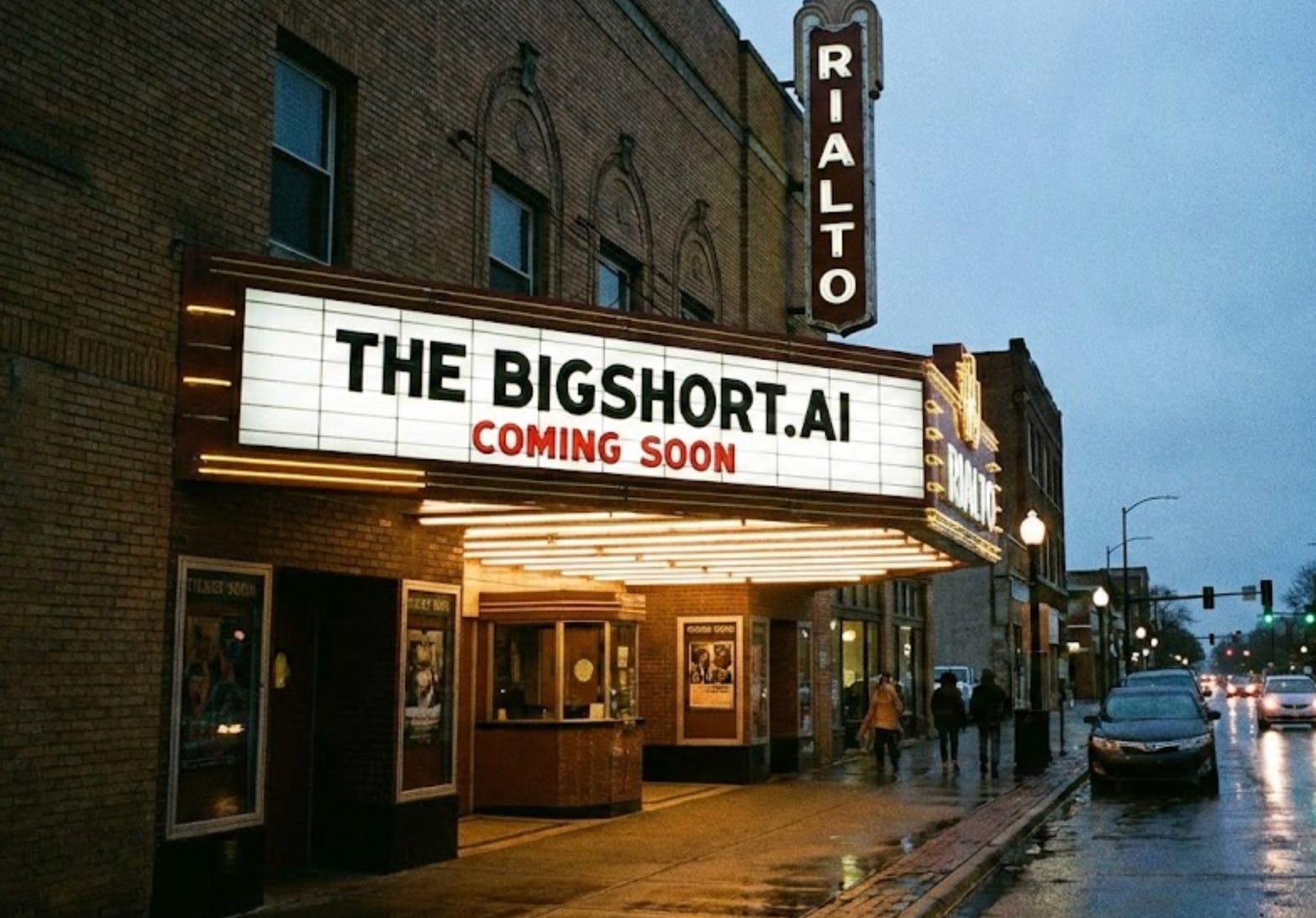
In the real world, this business goes bankrupt by lunchtime.
The owner goes home, cries a little, and finds a new job.
But this isn’t the real world.
This is Silicon Valley in the year 2025.
In this world, a guy in a fleece vest walks up to the lemonade stand. He sees them losing $5 on every cup.
And what does he do?
He doesn’t shut them down. He hands them a check for ten million dollars.
“Keep going,” he says. “Eventually, everyone on Earth will drink this lemonade. Once you have a billion customers, then we’ll worry about the price of lemons.”
So, the owner builds a factory.
He buys a thousand blenders.
He hires a team of engineers to optimize the squeezing process. He loses money faster and faster, but his “valuation”, the imaginary price tag on his business, keeps going up.
Now, zoom out.
Replace the lemons with computer chips.
Replace the sugar with enough electricity to power a small country. And replace the lemonade stand with the Artificial Intelligence industry.
This is the situation right now.
We are watching the biggest construction project in human history, built on a foundation of losing money.
Everyone is partying.
Everyone is getting rich.
The music is blasting.
But in the corner of the room, there is a guy wearing headphones, listening to heavy metal, reading the receipts that everyone else threw in the trash.
His name is Michael Burry.

He’s the guy who predicted the 2008 housing crash when everyone else said real estate was invincible. And he just looked up from his spreadsheet with a terrified look in his eye.
He thinks the lemonade stand is about to explode.
The Doctor of Doom
You might remember Michael Burry from The Big Short. In the movie, he was the guy with the glass eye and the bad haircut who realized that the American housing market was a tower of cards built on bad loans.
He bet against it.
He waited.
Everyone laughed at him. His own investors tried to sue him. And then, the world collapsed, and he made a fortune.
Burry isn’t a normal investor. Most people buy stocks because they like the company. They like the CEO’s smile; they like the commercials.
Burry buys (or sells) stocks because he reads the boring footnotes on page 104 of the financial report. He looks for “glitches in the matrix”, things that simply cannot be true, even though everyone believes them.
Fast forward to late 2025. Burry has been quiet for a while. But then, quietly, his investment firm, Scion Asset Management, files a report showing his latest investments.
The report shows that Burry has taken a massive bet against the heroes of the AI revolution. He bought put options against Nvidia and Palantir.
Nvidia is the company that makes the “brains” (the chips) for AI. Palantir is the company that sells the software. These are the two most popular kids in school. Betting against them is like betting against Santa Claus on Christmas Eve.
So, why is he doing it?
Is he crazy?
Or does he see the lemons costing $7 again?
To understand his bet, we have to look at the three specific “glitches” he has found in the AI machine.
The $600 Billion Question
The first problem is simple math. It’s what Burry calls “Supply-Side Gluttony.”
Let’s go back to the internet boom of the late 90s. Companies went crazy building fiber-optic cables. They laid cables under the ocean, under cities, everywhere. They spent billions thinking, “The internet is coming! We need the roads!”
They were right. The internet did come. But they built way too many roads way too fast. By 2002, 95% of those cables were sitting dark and unused. The companies that built them went bankrupt.
Burry sees the exact same thing happening with AI chips.
Right now, big tech companies (Google, Microsoft, Amazon) are acting like hoarders during a panic. They are buying every Nvidia chip they can find. They are spending roughly $600 billion a year building data centers.
Here is the $600 billion question: Where is the rent money?
If you build a $600 billion hotel, you need guests to pay for rooms. In the AI world, the “guests” are companies paying to use that AI software.
The problem is, right now, the guests are only paying about $50 billion to $100 billion a year.
Do the subtraction. $600 billion going out. $100 billion coming in. That leaves a $500 billion hole.
The optimists say, “Don’t worry! The revenue is coming!
Soon, AI will write all our emails, drive our cars, and cook our dinner!”
Maybe.
But Burry looks at the clock.
These chips are expensive.
They get hot.
They break.
And most importantly, they get old. If that $600 billion in revenue doesn’t show up fast, these companies are going to be left holding the most expensive bag of obsolete computer parts in history.
It’s like building a factory to manufacture Ferraris, but the only people buying cars right now just want a used Honda Civic. You can’t pay for the factory by selling Civics.
The Magic Trick (Depreciation)
This is the part where your eyes might glaze over, but it’s actually the smoking gun. It’s the “dirty little secret” of the accounting world.
It’s called Depreciation.
Let’s say you buy a brand new laptop for $1,000. You know that in about 3 years, that laptop is going to be slow, the battery will die, and you’ll need a new one.
So, logically, that laptop costs you about $333 a year.
Year 1 cost: $333
Year 2 cost: $333
Year 3 cost: $333
Now, lets say you want to look richer than you actually are. You decide to pretend that your laptop will last for 6 years.
Suddenly, your math changes. Now, it only “costs” you $166 a year on paper.
Year 1 cost: $166.
Boom!
You just “saved” nearly $200! Or did you…
You didn’t actually save any money, the laptop is still going to die in 3 years. But on your budget spreadsheet, you look like a genius. You look profitable.
Burry noticed that the big tech companies have quietly changed their math. They used to say their servers lasted 3 or 4 years. Now, they are saying they last 6 years.
By making this tiny tweak on a spreadsheet, they have magically created ~$200 billion in “fake profits” over the next few years.
Burry calls this the “Depreciation Gimmick.” He thinks it’s a lie.
AI chips run hot. They run 24 hours a day at maximum power. They burn out faster than normal computers, not slower. Burry believes that in a year or two, these companies are going to wake up, realize their chips are fried, and have to admit they lost billions of dollars.
When they admit that, their stock prices will crash. And Burry will be waiting to cash his check.
The Infinite Money Loop
If the math is so bad, why is everyone so rich?
Why is the stock market going up every day?
This brings us to the most dangerous part of the story. The Circular Economy.
In a normal economy, money moves in a line.
You make a product.
A customer buys it with their own money.
You make a profit.
In the AI bubble, money moves in a circle.
Here is how it works:
Big Cloud Company (let’s call them “CloudCorp”) has billions of dollars.
CloudCorp gives $100 million to a hot new AI Startup.
AI Startup takes that $100 million and immediately pays it back to CloudCorp to rent their servers.
CloudCorp records that $100 million as “Revenue.”
CloudCorp’s stock goes up because their revenue is growing.
CloudCorp uses its higher stock price to raise more money to give to another startup.
Do you see what happened?
No new money entered the system.
They just took money from their left pocket, handed it to a stranger, and had the stranger put it back in their right pocket.
This looks like growth. It looks like demand. But it’s an illusion.
Startups are spending $5 to make $1, but it’s okay because investors keep giving them more $5 bills. They are “burning cash” to create the illusion of a revolution.
But eventually, the investors run out of $5 bills.
The Cisco Kid
To really understand how this ends, we have to look at the ghost of Christmas Past.
The year was 2000. The Dot-com bubble. The internet was taking over the world (and it did!). The star of the show was a company called Cisco.
Cisco made the routers and switches that ran the internet. They were the “plumbers” of the digital age. Everyone said, “It doesn’t matter which website wins, they all need Cisco equipment! Cisco is a safe bet!”
Cisco was a real company. They made real products. They made real money.
But their stock price got so high that it stopped making sense. People were pricing Cisco as if it would own the entire global economy.
Then, reality hit. The bubble burst.
Cisco didn’t go bankrupt. They are still a huge company today. But if you bought Cisco stock at the peak in 2000, it took you nearly 20 years just to break even. You lost almost everything, even though the company survived.
Burry looks at Nvidia and sees Cisco.
Nvidia is a great company. Their chips are amazing. But the price of their stock assumes that they will keep growing at 50% or 100% every year forever.
Burry is betting that “forever” ends soon.
He believes that once the “Circular Economy” stops spinning, and once the “Depreciation Gimmick” is exposed, companies will stop buying so many chips. Nvidia’s sales will drop, maybe not to zero, but enough to panic the market.
And when the market panics, it doesn’t gently lower the price. It throws the price out the window.
The Gravity Check
So, here we are. We have a lemonade stand losing money on every cup. We have accountants pretending lemons last forever. We have companies paying each other with the same twenty-dollar bill.
We have Chip CEOs saying essentially “Trust the process”
With no clear indicator how the gap between revenues and costs ever gets closed.
Michael Burry has pushed his chips to the center of the table. He has closed his fund to outsiders, locked the doors, and put on his headphones. He is betting on gravity.
Gravity is the one law of economics that never changes. You cannot spend more than you earn forever. You cannot value a company at trillions of dollars if it relies on “fake” profits. Eventually, what goes up must come down.
Now, Burry is used to being the “Cassandra.” In Greek mythology, Cassandra was a woman who was cursed to tell the future, but no one would ever believe her. She warned everyone that Troy would fall. They laughed. Then Troy fell.
Burry warned everyone about the housing market. They laughed. Then the market crashed.
Now he is warning us about the AI bubble.
Is he right?
Maybe this time really is different. Maybe the robots will save us, fix the economy, and justify all the spending.
Maybe the lemonade stand will magically start making a profit.
But look at it this way: If you are walking down the street and you see a man who has successfully predicted two earthquakes standing outside a building screaming, “GET OUT!”...
Do you really want to be the guy who walks inside to see if he’s bluffing?