

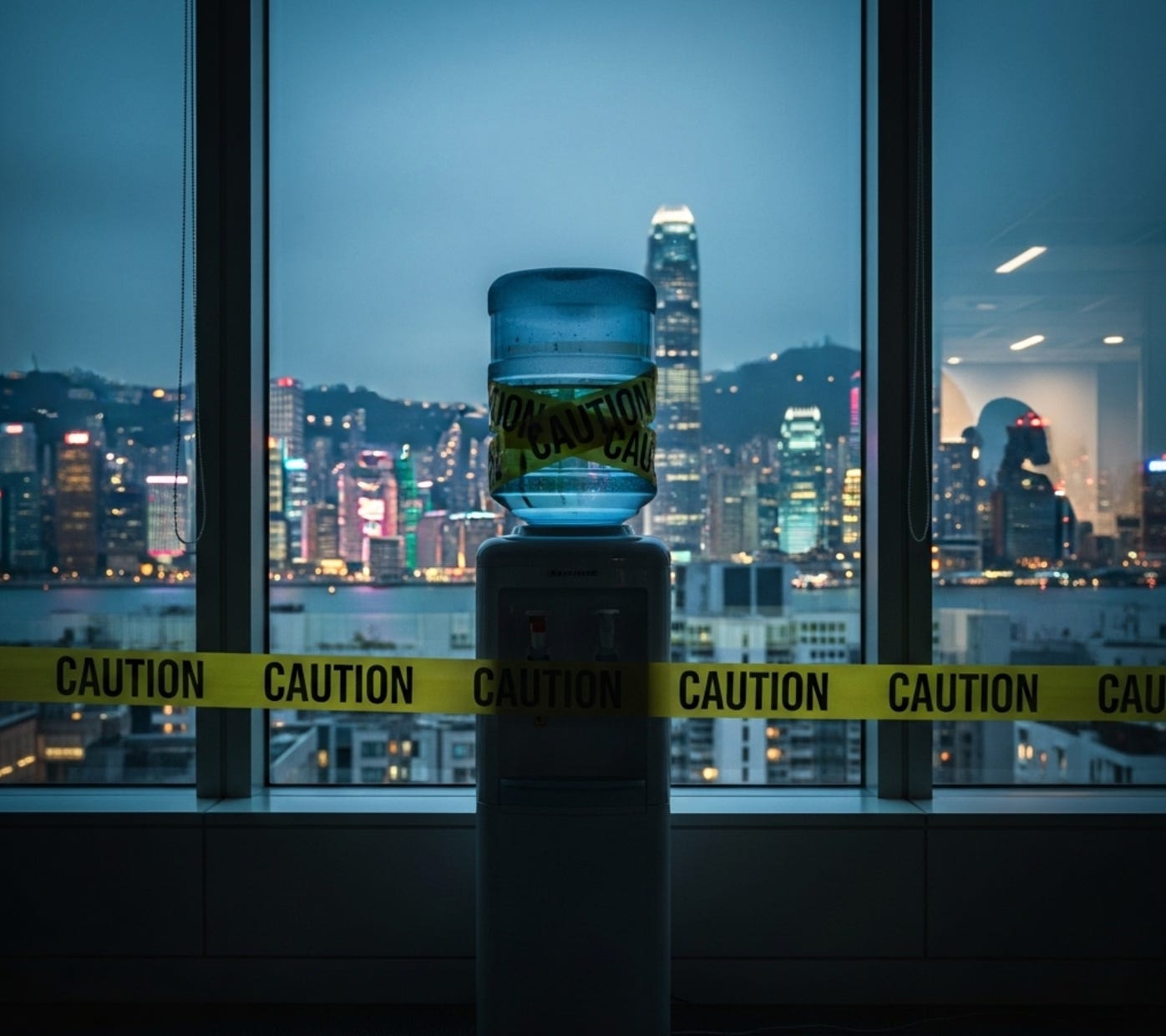
It’s the most boring, everyday item in any government office: the water cooler. It’s a place for idle chatter, a refuge from a stuffy cubicle, and a source of basic hydration. You assume the water is clean, the contract to get it there was handled properly, and the whole system just… works.
You don’t think about it.
But in Hong Kong, the humble water bottle has become the symbol of a massive government failure, sparking a scandal that’s about much more than just H₂O.
It’s a story of fraud, systemic rot, and the fragile nature of public trust.
The Anatomy of a Simple Scam
The story begins with a contract, as these things often do. The Hong Kong government needed bottled water for its thousands of civil servants for the next three years. A company called Xin Ding Xin Trade (XDX) put in a bid and won the deal, worth about $7 to $9 million US dollars. On the surface, nothing seemed out of the ordinary.
But XDX wasn’t what it seemed.
The company, run by a married couple, allegedly played a shell game with its paperwork.
To win the contract, they needed to prove they had a credible, high-quality water source. So, they submitted a mix of real and forged documents, claiming they were partnered with a well-respected water supplier on the mainland.
It was a lie.
Their actual source was a different, unvetted supplier in the city of Dongguan.
For months, as the contract began in June 2025, no one was the wiser. Civil servants across Hong Kong were drinking water from a questionable source, supplied by a company that had seemingly cheated its way into a multi-million-dollar government deal.
The house of cards began to wobble in August. As government officials started digging, they realized something was deeply wrong.
First, on August 16th, they "partially terminated" the contract, a bureaucratic way of saying, "We have serious doubts about you."
By August 20th, the government severed all ties with XDX and its related companies, and the couple who ran the business were arrested for fraud.
The Apology That Blamed Everyone and No One
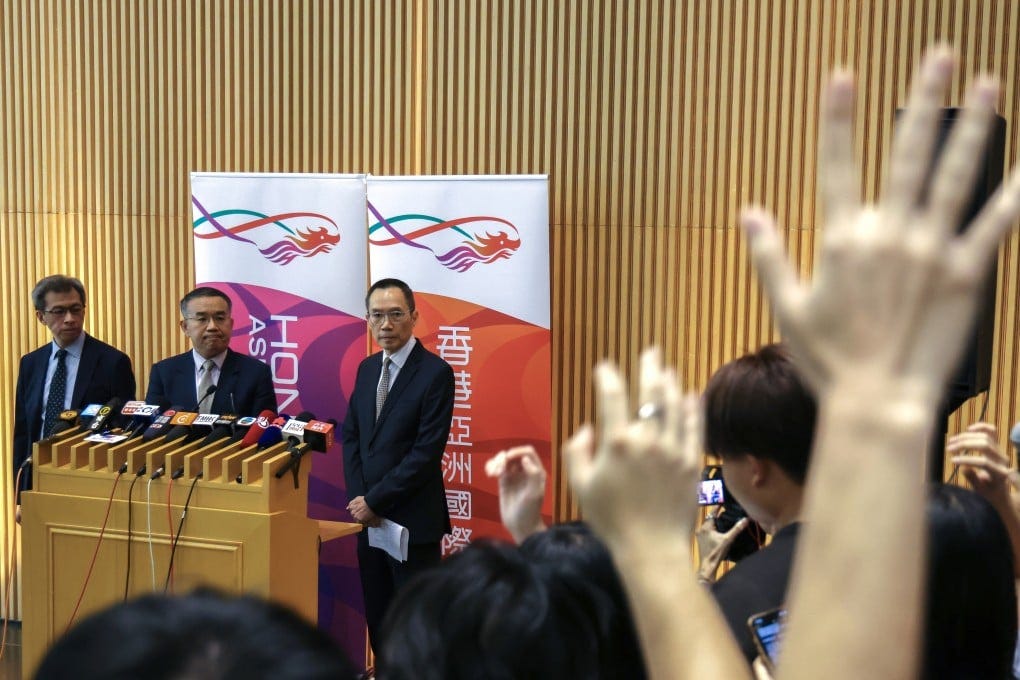
This is where the story shifts from a simple case of corporate fraud to a damning indictment of a government system. The head of the Government Logistics Department, Carlson Chan Ka-shun, held a press conference and did something rare for a bureaucrat: he apologized.
But his apology was telling.
He admitted to "shortcomings" and "procedural flaws." He explained that the scammers were clever, using a mix of real documents (likely obtained illegally) and forgeries to fool the system. Shockingly, he also admitted that the government’s process for awarding contracts didn't even require basic financial background checks on the bidders.
In essence, the government’s front door was wide open. All you needed was a convincing-looking pile of paper to walk away with millions in taxpayer money.
The apology highlighted a problem familiar to anyone who has dealt with large bureaucracies: collective responsibility.
It wasn't one person's fault; it was the system's fault. This vague admission of failure infuriated the public and politicians, who demanded to know who, specifically, would be held accountable for such a colossal error.
Why a Water Scandal in Hong Kong Matters
It's easy to dismiss this as "inside baseball"—a faraway government's mishap. But that would be missing the point entirely. The themes bubbling to the surface in Hong Kong are universal, and we’ve seen them play out in our own backyards.
Remember the mad scramble for PPE during the early days of the COVID-19 pandemic? All over the United States and Europe, governments handed out massive, no-bid contracts to brand-new companies with no experience, sometimes run by politically connected individuals.
We ended up with warehouses full of useless masks and defective gowns.
Why?
Because, like in Hong Kong, the systems for vetting suppliers were either too slow, too weak, or bypassed entirely in the name of urgency.
The core failure was the same: a lack of basic due diligence.
This scandal also puts a spotlight on supply chain integrity.
We live in a globalized world where the label on a product is often the last and least reliable part of its story. XDX claimed its water was from a premium source, but it was really coming from somewhere else entirely.
Does that sound familiar? It should.
We see it constantly in food safety scandals, from horsemeat being passed off as beef in Europe to honey from China being cut with cheap syrups. When a government can’t even verify the source of the water its own employees are drinking, it erodes public confidence in its ability to regulate anything, the food in our stores, the medicine in our pharmacies, or the parts in our cars.
Finally, this is a story about the erosion of trust. A functioning society is built on the belief that while government may be inefficient, it is at least competent at the basics. It can keep the lights on, pave the roads, and buy bottled water without getting fleeced.
When that basic competence is called into question, bigger doubts start to creep in.
If they can’t get the water right, can we trust them on the economy?
On public health?
With our future?
The Hong Kong government is now in damage control mode. A special task force has been formed, and a full audit has been promised.
The deposit XDX paid will be used to cover some of the losses.
But the real damage is the blow to the public’s faith in their institutions.
This is the lesson for all of us, whether in Hong Kong, London, or Ohio. The institutions we rely on rarely collapse in a single, dramatic event. They erode slowly, through a thousand unexamined contracts and a million moments of failed oversight. This time, the decay was exposed by something as simple as a bottle of water. It forces us to ask a deeply uncomfortable question: what other dangers are hidden behind a trusted label?