

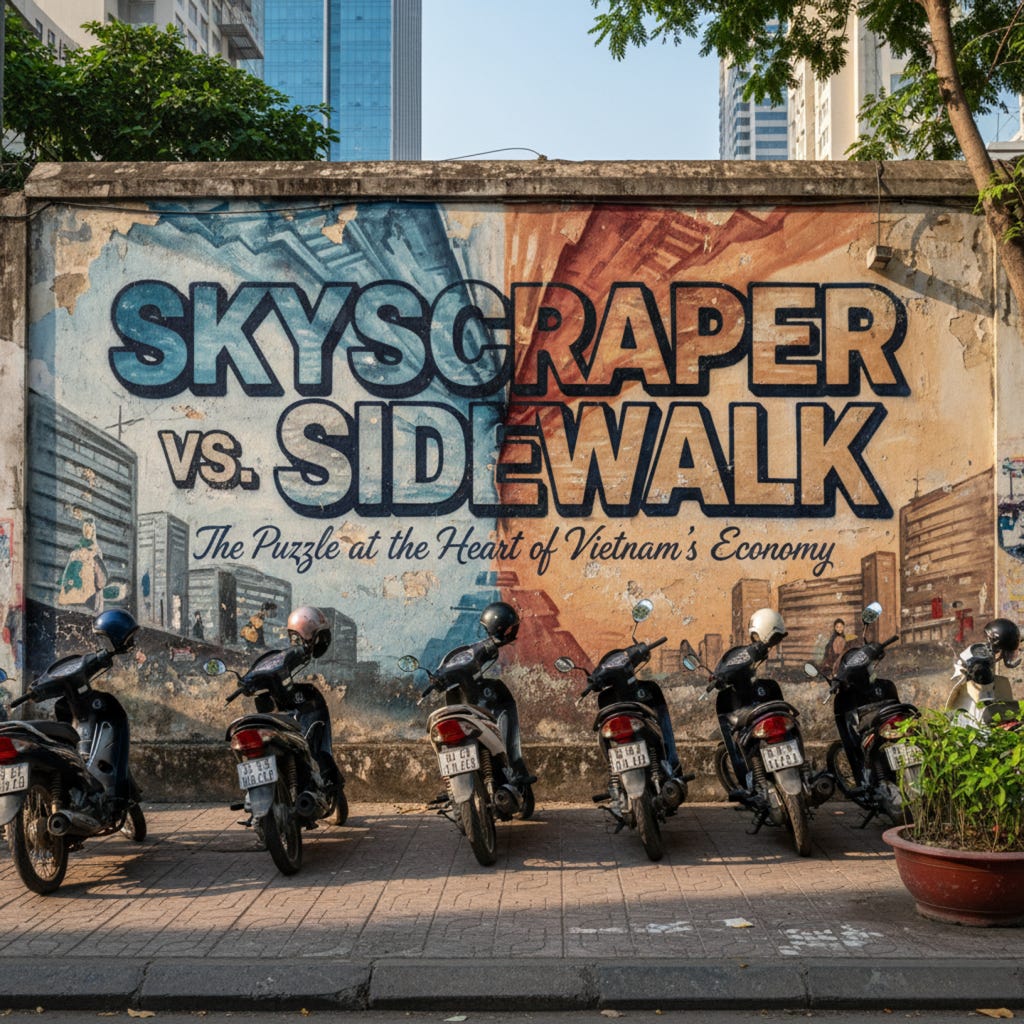
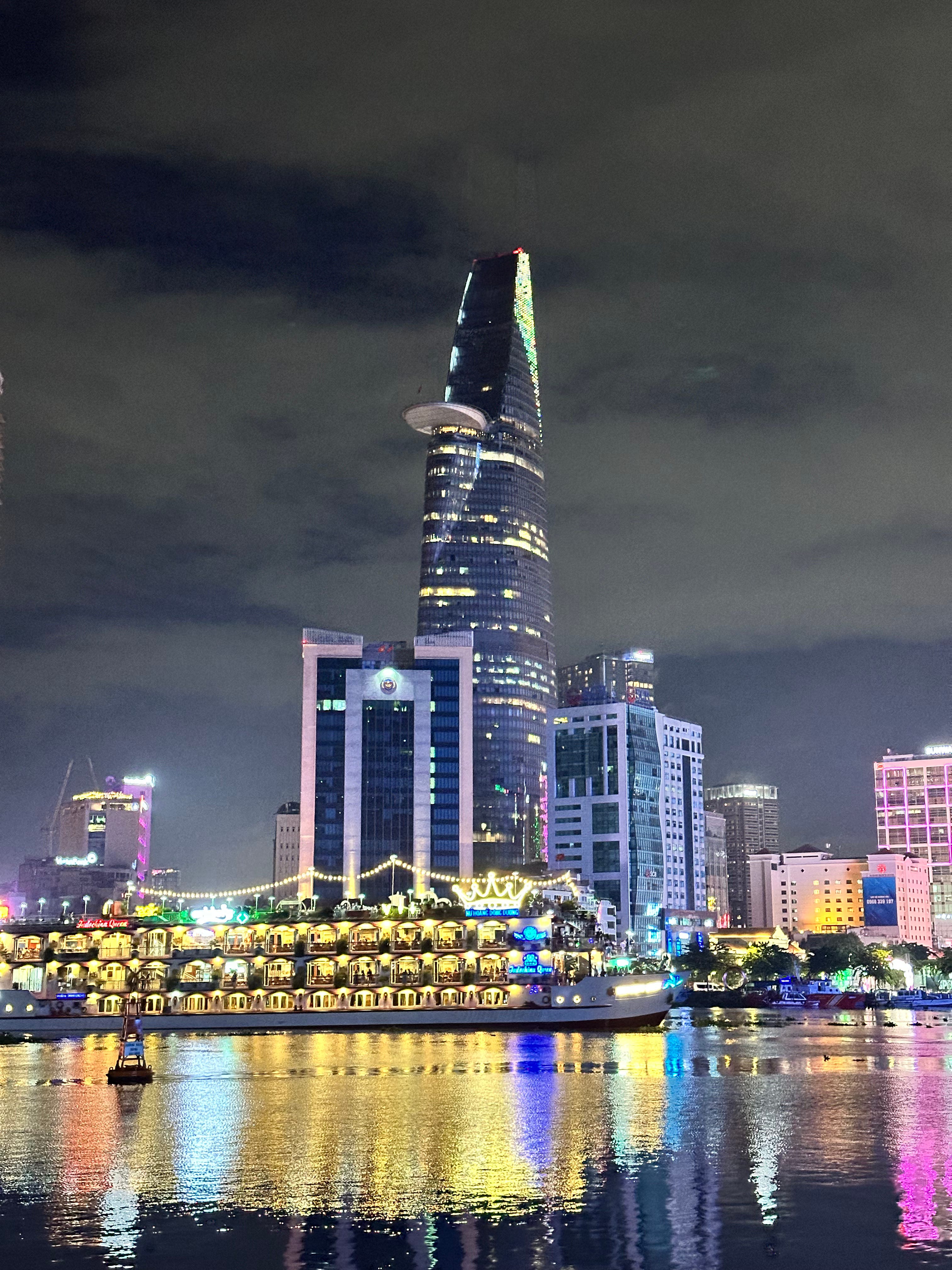
Imagine standing on a street corner in Saigon, the biggest city in Vietnam.
You look up and see giant, gleaming glass-and-steel towers.
They are brand new, futuristic, and symbols of a nation that is rushing toward the future as fast as it can.
Then, you look down at the sidewalk right in front of you.
You find you can’t even walk on it.
It’s a mess of parked motorbikes, little plastic stools, and vendors selling everything from phone cases to fruit.
This single image, of the gleaming skyscraper and the messy sidewalk, is the central puzzle of modern Vietnam.
It is a nation that feels like it is running at two different speeds at the same time.
The gap between these two speeds defines both the country’s incredible promise and its biggest, most dangerous problem.
There is a powerful feeling you can sense all across the country.
It’s an unstoppable optimism that “tomorrow will be better than today.”
For the past 40 years, this has been true.
After a long and terrible war, Vietnam was one of the poorest countries on Earth.
But in a single generation, it has completely transformed itself into a dynamic, busy, middle-income economy.
Its economic growth, has been the second-fastest in the world, right behind its giant neighbor, China.
This rapid rise has led many people to ask, “Is Vietnam the next China?”
It’s easy to see why.
The booming cities, the endless construction, the new factories, and that “tomorrow will be better” feeling are all things people said about China in the early 2000s.

But this comparison, while tempting, is dangerously misleading.
Vietnam’s path is not like China’s.
Its economy is built in a completely different way, and the challenge it faces now is arguably far more complex than the one China faced.
Vietnam’s economy is defined by a deep structural flaw, a major problem in its very design.
It works like this: Vietnam has a hyper-productive, super-fast “engine” that is owned by foreign companies.
This engine is running in isolation, dangerously disconnected from the “slow” part of its economy—the part owned by regular Vietnamese people, which is often starved for money and resources.
The good news is that the Vietnamese government understands this flaw.
Its entire national strategy for the next 20 years is a high-stakes gamble to modernize the Vietnamese owned portion of the economy
The optimism in Vietnam is real.
But success is far from guaranteed.
The China Parallel: A Tale of Two Models
The comparison between Vietnam today and China in the early 2000s is a compelling place to start, but when you look under the hood, you see two very different situations.
It’s true that both countries are socialist-oriented market economies.
This means the government has a lot of control, but they also allow private companies and a free market to exist. Both countries started their incredible success stories with transformative reforms: China’s “Reform and Opening Up” in 1978 and Vietnam’s Đổi Mới (which means “Renovation”) in 1986.
Both have been stunningly successful.
But how they got successful is what matters.
China’s explosive growth in the 2000s was a story of home-grown success. It was the payoff from difficult reforms it had already made in the 1990s. Its boom was underpinned by two main factors that Vietnam does not have.
First, China had a massive wave of domestic investment. Chinese people and the Chinese government saved a huge amount of their money and poured it into building new roads, bridges, factories, and cities.
Second, and this is the most critical part, China had a historic surge in what economists call “Total Factor Productivity,” or TFP.
This sounds complicated, but it’s a simple idea.
Lets assume two people are paid to build a house.
One person works very hard for 12 hours a day but makes a lot of mistakes, wastes wood, and has to redo his work.
The second person has a better plan, uses better tools, and works smarter.
In 8 hours, he builds a better wall with no wasted wood.
The second person has higher “productivity.”
TFP is a measure of how smart a whole country is working, not just how hard it’s working. It measures innovation, good ideas, and efficiency.
China’s TFP shot through the roof in the 2000s.
Why?
Because before it joined the WTO in 2001, it had already done the most painful and difficult reform: it fixed its “State-Owned Enterprises,” or SOEs. One of the best China documentaries, Tie Xie Qu, captured this transition.
China’s government “let go of the small ones,” closing down or selling off inefficient state companies. This unleashed a massive wave of new, private Chinese companies that were more efficient, more creative, and ready to compete.
Vietnam’s current model is not a domestic story; it is an external one.
Its economy is being shaped and fueled by other countries.
Vietnam has become the world’s number one beneficiary of the “China Plus One” strategy.
This is a business idea where large companies, afraid of having all their factories in China, decide to build one new factory somewhere else, “just in case.”
Vietnam became that “somewhere else.”
Giants like Samsung, Intel, and the companies that build parts for Apple have all poured billions of dollars into Vietnam to build massive new factories.
This strategy has been a huge success in one way: it changed what Vietnam sells to the world.
In 2010, Vietnam mostly sold t-shirts and shoes.
By 2020, electronics made up 38% of all its exports.
But here is the critical difference.
While China’s 2000s boom was built on its own private companies, Vietnam is still grappling with a large, unreformed, and inefficient system of those government-owned companies (SOEs).
These SOEs still dominate key parts of the economy, like banking, construction, and electricity. And they get special treatment, like favorable access to credit and land. This means a slow, inefficient government company can get a bank loan easily, while a new, smart, private Vietnamese company gets “crowded out” and can’t get the money it needs to grow.
The result is a productivity inversion.
While China had its best-ever TFP growth, Vietnam is experiencing the opposite. Recent studies show Vietnam’s TFP is on a downward trend.
Its fast growth is coming almost entirely from just piling on more inputs with more international investment and more labor.
It’s working harder, not smarter.
This is the classic, unsustainable recipe for hitting the “middle-income trap.”
The comparison to “China in the 2000s” is right about the feeling of optimism, but it’s a near-perfect opposite when it comes to the economic substance.
Understanding the “Dual Economy”
Foreign-owned firms account for ~75% of all of Vietnam’s exports.
You would think that if Samsung built a giant factory, a lot of small Vietnamese companies would pop up to sell it screws, plastic cases, wires, and boxes.
This is what happened in China and South Korea.
But in Vietnam, it’s not happening.
The domestic firms “lack the capabilities” to join these “Global Value Chains” (GVCs).
Think of it this way: to build an iPhone, the ideas come from California, the special glass comes from Kentucky, the computer chips come from Taiwan, and the camera sensors come from Japan.
Then, all those high-value parts are shipped to a country like Vietnam, where a worker does the final, lowest-value step: assembling them all into a finished product.
Instead of fostering a local ecosystem of suppliers, the big FDI firms just import all their high-value components.
The problem is not getting better; it’s getting worse.
The share of Vietnamese firms that have any connection to these global assembly lines has actually declined since 2009.
So, what are the local Vietnamese companies doing?
They are “crowded out” and stuck in low-productivity, non-exporting jobs.
They are in construction, real estate, or running small local restaurants and shops.
The vast majority are not mid-sized industrial firms; they are “micro-enterprises.” This means 70% of all domestic firms are tiny, with just a handful of employees.
The result is that Vietnam captures only a fraction of the overall value embedded in the goods it exports.
The “Made in Vietnam” label is, in most cases, merely “Assembled in Vietnam.”
All the high-value, high-profit jobs: the design, the research, the marketing, and the high-tech component manufacturing, are all happening somewhere else.
This huge structural flaw is now colliding with new binding constraints.
The pool of cheap, young workers that fueled its growth is now shrinking.
And the nation faces a limited supply of high skills, with only about 30% of its young people enrolling in any form of college or vocational training after high school.
This is the very definition of the “middle-income trap.”
Think of a country’s development as climbing a staircase.
It’s relatively easy to get from the “poor” step at the bottom to the “middle” step. You just need to be a place with cheap, hardworking people, and factories will come.
But that middle step is really, really wide and slippery.
It’s very hard to get your footing to make the next big jump to the “rich” step at the top. To make that jump, you need your own ideas, your own brands, your own technology, and a very highly-skilled population.
The model that enabled Vietnam to climb from “poor” to “middle-income” is now exhausted.
Vietnam will need a new model if it hopes to reach the “rich” step.
A High-Stakes Pivot to Escape the Trap
The Vietnamese government is not blind to this. Its future plans are a direct response to this “dual economy” problem.
The goal is incredibly ambitious: to become an “upper-middle-income” country by 2030 and a “high-income” nation by 2045 (the 100th anniversary of the country’s founding).
To do this, it knows it must build a powerful, innovative, and domestic private sector.
The centerpiece of this new strategy is a 2025 document called “Resolution 68.”
It officially changed the description of the private sector.
The old description was that the private sector is “an important driving force.”
The new description is that the private sector is “the most important driving force of the national economy.”
This is a fundamental break from the old model of favoring government-owned companies (SOEs).
The plan explicitly adopts the “South Korean” development model.
Resolution 68 calls for the creation of at least 20 “national champions” by 2030. This is a direct attempt to replicate the success of South Korea’s chaebols. A chaebol is just a giant, family-run super-conglomerate. You know them today as Samsung and Hyundai.
In the 1960s and 70s, the South Korean government picked these companies and gave them special treatment, helping them grow into global giants.
Vietnam wants to build its own Samsungs.
This “chaebol” strategy, not the “China” model, is the most relevant comparison for Vietnam today.
However, it is an incredibly risky plan.
Analysts warn that for this to work, you need transparent, clear government.
The risk is that the plan could fail to produce “dynamic multinationals” and instead create politically-connected conglomerates that prioritise rent-seeking.
Rent-seeking is when a company makes money by getting special favors from the government, not by actually building a better product.
The method for building these champions is a focused push into high-tech.
The goal is to transition the economy from low-skill assembly to high-value design, research (R&D), and services.
The flagship initiative is the National Semiconductor Strategy.
The strategy is ambitious: train 50,000 semiconductor engineers by 2030, attract 100 design companies, and establish Vietnam’s own manufacturing facilities. This is now a top national priority.
This is running in parallel with a National Digital Transformation Program, which aims to have the “digital economy” (things like e-commerce, software, and AI) contribute 25% of the country’s GDP by 2030.
This is being fueled by massive investment in 5G internet and a push to make 100% of government paperwork available online.
Finally, the government is creating new tools to force the “dual economy” to integrate. A “Supporting Industries” program is designed to plug small and medium-sized Vietnamese companies (SMEs) into the FDI value chain.
The goal is to help these domestic suppliers meet the high standards of the big multinationals, with a target of 2,000 domestic companies becoming direct suppliers by 2030.
And to fuel all this, a new Investment Support Fund provides direct cash grants to subsidize this pivot. It will pay for up to 50% of the cost of human resource training, and up to 30% of R&D costs.
Most critically, it will pay for up to 50% of the initial investment for any new R&D centers in the semiconductor and AI industries. The government hopes by absorbing some of the financial risk, private companies are more willing to take risks.
Policy vs. Pavement: On-the-Ground Realities
This is where the high-level, 30,000-foot plans slam into the on-the-ground reality. The work in progress feeling you get from visiting Vietnam is not a contradiction of the economic data; it is the most visible manifestation of it.
The unresolved tensions on Vietnam’s streets are the precise friction points of its deep structural challenges.
Let’s go back to the sidewalks.
Major cities like Saigon and Hanoi are famous for being hostile to pedestrians.
But this is not a simple infrastructure problem.
The sidewalk is an economic battleground.
It is the physical home of Vietnam’s massive “informal economy.”
This informal or “grey market” economy is a term for all the people who make a living without an official, registered job.
It is the street vendor selling phở (noodle soup), the small household business, the gig worker driving a motorbike taxi, and the person selling trinkets on a mat.
This is not a small, niche sector.
It is the country’s largest employer.
As of 2021, an estimated 68.5% of Vietnam’s entire workforce was in informal employment. This “grey market” functions as a vital safety net for millions of people, providing livelihoods and social connection.
The chaos on the sidewalks is this unresolved conflict: the state’s top-down vision of a “civilized,” “smart,” and orderly city (one that looks good to foreign investors) versus the bottom-up, chaotic, and essential economic reality of its citizens.
State attempts to “fix” the sidewalks often fail because they are trying to regulate a complex, self-organizing social and economic system.
This issue is so central that Resolution 68, for the first time, places a specific policy focus on “household businesses.”
The long-term plan is not to eradicate this informal economy, but to formalize it into an official, taxable private sector.
Vietnam’s government is also engaging in an external, pro-investment, pro-tourism effort. Aiming to take companies, tourists, and retirees that would traditionally go to Thailand and have them choose Vietnam instead.
To enforce the government’s vision of modern Vietnam it has run nationwide movements like the “All people unite to build cultural life” campaign and local initiatives like Hanoi’s “Code of Conduct.” These are top-down efforts to shape cultural standards and enforce public behavior.
Part of this “civilizing” push is the ongoing “Blazing Furnace” anti-corruption campaign. While this is necessary to tackle widespread corruption it has also been used to consolidate political power.
It has also created a new problem: bureaucratic paralysis.
Many government officials are now so afraid of being accused of corruption that they will not sign any new permits or approve any new projects, slowing down investment and decision-making.
Another of the government’s more interesting plans is to turn Da Nang, a sleepy beach town in the middle of the country, into a financial hub.
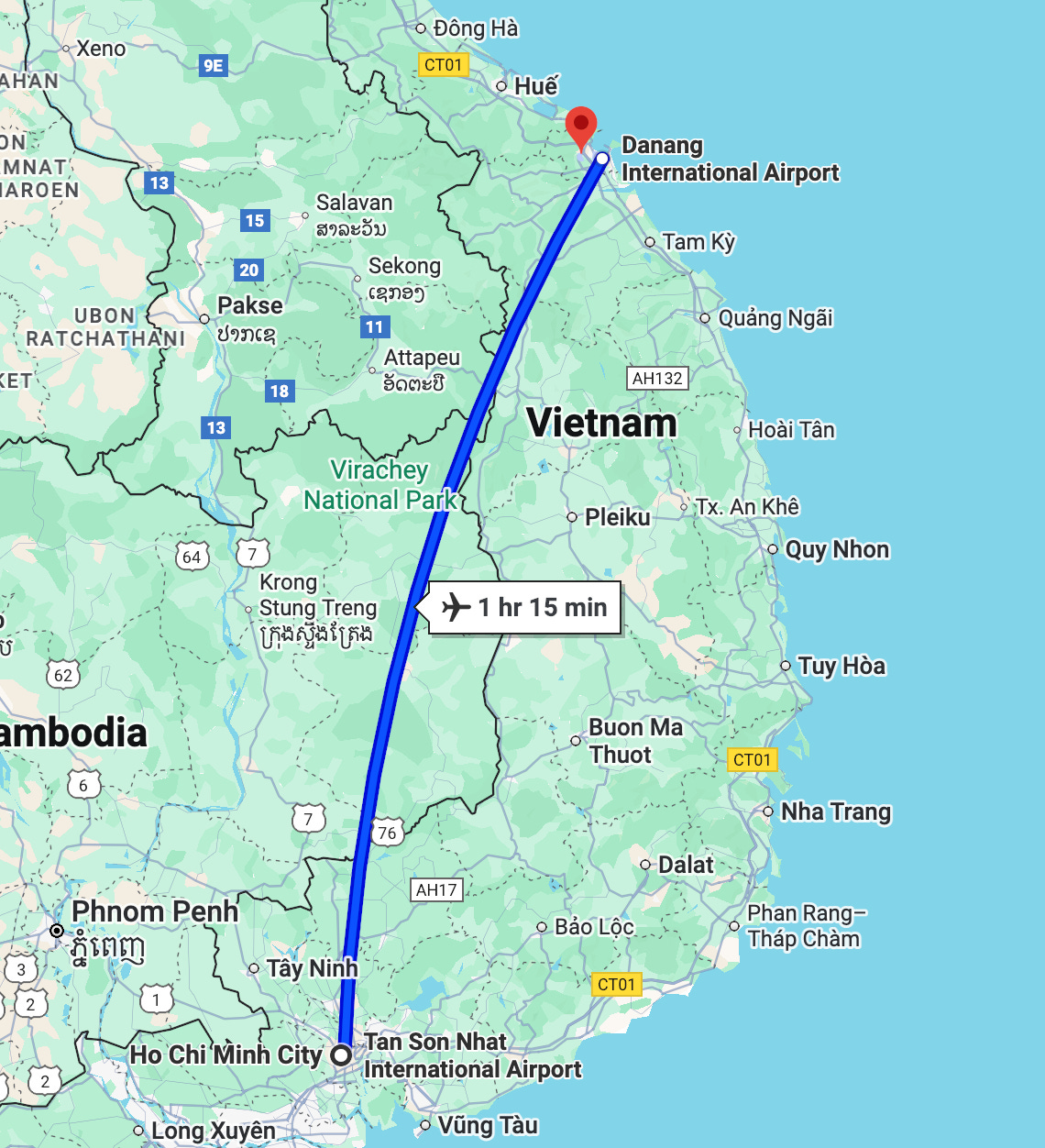
The government has approved a “one center, two destinations” model.
Ho Chi Minh City (Saigon) will be the “flagship” center for traditional banking.
Da Nang, will be the “pilot” center, designated as a national “regulatory sandbox.”
Its specific job is to be a hub for fintech innovation.
Oppoents would argue this is nearly impossible to create a new financial system in a country with a different legal system and that lacks an elite corps of global bankers, regulators, and specialized lawyers.
So, why do it?
Viewing the Da Nang hub as a project that will rival Singapore is misreading its true strategic purpose.
Da Nang’s potential transformation is better understood not as a goal, but as a “forcing mechanism.”
By setting this far-fetched goal, the government is creating a contained sandbox to force its own conservative, slow-moving bureaucracy to confront and experiment with the deep, structural reforms (in its legal system, its money controls, and its talent development) that the entire country must undertake if it is to achieve its 2045 high-income ambition.
Critical Risks and the Open Question
Vietnam’s ambitious national strategy is not being executed in a vacuum. It is vulnerable to powerful headwinds that could derail its 2045 ambition.
The first is geopolitical.
Vietnam’s entire economic model is a product of these interactions, specifically, the “China Plus One” strategy, which is driven by US-China trade tensions.
This places Vietnam in an incredibly precarious position.
It must practice what it calls “bamboo diplomacy” (strong on the inside, but flexible on the outside).
An escalating US-China trade war is a major threat to Vietnam.
Why?
Because the US is its largest export market
While China is its largest source of imports
It cannot afford to alienate either, yet it is being pressured to choose.
The second is the natural environment.
Vietnam is consistently ranked as one of the top 5-10 countries most vulnerable to environmental changes. The Mekong Delta, the nation’s “rice bowl”, has recently delt with increasingly catastrophic flooding.
This flooding already costs hundreds of millions of dollars a year. A significant and growing portion of Vietnam’s money, which could be spent on R&D and education, must now be diverted to adaptation and simple survival.
In the end, the story of Vietnam’s rise is really the story of two different Vietnams living in one body.
There is the fast, modern, foreign-powered Vietnam that builds our phones.
And there is the local, traditional, and struggling Vietnam that is trying to find its place, the one that lives on the “informal” sidewalks.
The country’s entire future depends on whether it can merge these two identities into one.
Vietnam has a clear goal to become a high-income nation by 2045.
Its new national plan is a direct and ambitious attempt to solve it.
But history is filled with countries that had great plans and got stuck on that wide, slippery “middle-income” step.
Will Vietnam be different?
Will its top-down push for a high-tech “chaebol” future really work in a country whose domestic economy is mostly “grey market” vendors on the sidewalks?
That remains to be seen.
The “tomorrow will be better” feeling is powerful, but now, it must be built, not just felt.