

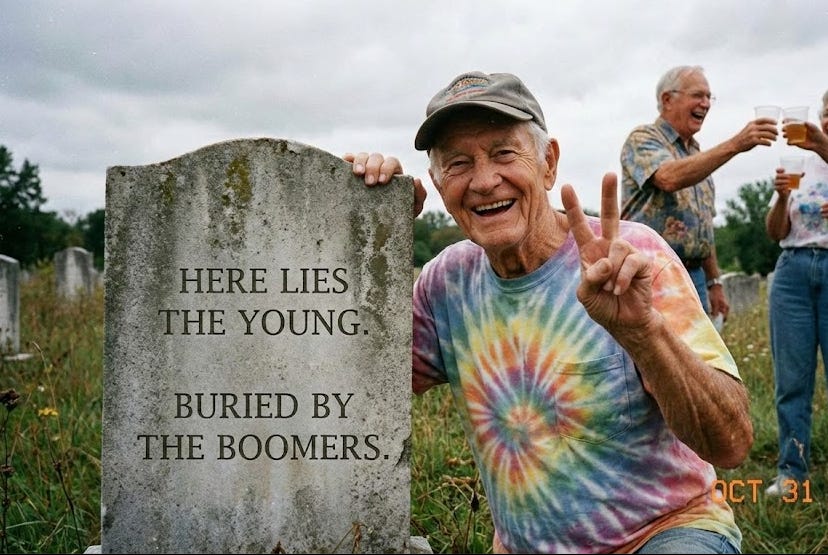
You go out to dinner with a big group.
You order a side salad because you are broke.
But the person sitting across from you—who has the most money at the table—orders the steak, the lobster, and three rounds of drinks. Then, when the check comes, the waiter walks right past the steak-eater and hands the bill to you.
The person across the table smiles, pats their full stomach, and says, “Thanks, kid. You’re a hero.”
This is the American economy right now, in late 2025.
For a long time, we were told a story about a “social contract.” The story said that if you worked hard, paid your taxes, and followed the rules, the system would take care of you. It was supposed to be a circle: you take care of your parents, and one day, your children will take care of you.
But if you look around today, you can see that the contract has been rewritten in invisible ink. The new version is simple: The young will pay the tab so the old can keep eating the lobster.
This didn’t happen by accident. It wasn’t one bad law or one bad president. It is the result of thousands of small choices made over forty years.
Politicians, voters, and leaders chose the present over the future again and again. They chose to keep the party going for the people who were already seated at the table, while locking the doors for everyone still waiting outside.
Now, we are standing on the edge of a cliff.
The ground is crumbling under our feet. To understand how we got here, and how we might stop the fall, we have to look at the history of the “Great Betrayal.”
The Pyramid Scheme That Ran Out of People
To understand why your future is being sold off, you have to look at a classroom from 1960.
In 1960, America looked like a pyramid. There were millions of children at the bottom, a solid group of workers in the middle, and a very small group of retired people at the top. The math was beautiful. If you picked five students from a classroom in 1960, all five of them would grow up to support just one retired person.
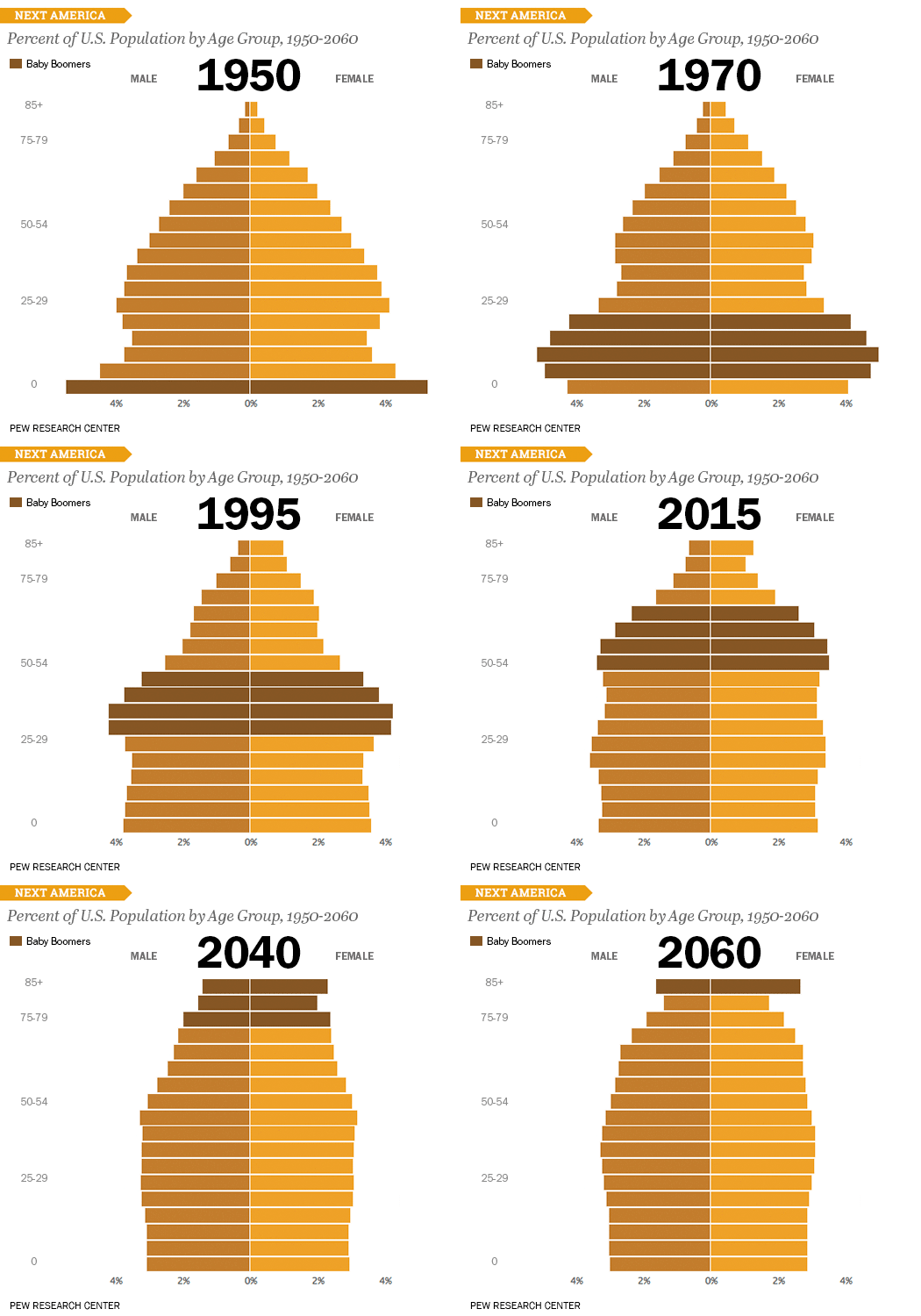
Because there were so many workers and so few retirees, the taxes were low. It was easy. The government could pay for Grandma’s pension and still have plenty of money left over to build highways, moon rockets, and schools for the kids.
But then, the pyramid broke.
Two things happened at the same time.
Americans started having fewer babies. We went from families of four or five kids to families of one or two.
We started living much longer. In 1960, if you made it to 65, you weren’t expected to live much longer. Today, people are living into their 80s and 90s and the number continues to go up.
Walk into a classroom today.
Pick out two students.
Maybe two and a half. That’s it.
Those two kids are the only ones who will be working to support that same retiree.
The math has flipped. We moved from five workers per retiree to two. But here is the critical part: we never changed the promise.
The government kept promising the same generous benefits (actually, even more generous ones) to the older generation, even though there were fewer young people to pay for them. It is like going to a pizza party where they promised everyone two slices, but half the pizzas never showed up.
Instead of cutting the slices, the people at the front of the line (the elderly) took their two slices, and the people at the back (the young) were left with crumbs.
This brings us to the “Lie of the Trust Fund.”
You will hear politicians talk about the “Social Security Trust Fund.” They make it sound like there is a giant vault in Washington D.C. filled with gold bars or cash, saving up for your retirement. This is a lie.
The “Trust Fund” is just a filing cabinet full of IOUs. The money you pay in taxes today isn’t being saved for you. It flows right out the door to pay for your grandmother’s check today. It is a “pay-as-you-go” system. And because the Trust Fund is running out of those IOUs, the system is about to crash.
The experts tell us the money runs out in the early 2030s. If you are in 8th grade today, that is roughly the year you will graduate college.
Welcome to the “real world”—your graduation present is a bill you cannot pay.
The Voting Booth (Why They Did It)
You might wonder: If the math is so bad, why didn’t the politicians fix it? Are they evil? Are they stupid?
No. They are just scared.
To understand the economy, you have to understand the “Third Rail.” In politics, Social Security is called the Third Rail. If you touch it, you die.
Here is the secret that explains almost everything about your life: Old people vote. Young people don’t.
In the last few major elections, people over age 60 turned out to vote in huge numbers. They show up for President, for Congress, and for the local town council. People under age 30? They barely show up.
This creates a “Survival Instinct” for politicians. Imagine you are a Senator. You see the math. You know the system is going broke. You have two choices:
Choice A: You tell the older voters the truth. You say, “We have to cut your benefits a little bit or raise the retirement age to save the system for your grandkids.”
Result: The older voters get angry. They vote you out of office immediately. You lose your job.
Choice B: You lie. You tell them, “I will protect every penny of your benefits! You earned it!” Then, to pay for it, you borrow trillions of dollars and put the debt on the credit card of the unborn.
Result: The older voters cheer. You get re-elected. The problem becomes the next guy’s problem.
For forty years, Republicans and Democrats alike have picked Choice B. They kicked the can down the road. But now, we have run out of road.
They chose to protect the past because the past shows up on Election Day. They chose to sacrifice the future because the future stays home.
The Housing Ladder (Pulling It Up)
The betrayal didn’t just happen in Washington. It happened in your neighborhood.
The American Dream has always been built on a simple idea: You get a job, you save a little money, and you buy a house. That house acts as a “forced savings account.” You pay down the mortgage, the house goes up in value, and by the time you retire, you have a nest egg.
That ladder worked great for the Baby Boomers (people born between 1946 and 1964). They bought houses in the 1970s, 80s, and 90s when homes were cheap compared to their salaries.
But once they climbed up the ladder, they turned around and pulled it up behind them.
How?
Through something called “NIMBYism” (Not In My Back Yard).
Homeowners realized that if fewer houses were built, the houses they already owned would become more valuable. It is simple supply and demand. So, they started showing up at town hall meetings. They passed “zoning laws.” These are rules that make it illegal to build small, affordable starter homes or apartments in nice neighborhoods.
They said things like, “We want to preserve the character of our town.” What they really meant was, “We want our property values to go up, even if it means our children can’t afford to live here.”
The result is a disaster for anyone under 40.
Prices for homes have skyrocketed. But that is only half the story. The other half is the “Lock-In.” Older generations are sitting in large, multi-bedroom houses. They have paid off their mortgages. They have “locked in” their wealth. They have no reason to sell.
Meanwhile, young families are squeezed into expensive apartments, paying rent to—you guessed it—older landlords.
This situation is very common in Asia, where the vast majority of the population lives in small, high-rise apartments owned by massive corporate conglomerates.
In this new reality, the “ownership class” shrinks to a tiny elite, while the middle class is transformed into a permanent “renter class,” paying a significant portion of their income for a shrinking amount of square footage that they will never own.
In 1980, the average house cost about three times a typical worker’s yearly salary. Today, in many cities, it costs eight or ten times that salary.
The ladder isn’t just higher; it is gone.
The Education Trap
While young people were getting locked out of the housing market, they were also set up to fail in the classroom.
Fifty years ago, state colleges were almost free. The government (taxpayers) paid the bill because they believed that educating young people helped the whole country.
But starting in the 1990s and 2000s, that changed. The government decided it didn’t want to spend as much tax money on schools. But colleges didn’t get cheaper; they got more expensive. So, how did they bridge the gap?
They told 18-year-olds to borrow it.
They created a culture where it was considered “normal” for a teenager to sign a paper accepting $30,000, $50,000, or $100,000 in debt before they even had a job. They called it “Financial Aid,” but it was really a “Future Tax.”
This is the “Education Trap.” You are told you need a degree to get a good job. But to get the degree, you have to take on debt that prevents you from buying a house or starting a family.
The government basically said: “We won’t tax the wealthy people today to pay for your school. Instead, we will tax you for the next 20 years to pay for it yourself.”
The Sandwich Generation
Now, put all these pieces together. The taxes, the housing, the debt. Who gets crushed?
The “Sandwich Generation.”
You might hear people call Millennials or Gen Z “lazy.” They say, “Why don’t you just work harder? I bought a house when I was 25! I paid for college with a summer job!”
This is gaslighting.
Gaslighting is when someone tries to make you think you are crazy for seeing the truth. The truth is that young adults today are working incredibly hard, but the economy is designed to extract wealth from them.
Take a look at a typical 35-year-old woman today. Let’s call her Sarah.
Sarah has a toddler. She wants to work, but daycare costs $1,500 a month—more than her mortgage used to be. The government doesn’t help much with this.
Sarah also has student loans. That’s another $400 a month out of her bank account.
Now, add the third layer of the sandwich. Sarah’s parents are aging. Because the American healthcare system is great at keeping people alive but terrible at helping them live independently, Sarah’s parents need help. They need rides to the doctor. They need help with bills. They might need a nursing home, which can cost $10,000 a month.
Since Medicare doesn’t pay for long-term nursing care, the burden falls on the family. Sarah is squeezed from both sides. She is paying for the past (her parents) and the future (her kid), leaving nothing for herself.
She is running a marathon while wearing a backpack full of rocks, and the people sitting in the stands are yelling at her to run faster.
The Ghost Economy
What happens when you push a generation too far? They stop playing the game.
This is the scariest part of the story. It isn’t about money; it is about hope.
When young people look at this deal they check out.
The birth rate in America has crashed. We are at an all-time low. This isn’t because people hate kids. Surveys show most young people want to have children. They just can’t afford them. They look at their tiny apartment and their student loan balance, and they say, “I can’t bring a baby into this.”
This creates a “Death Spiral.”
Remember the pyramid? It relied on lots of new workers to pay for the old ones.
But if young people can’t afford to have kids, there will be even fewer workers in the future.
Which means the taxes on those few workers will have to be even higher.
Which means they will be even poorer.
We are creating a “Ghost Economy”, a country of old people sitting in empty houses, wondering why there is no one left to fix the plumbing or staff the hospitals.
How to Stop the Fall (America First)
Is it hopeless?
No.
But fixing it requires toughness. We have to stop worrying about hurting feelings and start worrying about saving the country. We have to stop listening to the “experts” who broke the system and start putting American citizens first.
Here is what a plan to actually save the future looks like.
1. Kick Wall Street Out of the Neighborhood We need to treat housing as a home for American families, not an investment for global hedge funds.
The Fix: Ban foreign investors and massive corporations like BlackRock from buying up single-family homes. If you are a hedge fund in New York or a billionaire in Shanghai, you have no business owning the house a young mechanic in Ohio is trying to buy. Force them to sell those houses back to the people.
The Fix: Slash the regulations. The reason houses cost so much is because environmental bureaucrats and local zoning boards make it impossible to dig a hole. We need to clear the red tape so American builders can build cheap, solid homes for American workers.
2. Make American Labor Valuable Again Why are young people broke? Because their wages have been flat for decades. Why are wages flat? Because we flooded the country with cheap labor.
The Fix: Close the door. When you restrict the supply of labor, the price of labor goes up. It is basic economics. If we stop the flow of cheap labor from overseas, corporations will be forced to pay young Americans higher wages. A young person should be able to support a family on a single income again. That only happens when his labor is scarce and valuable.
3. The “Baby Bonus” (Pay Parents, Not Bureaucrats) The most important thing a society can do is produce the next generation. We need to stop apologizing for the traditional family and start paying for it.
The Fix: Rewire the tax code to punish childless corporations and reward American parents. We should offer massive tax credits or even direct “baby bonuses” to married couples who have children. If you are doing the hard work of raising the next generation of citizens, the government should be cutting you a check, not taxing you to death to pay for foreign wars or bloated bureaucracies.
4. Protect the Sovereignty of the Young The current system is globalist; it sells out local citizens to benefit the global economy. We need a nationalist economy.
The Fix: We need to stop borrowing money from China to pay for benefits we can’t afford. We need to re-industrialize America so that young people have real jobs making real things—cars, steel, chips—not just serving coffee or writing code. Real wealth comes from making things here, by our people, for our people.
The Choice
There is an old Greek proverb that says: “A society grows great when old men plant trees whose shade they know they shall never sit in.”
It means that a good generation sacrifices a little bit of its own comfort to make sure the future is better for their children. It is a beautiful idea.
It is the definition of love.
But right now, in America, we are doing the opposite. We are chopping down the forest to build bonfires for the elderly. We are burning the future to keep the present warm.
Every time we let a hedge fund buy a neighborhood, we are chopping down a tree.
Every time we open the border to cheap labor that crushes the wages of our own kids, we are chopping down a tree.
Every time we prioritize a global corporation over an American family, we are chopping down a tree.
We cannot keep asking the person with the side salad to pay for the lobster. We cannot keep locking the doors to the American Dream.
The cliff is coming in the 2030s.
The bill is due.
We have a choice. We can keep fighting a generational war, where the old hoard the wealth and the young inherit the ashes.
Or, we can decide that we are all in this together.
We can decide to put our own citizens first. We can decide to start planting trees again.
But we have to start now.
Because the shade is already disappearing.