


In 1993, Danville, Virginia had seven textile mills and 6,500 people working in them. Dan River Mills paid enough that you didn’t need a college degree to own a house. Over the next decade, nearly all of those jobs vanished.
The mills closed. The machinery shipped overseas. Drive through Danville today and you can still count the damage. Boarded windows, empty storefronts, a population that never recovered.
That was NAFTA. It took a decade to gut one industry in one region. The government spent billions on retraining programs. They failed so badly that even workers who completed them and found new jobs mostly earned less than they had before.
Now the same thing is about to happen to 3.3 million office workers across the country. Medical coders, claims adjusters, customer service reps. Not in one town over ten years. Everywhere, in about three.
I call these people “mushy potatoes”. Every company has them. The people who followed the recipe. Showed up, learned the system, got good at the process. They were the foundation. The ones who filled in the gaps as growth happened, who kept the lights on while someone else got the credit. They did everything right and came out average. Now we’re facing a world that doesn’t need average anymore, and there’s no retraining playbook, because the last one already failed.
The NAFTA Template
Danville wasn’t unique. It was just one town in a pattern that hit the entire country.
The North American Free Trade Agreement went into effect on January 1, 1994. The promise was that free trade would create prosperity for everyone. Some jobs would be lost, but they’d be replaced by better jobs. The workers would be retrained. Everyone would benefit.
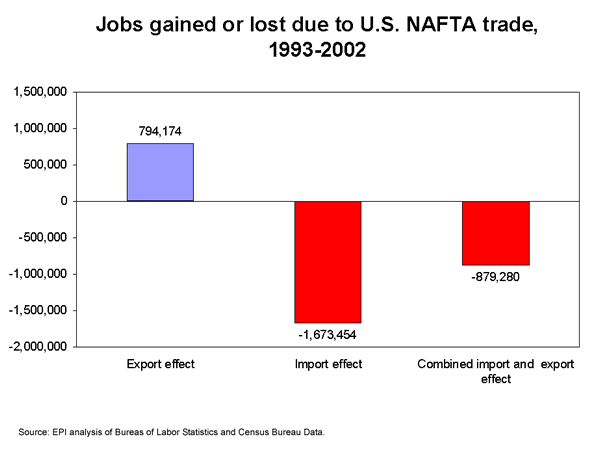
Between 1993 and 2002, NAFTA displaced 879,280 jobs. By 2016, more than 900,000 workers had been certified as NAFTA-displaced. But those are just the direct job losses. They don’t count the ripple effects. The suppliers who closed when their biggest customers vanished. The housing markets that collapsed when entire industries left town.
The government created Trade Adjustment Assistance programs. Retraining and job placement services. They spent billions trying to help displaced workers transition.
The programs failed catastrophically.
Only about half of eligible workers even entered the training programs. Why? Because they couldn’t afford to. Training takes time. You can’t pay rent with promises of future employment. Most displaced workers took the first job they could find, even if it paid half what they were making before.
Of those who completed training and found new jobs, most still earned less than they had before. The government’s own data showed only 56 percent of reemployed workers were earning 80 percent or more of their prior wages. The placement rate was dismal. Less than four out of ten workers got placed in jobs that used their new skills.
Two in five displaced manufacturing workers who found new jobs took pay cuts, and roughly one in four took cuts exceeding 20%. The new jobs paid a fraction of manufacturing wages. You went from middle class to working poor overnight.
Case and Deaton called what followed “deaths of despair.” Drug overdoses, suicides, communities hollowed out. The effects lasted 25 years. The damage passed to kids who grew up watching their parents spiral and never recovered.
The Government Accountability Office found the Trade Adjustment Assistance programs fell far short of need, concluding that improvements were necessary but the programs alone could not solve communities’ long-term problems. Meanwhile, nearly a million people needed help.
That was the retraining playbook. It had one advantage AI displacement doesn’t: time. NAFTA’s damage unfolded over decades. AI is compressing the same disruption into years.
And this time, the jobs at risk aren’t concentrated in mill towns. They’re spread across every office park in America. Three professions in particular look safe on paper. They’re not.
Three Jobs That Look Safe
You’d think medical coding would be safe. 195,000 specialists translating doctor’s notes into billing codes. It’s detailed work that requires knowledge of anatomy and insurance requirements. The Bureau of Labor Statistics projects 7% growth through 2034. Healthcare is booming, right? More patients means more coding.
Except the routine work is already being automated. Optum launched an autonomous medical coding platform in May 2025. Healthcare organizations are now racing to pilot it and similar platforms. The coders who remain aren’t coding anymore. They’re auditing. Checking the AI’s work. Quality control for algorithms.
That’s the first step. You go from 100 coders doing coding to 100 coders checking AI output. Productivity improves. Margins improve. Then you realize that one person can check the output of ten AI coders. Now you need 10 people, not 100. The math is brutal and obvious.
Insurance claims adjusters tell a different story. 356,100 of them assess damage and negotiate settlements. They drive to accident sites and inspect damage firsthand. Seems hard to automate. You need judgment and the ability to spot fraud.
In optimized deployments, AI-powered systems can handle 70-90% of simple claims from start to finish with no human involved, compared to an industry-wide straight-through processing rate of roughly 7%. Tractable’s AI can assess vehicle damage from photos as accurately as a trained adjuster. Upload pictures from your phone, the AI estimates repair costs, claim approved. No adjuster visit needed. The BLS projects a 5% decline in claims adjuster jobs from 2024-2034. That’s their official, conservative estimate.
Talk to anyone in the insurance industry and they’ll tell you the real number is going to be much higher. Soon asking insurance companies “Are you using AI?” in 2027 will sound as dated as asking “Do you have a website?” in 2007. The shift isn’t coming. It’s here. It just hasn’t scaled yet.
Then there’s the big one. 2.8 million customer service representatives. 2.8 million people answering phones and processing returns. Gartner predicts that by 2029, AI will resolve 80% of common customer service issues without any human involvement. Today, that number is in the single digits.
We’re going from single digits to 80% in four years. The automation creeps, then sprints. 2027 and 2028 are going to be the inflection years. That’s when companies finish their pilots and start scaling. That’s when “AI customer service” stops being a beta feature and becomes the default.
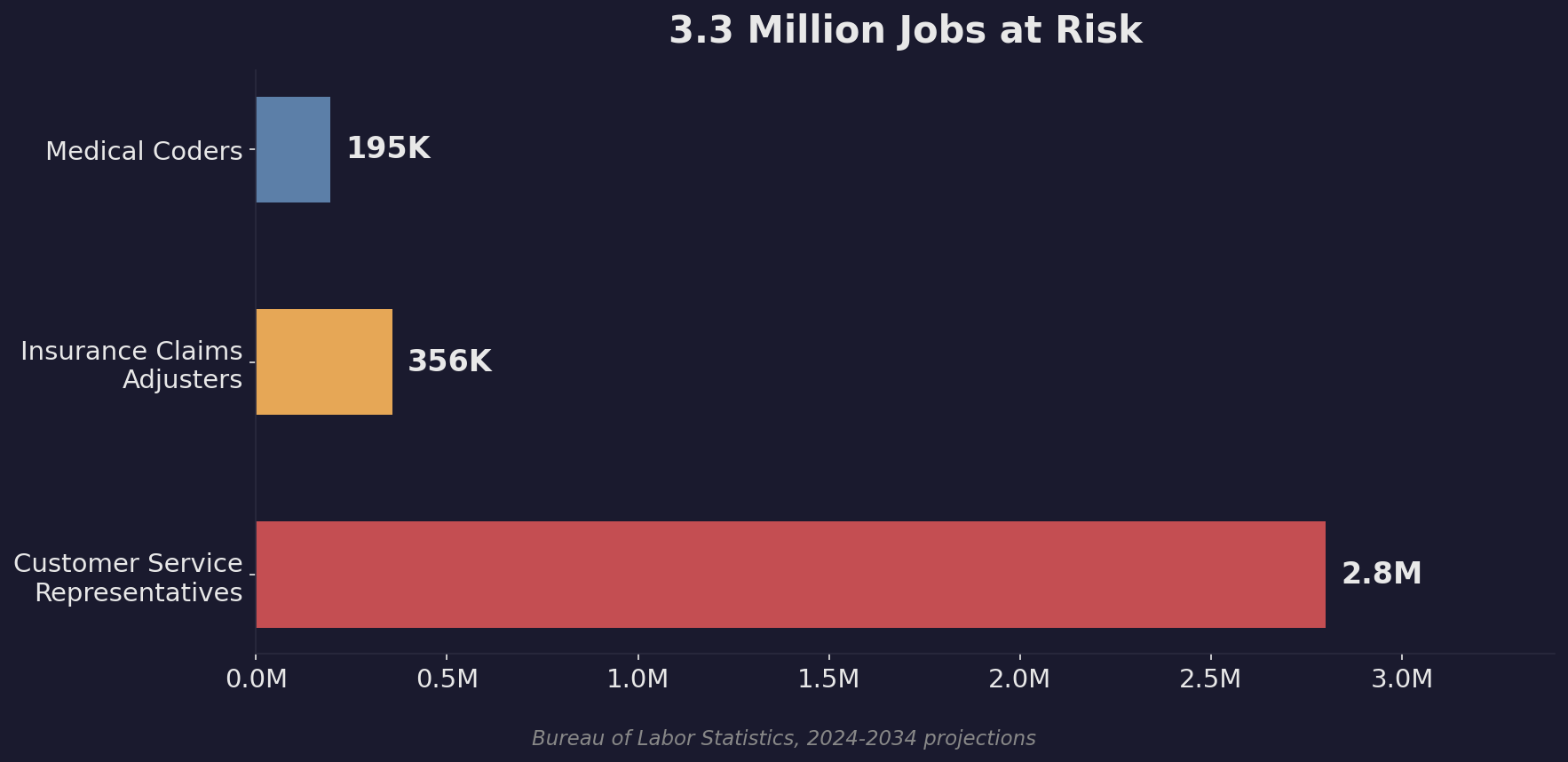
2.8 million people. And that’s just one job category. Companies have already tried replacing them wholesale. The results should be reassuring. They’re not.
The Klarna Lesson
The media misread Klarna. They see early failures and assume permanent failure.
In February 2024, the Swedish fintech company announced its AI assistant was doing the equivalent work of 700 full-time agents. CEO Sebastian Siemiatkowski went on a victory lap. The AI handled 2.3 million conversations in its first month. Resolution time dropped from 11 minutes to under 2 minutes. He projected $40 million in profit improvement. That isn’t what happened.
Quality collapsed. Simple problems escalated into nightmares because the AI couldn’t handle context or nuance. Engineers who were supposed to be building products got pulled off their work to answer phones. The people who remained were drowning.
By late 2024, Siemiatkowski was doing interviews admitting they went too far, too fast. He said cost had been “a too predominant evaluation factor.” Klarna started rehiring humans.
The media jumped on this.
See? AI can’t replace humans.
You need the human touch. The empathy. We’re safe.
But that’s not what the Klarna story actually means.
What it means is that we’re in the awkward middle. The capability exists, but companies are still struggling to use the tools. Klarna deployed badly. Not because AI can’t do customer service, but because they rushed the rollout without figuring out when to hand a customer to a real person.
Every company that tries too early and fails is learning the lesson. They’re going to try again in 18 months with better tools and better implementation. The second wave won’t make Klarna’s mistakes. They’ll have learned from them.
The mushy potatoes see the Klarna story and think they’re safe. They’re not. Their turn just hasn’t come.
The Quiet Part
The AGI debate is a distraction. People argue about whether artificial general intelligence is here today or arriving next year. We can laugh about AI recommending you walk to the carwash instead of driving, and point to logic failures as proof it isn’t ready
But that’s not the question that matters for employment.
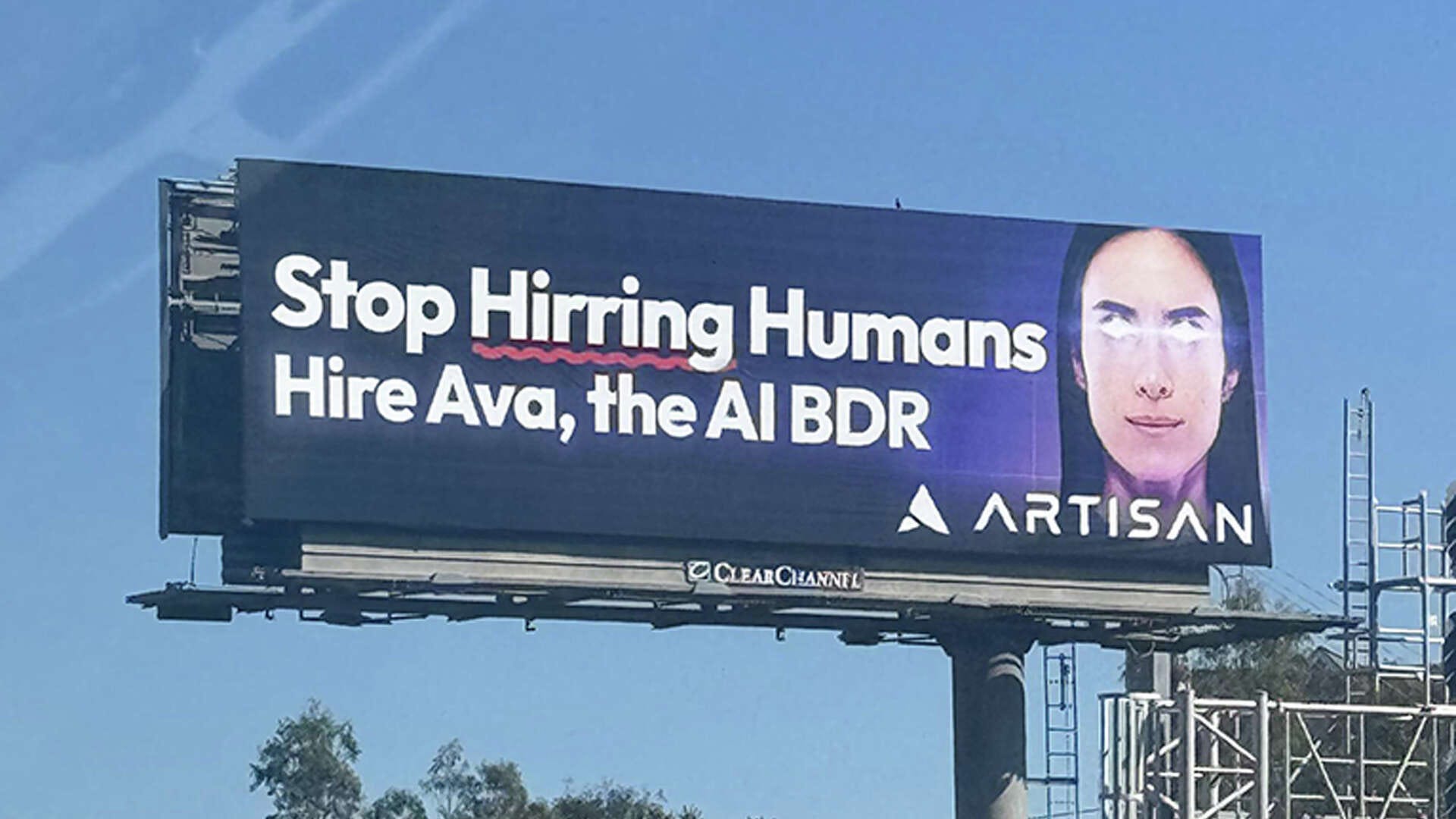
In San Francisco, a startup called Artisan AI put the quiet part on a billboard: “Stop Hiring Humans.” Their product is an AI sales agent named Ava that handles the prospecting and outreach that used to require a team of junior reps. The founder, 23-year-old Jaspar Carmichael-Jack, raised $25 million on that pitch.
He’s not the only one thinking this way. Platforms like Synthflow let a plumber deploy an AI phone agent in an afternoon. No code required. It answers every call and books every appointment. One case study: 600,000 monthly calls handled, 40 AI agents deployed in 60 days, zero new hires. The person on the other end often doesn’t realize they’re talking to software. The system can be configured to introduce itself as an employee or use the owner’s name, blurring the line between human and automated service.
A September 2025 New York Fed survey found that 12% of service firms already using AI had hired fewer workers because of it. Nearly a quarter of firms planning to adopt AI expected to do the same.
But who benefits when those jobs disappear?
Not the people who succeeded by following the process. Process-following is how you climb in traditional organizations. You learn the rules, you work the rules. But following rules is useless for anticipating what replaces them. The skills that made someone reliable for twenty years are exactly what strand them when the job evaporates. A structural trap, not a character flaw.
The people who thrive with these tools are the ones with more ideas than hours in the day. The ones who were always told they were “too much” or “not a culture fit.” AI removes the bottleneck that held them back: other people. Give that person tools that replace the team they never had, and the gap between what they can do and what a traditional company can do disappears.
Pieter Levels runs Photo AI, an AI headshot service pulling in $132,000 a month. Zero employees. He handles everything from code to customer support. A traditional SaaS at that revenue would typically employ a team. Levels does it alone and told Lex Fridman: “Every employee makes your company slower.” His operating philosophy: automate everything and go surfing.
The technology today is the worst it will ever be, and so are the skills of the people using it. Both are improving at the same time. Once an operator realizes they can outcompete a company with a hundred employees using nothing but AI, they don’t go back.
This is also one of the most actively resisted technologies in memory. Corporate politics run on headcount. Managers don’t voluntarily shrink their teams. That’s why the adoption curve looks artificially slow and the aggregate numbers haven’t moved enough to alarm policymakers. The resistance is rational. It’s also temporary.
So what happens to the 3.3 million people whose jobs become optional?
The Davos Disconnect
The people running the world know this is coming. They’re just wildly disconnected from what it actually means for normal people.
Jamie Dimon runs JPMorgan. He’s worth roughly $2 billion. In January 2026, he said he would welcome government bans on mass AI layoffs. His proposal: phase it in, retrain, you can’t lay off 2 million truckers tomorrow.
Sounds reasonable, right? Except it assumes everyone can be retrained. The 55-year-old trucker with a high school education who’s been driving for 30 years isn’t becoming an AI specialist. He’s not going back to school for a four-year degree in data science. The gap is too wide and the money isn’t there.
Dimon’s solution works for people like Dimon. People who are already educated and positioned to benefit from technological change. It doesn’t work for the mushy potatoes.
Larry Fink runs BlackRock. He manages $14 trillion in assets. He asked the right question at Davos. “What happens to everyone else if AI does to white-collar workers what globalization did to blue-collar workers?” His answer: invest pensions in AI infrastructure so displaced workers “participate in the upside.”
In practice: you lose your job, but don’t worry. You’ll own shares in the robots that replaced you.
What happens to everyone else if AI does to white-collar workers what globalization did to blue-collar workers - Larry Fink
There are two problems with this. Most people don’t have meaningful retirement savings. The median 401(k) balance for Americans aged 55-64 is around $71,000. That’s not enough to live on for a year, let alone a lifetime. And the infrastructure investments he’s talking about aren’t guaranteed winners. They’re going to throw billions at AI data centers and energy projects. Some will succeed. Many will fail. The mushy potatoes get to gamble their retirement on which ones Larry’s team picks correctly.
Alex Karp runs Palantir. He has a PhD in social theory from a top European university. He graduated from Haverford, one of the most elite liberal arts schools in America. At Davos, he said “AI will destroy humanities jobs” and recommended vocational training instead.
The guy with a philosophy degree telling everyone else to learn a trade. He got his and pulled up the ladder. Now he’s giving advice from the top rung.
But even the vocational training argument breaks down when you think it through. What happens when robots can do plumbing? When autonomous systems handle HVAC repair? The timeline on that is longer than knowledge work, but it’s not infinite. We’re building general-purpose robots. They’re not going to stop at customer service.
Then there’s Elon Musk and Sam Altman with their universal basic income proposals. Give everyone enough money to live on. Problem solved.
Except it ignores basic human psychology. Money solves the rent. It doesn’t solve the 14 hours between waking up and going to sleep. For most of human history, work provided that. Strip work away and replace it with a monthly check, and aimlessness is what you get.
The deeper absurdity: the people pushing UBI are the same ones who hire armies of accountants to minimize their tax burden. Musk famously paid zero federal income tax in 2018. Now we’re supposed to believe they’ll fund universal income for millions of displaced workers? That’s a fantasy dressed up as a plan.
Every one of these proposals comes from people far removed from normal life. Their understanding of how average people navigate economic disruption is nonexistent. The minority who know how to leverage AI will pulling ahead. The rest are stuck. Not benefiting. Not improving. Just watching the gap widen.
The mushy potatoes aren’t even in the conversation. They’re not the power users. They’re not the early adopters. They’re the people who got a company-wide email about the new AI tools, clicked through a 20-minute training video, and went back to doing their jobs the same way they always have.
When their job gets automated, the advice will be “learn to use AI.” But they already couldn’t figure it out when they had time and job security. How are they supposed to learn it when they’re unemployed and desperate?
The Comfortable Cage
The optimists say AI frees humans from drudgery. People pursue meaning. Art and community. Renaissance 2.0. It’s a beautiful vision. It’s also completely disconnected from how most people work.
Finding your own meaning requires curiosity and internal drive without anyone telling you what to do. Strip away the structure and most people don’t become creative geniuses pursuing passion projects. They become depressed and aimless. We already saw this in NAFTA communities. Opioid epidemics. Disability claims skyrocketing not because people were more injured, but because it was the only socially acceptable way to stop working.
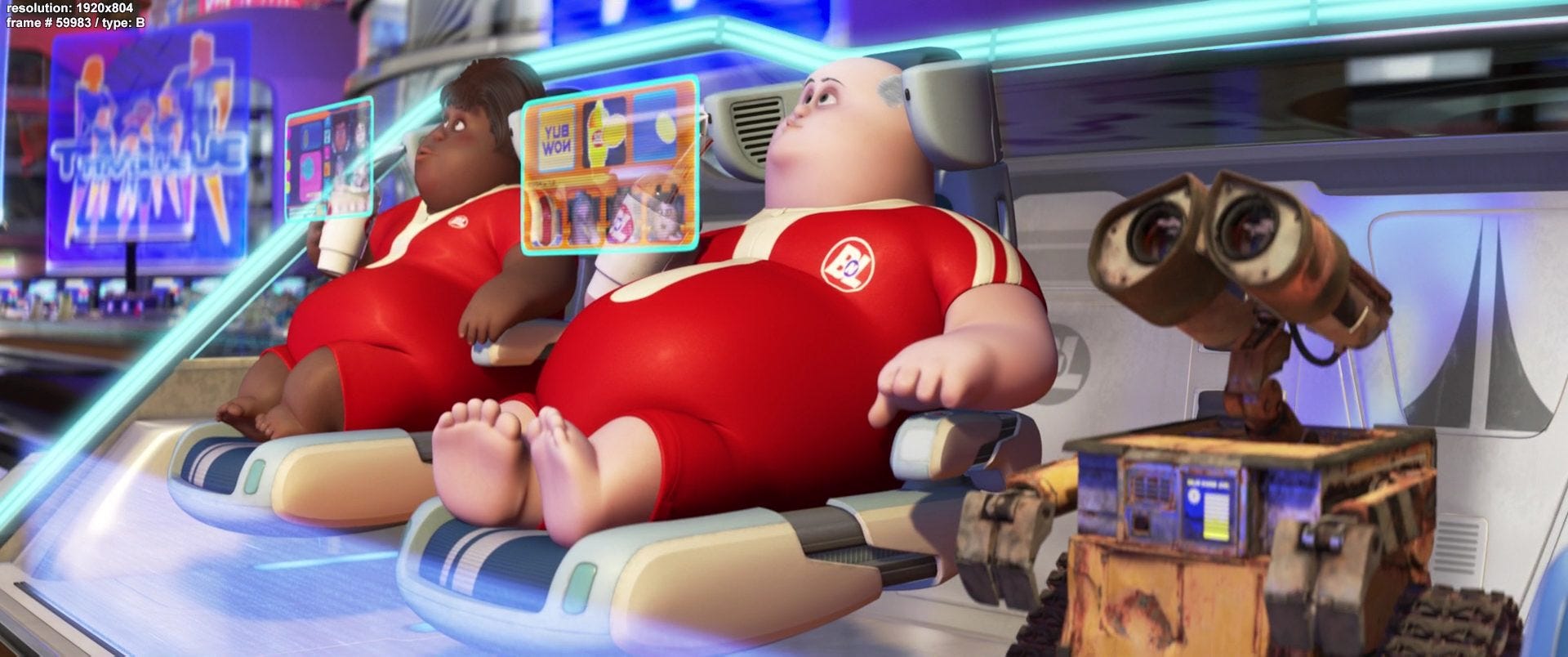
The pessimists say Wall-E. Monthly check, streaming services, bodies gone soft. Dystopia that feels comfortable.
California started putting VR headsets in prisons. Inmates get to take virtual vacations. Rickshaw rides through Thailand and walks through Paris. Creative Acts, the company running the program, reported a 96% reduction in disciplinary infractions across California prisons. At Corcoran, a one-week session cut infractions from 735 to 1. Violent offenders became docile and manageable. Creative Acts calls them “hope machines.”
Now scale that concept. If you can pacify a violent offender with a VR nature scene, could you pacify a displaced worker with a virtual life that’s better than their real one?
Managed containment through technology. Not prison in the literal sense, but a comfortable cage where people are too pacified to rebel. The sedative of our era, except instead of a pill, it’s a headset.
This is the most likely outcome. Not because anyone plans it, but because it solves the problem everyone is actually worried about: social instability. 3.3 million unemployed people with nothing to lose is a revolution. But 3.3 million people plugged into virtual worlds where they feel fulfilled? That’s stability.
No Recipe
Every previous wave of displacement had a landing zone. When manufacturing left, service jobs caught the fall. Worse jobs, worse pay, but jobs. When AI displaces service and knowledge workers simultaneously, there’s nowhere to land.
The winners are building for a world with far fewer employees. No payroll, machine speed, compounding their lead every quarter. But they were never mushy potatoes to begin with. They had ideas before they had tools. The tools just removed the bottleneck.
The mushy potatoes have all the raw material for something. But a recipe requires someone who knows what to cook, and everyone holding the cookbook is too busy profiting from the ingredients to write one.
Drive through Danville today. That’s what twenty-five years of “we’ll figure it out” looks like. Now multiply it by every office park in America and compress the timeline from decades to years.
We can do what we did last time. Retrain. Vouchers. Panel discussions. Watch the same movie play out faster and pretend the ending will be different. Or we can admit that nobody has a plan, and that building one is the most important thing this country could do right now. We put a man on the moon because a president said the words and a country decided it mattered. This is that kind of problem
We don’t need a jobs program or UBI checks. We need a real answer to the question nobody in charge wants to ask out loud: what does it mean to be useful when the machines don’t need you?
The mushy potatoes deserve an answer. And they’re not going to get one from the people holding the cookbooks.