

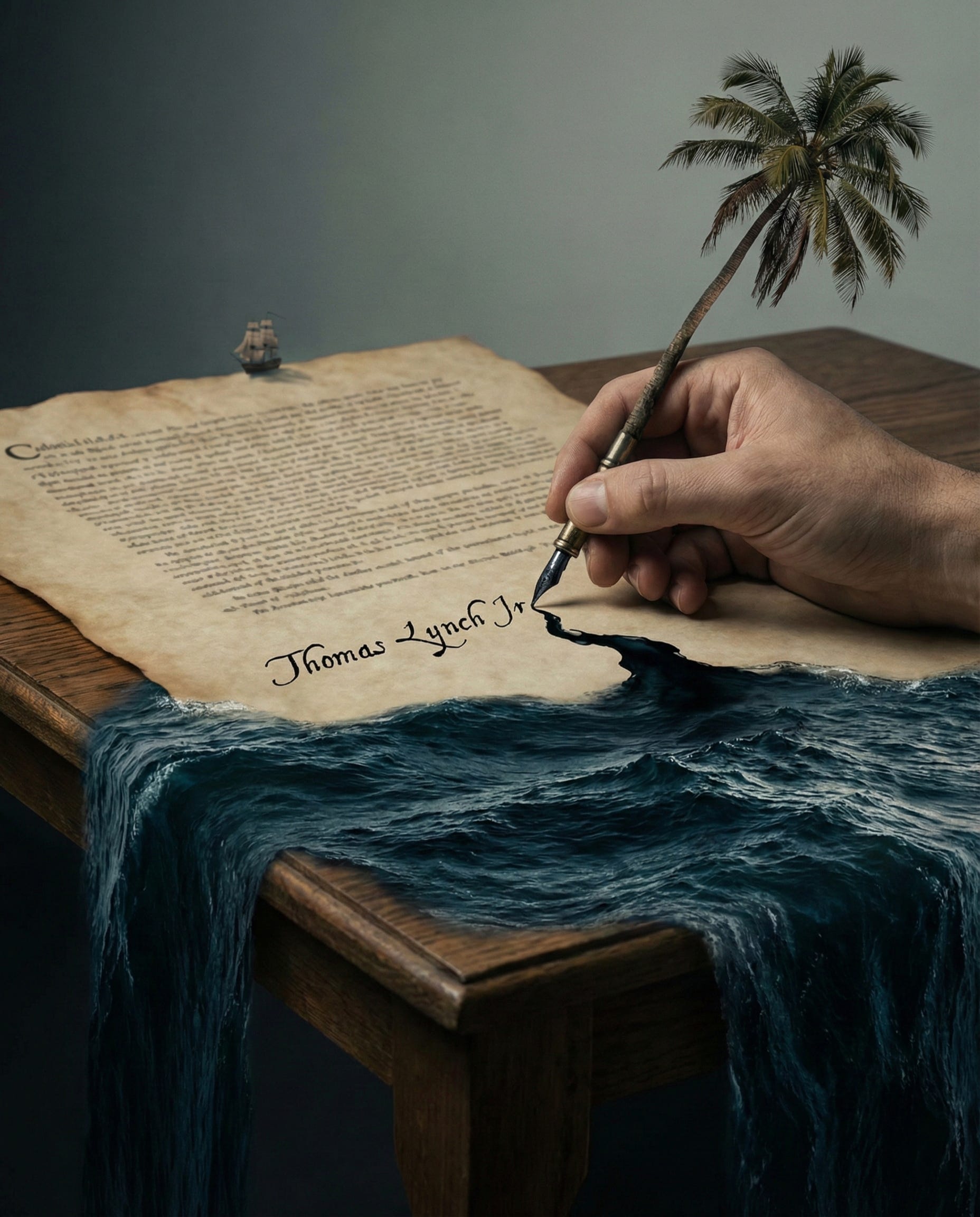
Of the fifty-six men who signed the Declaration of Independence, we know where fifty-five of them are buried.
One of them simply vanished.
Thomas Lynch Jr. was twenty-six when he signed his name to treason.
He was thirty when he stepped onto a ship with his wife Elizabeth, sailing from Charleston toward the West Indies.
The ship never made it. The Lynch family simply disappeared.
Leaving behind only a signature and a mystery that has never been solved.
The Dynasty
Thomas Lynch Jr. was born on August 5, 1749, into one of South Carolina’s most powerful families.
His father, Thomas Lynch Sr., was among the wealthiest planters in the colony, and the Lynch family belonged to the small circle of families who controlled the colony’s politics, economy, and society.
Young Thomas would inherit not just land and money, but expectations.
His family gave him the best education that money could buy. He began at the Indigo Society School in Georgetown, South Carolina, one of the first schools in the Carolina lowcountry. Then he crossed the Atlantic to attend Eton College, the boarding school that had educated England’s wealthy elite for three centuries. After Eton, he studied law at the Middle Temple in London, where generations of English lawyers had trained before him.
His father expected him to return polished and ready for leadership. And he did. But he also came back angry.
During his years in London, Lynch had met British politicians and heard how they talked about the American colonies. They didn’t speak of colonists as fellow citizens of the empire. They spoke of them as children who needed to be told what to do.
Lynch listened to these conversations in coffeehouses and dinner parties across London, and something changed in him. By the time he returned to South Carolina in 1772, at twenty-three years old, he had decided whose side he was on.
Father and Son
Thomas Lynch Sr. had been fighting for the American cause since before his son returned from England. He served as a delegate to the First Continental Congress in 1774 and continued into the Second, where he became one of the leading voices for Southern interests in the debates over independence.
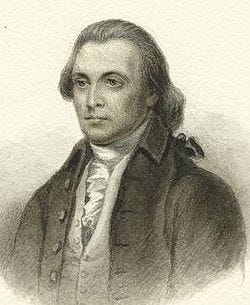
Then, in February 1776, everything changed. Lynch Sr. suffered a stroke that left him partially paralyzed. He could no longer walk to the congressional chamber, could no longer speak clearly in debate, could barely hold a pen. South Carolina still needed representation, and the most important votes in colonial history were approaching.
The assembly chose his son.

Thomas Lynch Jr. arrived in Philadelphia in the spring of 1776 with an impossible dual mission. He was there to represent South Carolina in Congress. He was also there to care for his dying father. For the next several months, he did both, going back and forth between the chamber where delegates debated independence and the boarding house where his father lay bedridden, watching him slip away day by day.
The Youngest Signer
When Congress adopted the Declaration of Independence on July 4, 1776, Thomas Lynch Jr. was twenty-six years old. Only one other signer was younger: Edward Rutledge, also from South Carolina, who was three months younger.
These were young men committing treason against the most powerful empire on Earth, in a war that their generation would have to fight.
Most delegates signed the Declaration on August 2nd, when the official copy was ready. Lynch added his name that day, grouped with the other South Carolina delegates: Rutledge, Thomas Heyward Jr., and Arthur Middleton.
His father’s name does not appear. The stroke had left him too weak to hold a pen.
Father and son left Philadelphia together that autumn, heading home to South Carolina.
They never made it.
In December, somewhere near Annapolis, Maryland, Thomas Lynch Sr. died. His son buried him and continued the journey home alone.
When Lynch finally reached South Carolina, he was the head of the family. He had inherited the plantations, the wealth, and all the responsibility that came with them. He was twenty-seven years old. And his own health had already begun to fail.
The Decline
No one knows exactly what was wrong with Thomas Lynch Jr. The doctors called it “bilious fever,” a catch-all term from that era that could mean almost anything: malaria, typhoid, or simply a body breaking down under stress. Whatever the cause, his condition worsened steadily after his father’s death.
He tried to keep going.
He served briefly in the South Carolina state legislature and attempted to manage the family plantations. But the work was too much. By 1779, he was too sick to continue.
For wealthy patients like Lynch, doctors of that era had one standard prescription: a sea voyage to warmer climates. The Caribbean islands were popular with Southern planters who wanted to escape the damp Carolina winters. Tropical air was supposed to heal what medicine could not.
In late 1779, Thomas and Elizabeth Lynch boarded a ship bound for the West Indies, hoping the tropical climate would help him recover.
They were never seen again.
The Mystery
What happened to Thomas Lynch Jr.?
The most likely answer is the simplest one: a storm. Ocean voyages in the eighteenth century were genuinely dangerous, and ships disappeared without explanation more often than we might imagine. A vessel caught in heavy weather could be swamped within hours, its passengers and crew swept into the sea with no one left to tell the story.
We will never know exactly what happened.
The sea took the Lynches, and the sea kept them.
The Legacy
Thomas Lynch Jr. left behind no children, very few letters, no grave. His widow Elizabeth vanished with him. The Lynch plantations passed to distant relatives, and the family name faded from South Carolina history.
Of all fifty-six signers, Lynch may be the most forgotten. His autograph is among the rarest, often mentioned alongside Button Gwinnett’s. But while Gwinnett’s rarity has made him famous among collectors, Lynch remains obscure even to them.

For the Lynch family, the loss was staggering.
Thomas Sr. had died on the road home from Philadelphia.
Thomas Jr. had vanished at sea.
Within three years, the direct line had ended.
The plantations passed to relatives, but the father and son who had signed and nearly signed the Declaration were both gone.
What Lynch Teaches Us
Thomas Lynch Jr. lived thirty years.
His public service spanned just four years, from a military commission in 1775 to his disappearance in 1779. He served in Congress for less than one of those years.
And yet his name sits on the Declaration of Independence, right there with Adams and Jefferson and Franklin.
Lynch’s moment came when his father couldn’t lift a pen. South Carolina needed someone to step into that seat, someone to vote for independence, someone to sign. Thomas Lynch Jr. was twenty-six years old, watching his father die, and he stepped forward anyway.
That’s what the signers did.
They showed up at a moment when showing up was dangerous.
Some of them went on to long careers.
Some of them, like Lynch, barely made it past the signing.
But the document doesn’t record how long they lived afterward. It only records that they were there.
History remembers people for their moments, not their lifespans.
Nineteen young men from Bedford, Virginia were among the first to die on Omaha Beach, and their sacrifice helped turn the tide of World War II.
Emily Brontë published one novel and died at thirty, but Wuthering Heights is still read almost two centuries later.
A young man who signs his name to treason can still help create a nation, even if the sea takes him three years later.
Thomas Lynch Jr. was twenty-six when he signed the Declaration.
He was thirty when he vanished.
But his signature is still there. Two hundred and fifty years later, it hasn’t faded.
Neither has his choice.
Next: Benjamin Franklin
From the youngest signers, we turn to the oldest.
Benjamin Franklin was seventy years old when he signed the Declaration of Independence. He was nearly half a century older than Thomas Lynch Jr. He had already lived multiple lives: printer, scientist, inventor, diplomat, philosopher. He was the most famous American in the world before America existed.
Franklin’s story is too big for a single essay.
His scientific discoveries alone would fill a book.
His diplomatic career changed the course of the Revolution.
His personal life was complicated, messy, and deeply human.
But at the signing, there’s a famous story. As he approached the document, pen in hand, Franklin reportedly said: “We must all hang together, or most assuredly we shall all hang separately.”
He probably never said it. Most of Franklin’s best lines were invented later.
But it captures something true about the man: even facing death, he couldn’t resist a joke.
That gallows humor, that refusal to take himself too seriously even in serious moments, is what makes Franklin endlessly fascinating to me.
He lived one of the most interesting lives in American history, and he seemed to know it was interesting while he was living it.
Next Sunday, I’ll try to tell the story of one of my favorite signers.
This is Essay #6 of 56 in the “The 56” series, profiling every signer of the Declaration of Independence. New essays every Friday and Sunday, culminating on July 4, 2026, the 250th anniversary of American independence.
Subscribe to follow the journey.
Sources: