

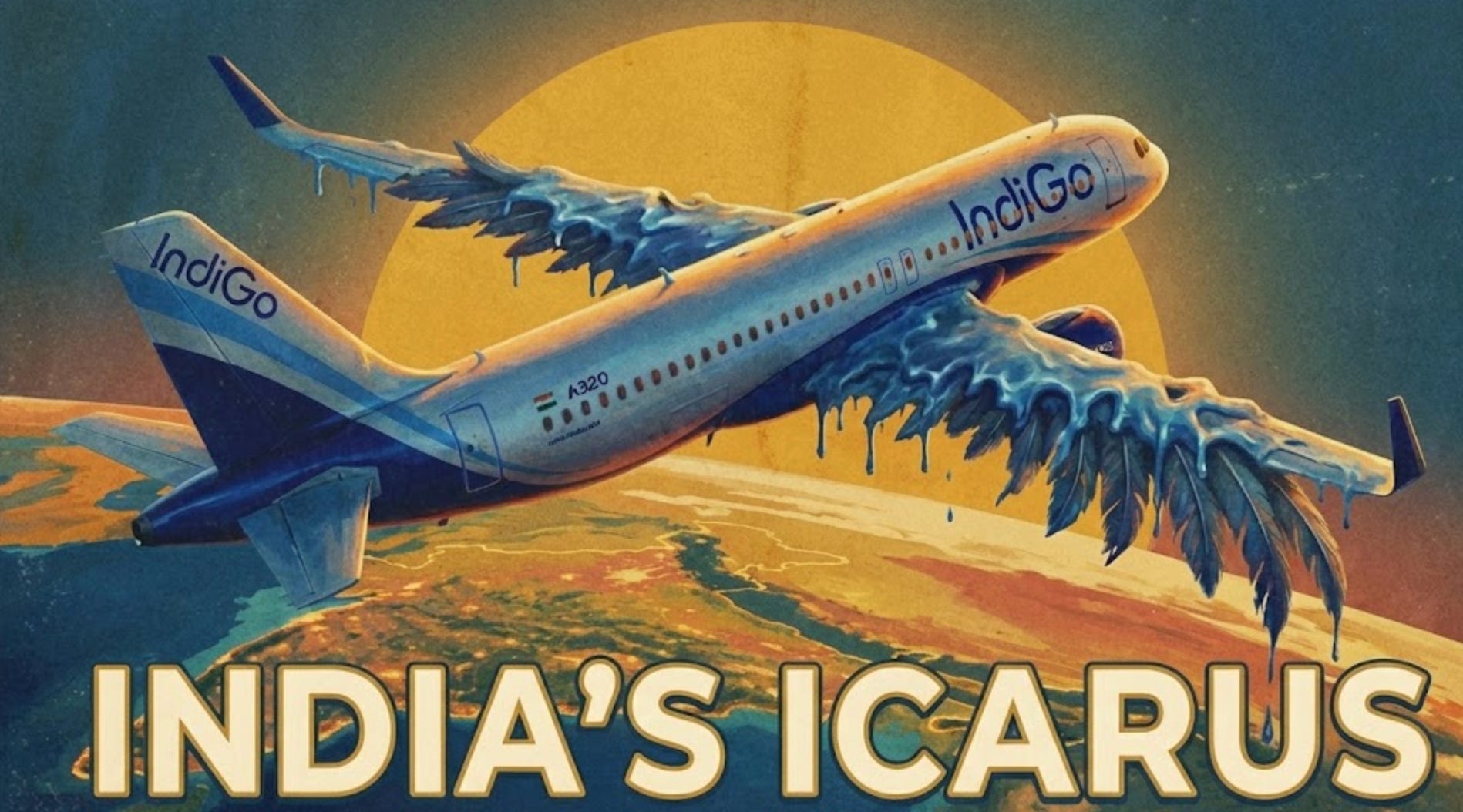
There is an ancient Greek story about a boy named Icarus.
His father was a brilliant inventor who made him a pair of wings crafted from feathers and wax. Before Icarus took off, his father gave him a stern warning: do not fly too close to the sun.
The heat will melt the wax, the feathers will fall out, and you will crash.
But Icarus was young, ambitious, and thrilled by the feeling of flight.
He climbed higher and higher, ignoring the warning, until the sun’s heat destroyed his wings.
He fell from the sky into the sea.
For nearly twenty years, an airline called IndiGo was the Icarus of India.
It flew higher than anyone else.
It was faster, cheaper, and more efficient than any competitor.
If you looked at the departures board in any airport in India—from the bustling capital of Delhi to the quiet terminals of smaller cities—you saw a wall of blue.
Row after row of flights listed the same status: “On Time.” IndiGo built its entire reputation on being a perfect machine.
It did not make mistakes.
It did not run late.
It just worked.
But in early December 2025, the wax began to melt.
The departures boards that used to be a comforting wall of blue suddenly turned into a terrifying sea of red. The words “On Time” were replaced by “Cancelled.”
It started small with a few delayed flights here and there. Then, it slowly spiraled out of control. Within one week, the airline grounded over 2,000 flights.
The perfect machine had broken down.
On social media, a new joke began to spread. People in India use the word “Panoti” to describe someone or something that brings bad luck.
As thousands of passengers found themselves sleeping on cold airport floors, surrounded by mountains of lost luggage, the internet decided that a “Panoti” must have taken charge of the country’s biggest airline.
The pride of the nation had become a punchline.
But this was not just a story about bad luck. It was a story about a company that flew too close to the sun, thinking the rules of gravity and mathematics did not apply to them.
The Week the Sky Fell
To understand how big this mess was, you have to look at the scene inside India’s airports. December is a busy time in India. The weather is cool, schools are on break, and it is the peak season for weddings. Families travel with heavy suitcases full of gifts and clothes. Business people fly between cities to close deals before the year ends.
On December 5, 2025, usually a normal Friday, the system collapsed. IndiGo cancelled roughly 1,600 flights in a single day. That was nearly half of all the flights they were supposed to fly.
Airports are designed to move people, not to store them. When thousands of people could not get on a plane, they had nowhere to go.
They filled the waiting areas.
Then they filled the hallways.
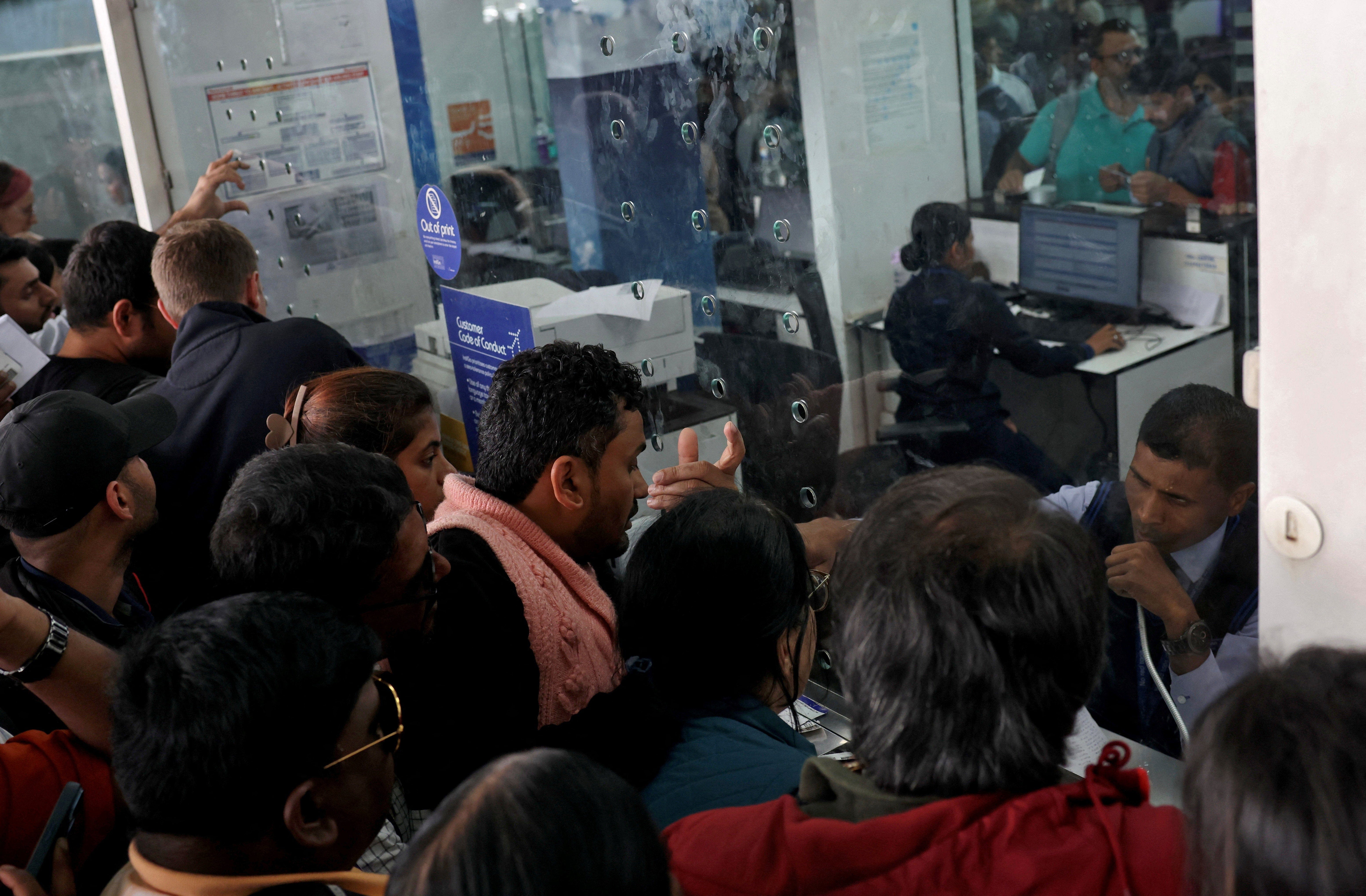
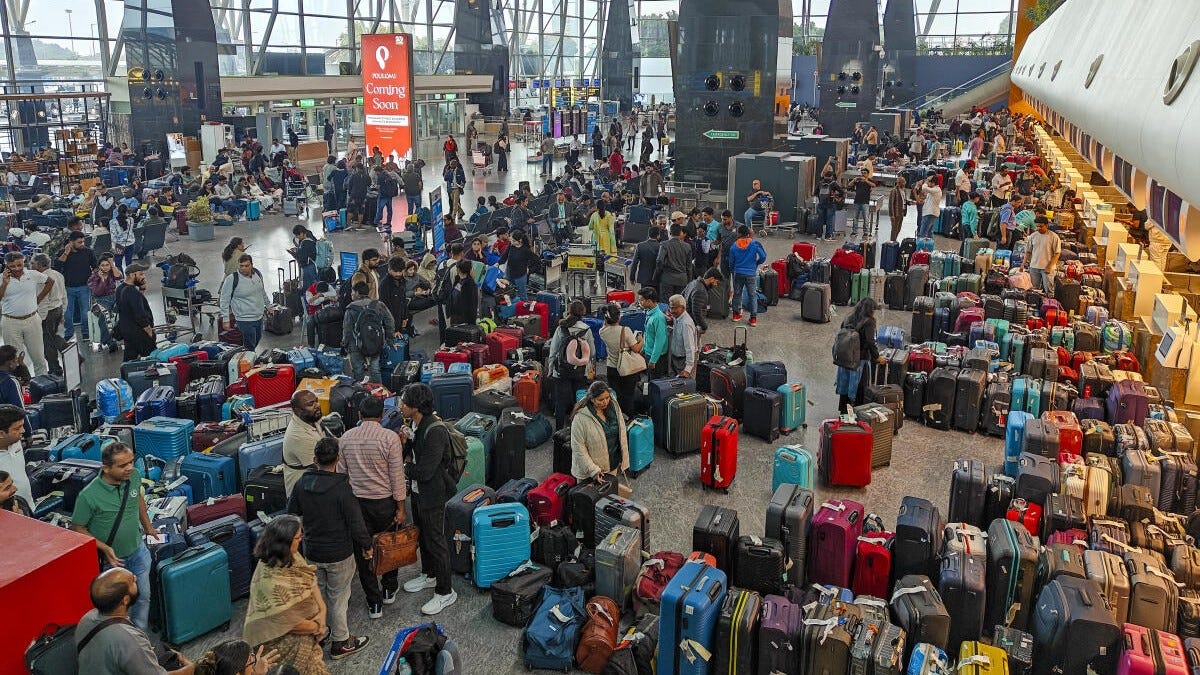
Eventually, the crowds spilled out onto the curbs outside. Inside, the baggage belts kept churning out suitcases for flights that were never going to take off.
The bags piled up in the middle of the terminal like barricades.
Video clips posted online showed angry passengers shouting at ground staff. These workers, who check tickets and load bags, had no answers.
They were just as confused as the travelers.
One actress posted a video from the Mumbai airport calling the scene “apocalyptic.”
It looked less like a travel hub and more like a disaster zone.
The disruption was so massive that it did not just hurt IndiGo. It hurt the whole country.
Since IndiGo controls about 65% of all flights in India, when they stop flying, India stops moving.
Prices for tickets on other airlines skyrocketed.
A ticket that usually cost ~$60 suddenly cost ~$600.
The government had to step in.
They ordered the trains to add more cars to help stranded people get home. They put caps on ticket prices to stop other airlines from taking advantage of the desperate travelers.
It was a total meltdown.
But unlike a meltdown caused by a blizzard or a hurricane, the sun was shining outside. The weather was fine. The storm was entirely inside the company’s computers and crew schedules.
The Trap of Efficiency
How does a company that is famous for being perfect suddenly fall apart? The answer lies in how they became successful in the first place.
IndiGo became the king of the Indian skies by being “lean.”
They did not buy extra planes.
They did not hire extra people.
They made sure every dollar spent brought a dollar back.
For years, this strategy worked wonders. IndiGo planes spent more time in the air than almost any other airline’s planes.
IndiGo perfected the art of the “turnaround.” This is the time it takes for a plane to land, let passengers off, get cleaned, refuel, load new passengers, and take off again.
Most airlines take 45 minutes or an hour to do this.
IndiGo could do it in 25 minutes.
They even weighed the sandwiches on board instead of counting them one by one to save a few seconds.
This obsession with speed made them very profitable. While other Indian airlines like Kingfisher (2012) and Jet Airways (2019) went bankrupt and disappeared, IndiGo kept growing. They became a giant.
But there is a hidden danger in being too lean. Engineers call it a lack of “redundancy” or “slack.”
Think of it like packing a backpack for a hiking trip. If you want to be “lean,” you pack exactly one bottle of water because you know the hike takes two hours and you drink one bottle in two hours.
You are efficient.
Your bag is light.
But what if you get lost?
What if the sun is hotter than you expected?
You have no extra water. You have no “slack.”
IndiGo ran its airline like that backpacker. They had exactly enough pilots to fly their planes if everything went perfectly.
They did not have many “backup” pilots sitting at home, ready to step in if someone got sick or if a flight got delayed.
They were betting that nothing would go wrong.
The Math Problem
The specific thing that went wrong was a change in the rules.
Pilots have a very difficult job.
They are responsible for the lives of hundreds of people. If a pilot is tired, they make mistakes. Because of this, every country has strict rules about how many hours a pilot can fly and how much rest they must have between flights.
In India, the government decided that the old rules were not safe enough. There had been scary incidents where pilots died of heart attacks or fell asleep. So, the aviation authorities announced new rules.
These rules increased the mandatory rest period for pilots. Instead of getting 36 hours of rest a week, pilots now needed 48 hours.
This sounds like a small change, only 12 extra hours.
But for an airline, it is a huge math problem.
If every pilot needs more rest, that means every pilot can fly fewer hours each week. To fly the same number of planes, you need more pilots.
A lot more.
Experts calculated that IndiGo would need about 20% more pilots to keep their schedule running under the new rules.
IndiGo knew these rules were coming.
They had months to prepare.
But instead of hiring hundreds of new pilots, they froze hiring.
They stopped bringing new people in.
Perhaps they thought the government would change its mind. Perhaps they thought they could squeeze their existing pilots just a little bit harder.
When the new rules kicked in on December 1st, the math simply stopped working. The schedule required more pilot hours than the airline had available.
It started a domino effect. Picture a row of dominoes.
If the first pilot is “timed out” (meaning they have flown their maximum hours and must stop), there is no backup pilot to take their place.
The flight gets cancelled.
The plane sits on the ground.
The passengers for the return flight are now stranded.
The crew that was supposed to fly that plane next is now in the wrong city.
Within three days, the entire roster—the master schedule of who flies where—was a jumbled mess.
Pilots were stuck in hotels in the Middle East waiting for a plane to fly home.
Planes were stuck in Mumbai waiting for pilots who were in Delhi.
The “lean” system had no buffer to absorb the shock. It shattered.
Too Big to Tame
This crisis revealed something scary about India’s aviation market. It is what economists call a “duopoly.” A duopoly is when a market is controlled by just two major players.
In the United States, there are four big airlines: American, Delta, United, and Southwest. If one of them has a meltdown, the other three can help absorb the passengers.
In India, there are basically only two groups. There is IndiGo, which is massive, and there is the Air India group (owned by the Tata company). Together, they control over 90% of the market.
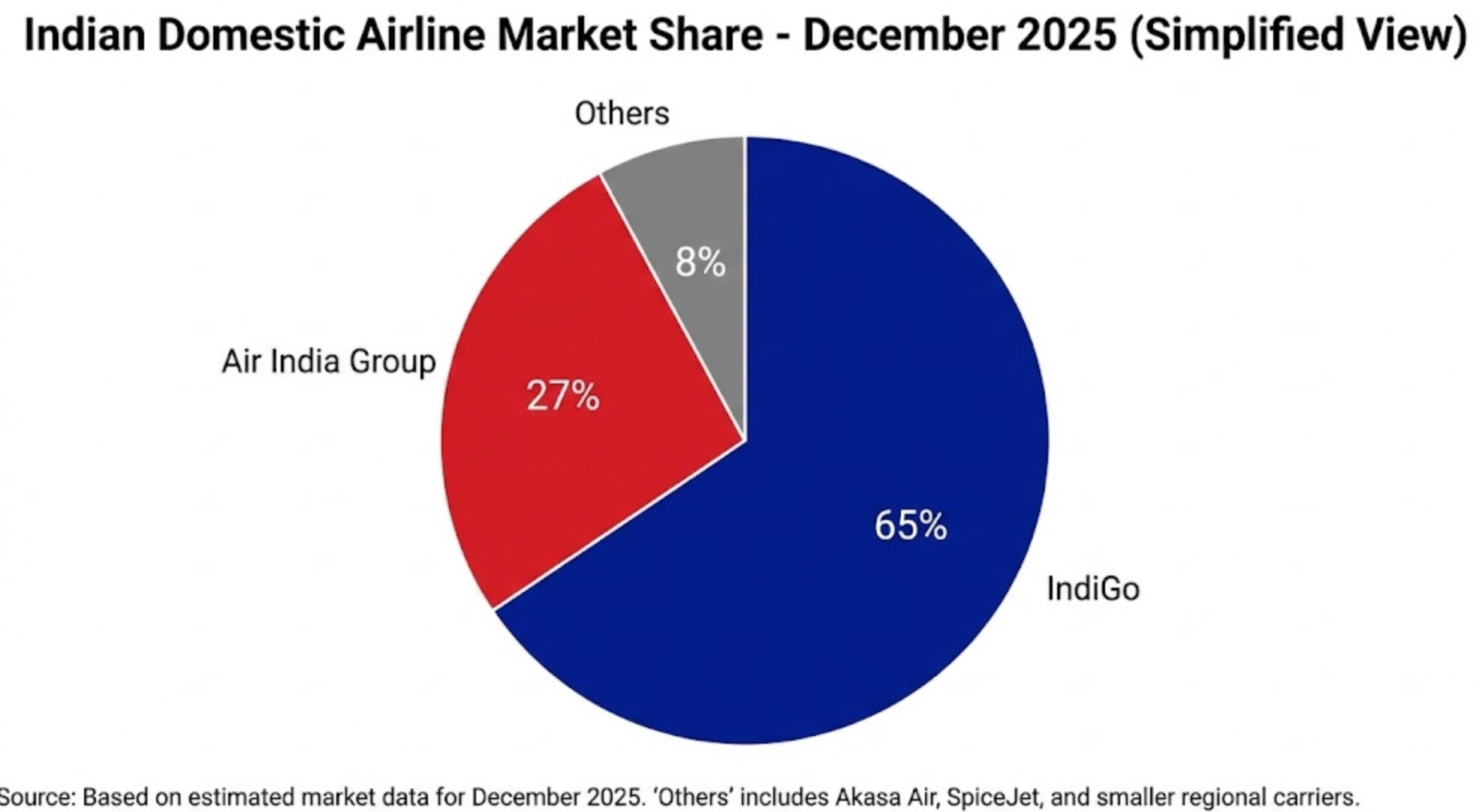
IndiGo is so big that when it fails, there is no one to catch the fall. Air India is still rebuilding itself and did not have enough spare planes to help. The smaller airlines are too tiny to make a difference.
This created a situation known as “Too Big to Tame.” Usually, we hear “Too Big to Fail,” where the government has to save a company because its collapse would destroy the economy.
“Too Big to Tame” is slightly different.
It means the company is so powerful that the government cannot enforce the law.
When IndiGo’s operations collapsed, the government regulator—the Directorate General of Civil Aviation (DGCA)—was in a bind.
They wanted to enforce the safety rules about pilot rest.
But enforcing the rules meant IndiGo would have to cancel thousands more flights for months, ruining the economy and travel plans for millions.
So, the government blinked.
They gave up.
In the middle of the chaos, the government granted IndiGo an “exemption.”
They allowed the airline to ignore the new safety rules for two more months. They let IndiGo go back to the old, less safe schedule just to get the planes moving again.
This showed that IndiGo held all the cards.
By failing so spectacularly, they forced the government to relax the safety standards. The “Panoti” bad luck had turned into a “Get Out of Jail Free” card.
Humans vs. Hardware
There is a deeper reason why this happened, and it goes beyond just one airline. It highlights a struggle that many rapidly developing countries face. It is the difference between “hardware” and “software.”
In this context, “hardware” is the stuff you can buy. You can buy airplanes. You can build shiny new airport terminals with glass walls and fast Wi-Fi. India has been very good at this. The government has doubled the number of airports in the last ten years. IndiGo has ordered nearly 1,000 new planes, the largest order in history. The hardware is world-class.
“Software” is different. In this analogy, the software is the people. It is the skilled pilots, the air traffic controllers, and the safety inspectors. You cannot just buy these things off a shelf. You have to train them.
It takes a few months to build an airplane. It takes years to train a captain.
India is buying planes faster than it is training pilots. The country needs about 30,000 new pilots in the next few years to fly all the jets it has ordered. But the training schools in India cannot produce that many graduates.
This has created a shortage. Airlines are trying to do more with fewer people. They had plenty of hardware (planes) but not enough software (pilots).
This is different from what happened in the United States a few years ago. In December 2022, Southwest Airlines had a similar meltdown. They cancelled thousands of flights and ruined Christmas for many Americans.
But the cause was different.
Southwest failed because their computer technology was old and broken. They had the people, but their actual computer software couldn’t keep track of them.
IndiGo’s computers were fine. Their technology is modern. Their failure was a “human capital” failure. They ran out of eligible humans to fly the machines.
You can fix a computer glitch with a software update. You cannot fix a pilot shortage overnight. This suggests that India’s aviation problems might last a long time.
The Middle-Income Trap
Economists have a theory called the “Middle-Income Trap.” It explains why it is easy for a poor country to become a middle-class country, but very hard for a middle-class country to become a rich one.
To go from poor to middle-class, you just need to move people from farms to factories. You build roads, bridges, and airports. You use cheap labor to make things. This is the “easy” part.
To go from middle-class to rich (like the US, Japan, or Germany), you need efficiency, innovation, and strong institutions. You need systems that are robust and safe. You need high-skilled workers, not just cheap ones.
The IndiGo crisis is a classic example of the Middle-Income Trap. India built the infrastructure (the airports and airlines) of a rich nation. But it was trying to run them with the mindset of a developing nation: cutting corners, saving every penny, and ignoring safety buffers.
The government wants India to be a “Viksit Bharat,” or a developed nation, by 2047. To do that, they have great ambitions.
They want Air India to compete with Emirates and Singapore Airlines.
They want Delhi to be a global hub like Dubai or London.
But you cannot be a global hub if your biggest airline collapses because of a roster change. You cannot be a developed nation if your solution to a safety problem is to cancel the safety rules.
The “Icarus” moment for IndiGo is a warning for the whole Indian economy. It is a sign that the country is growing so fast that its foundations are shaking. The “software” needs to catch up to the “hardware.”
Air India’s Problems
We cannot talk about India’s aviation struggles without looking at the other giant in the room: Air India.
While IndiGo was dealing with scheduling chaos, Air India was dealing with something far more tragic.
Air India was once a state-owned airline known for dirty seats and rude staff.
It was bought by the Tata Group, a massive and respected Indian company, which promised to restore it to glory.
They ordered 470 new planes costing $70 billion.
They promised a new golden age.
But in June 2025, disaster struck.
An Air India flight taking off from Ahmedabad crashed shortly after lifting off the runway. It was a horrific accident that killed 260 people.
It was the deadliest aviation crash in the world in a decade.
Investigators found something shocking.
The pilots had accidentally shut off the fuel to the engines right after takeoff.
One pilot asked, “Why did you cut off the fuel?” and the other denied doing it.
It was a confusing, terrible error.
This crash cast a long shadow over Indian aviation. It raised questions about pilot training and mental health.
It was actually this crash that made the government so strict about the new pilot fatigue rules. They wanted to make sure tired pilots were not flying planes.
So, the two crises are connected.
The tragedy at Air India led to the new rules.
The new rules led to the meltdown at IndiGo.
Both events showed that buying billions of dollars worth of airplanes is not enough to create a safe, reliable aviation sector.
Global Ambitions vs. Local Reality
These failures hurt India’s image on the world stage. India wants to attract tourists. It wants international businesses to set up headquarters in Mumbai and Bengaluru.
When a business traveler sees news about “apocalyptic” airports and lost luggage, they hesitate. When a tourist hears about safety issues, they might choose to vacation in Japan or Vietnam instead.
IndiGo itself has global dreams.
They recently ordered a new type of plane—the Airbus A350.
These are huge, wide-body jets meant for long flights to Europe and the US.
IndiGo wants to stop being just a domestic bus service and become a global carrier. They even announced a new business class service called “IndiGo Stretch.”
But running a long-haul international airline is much harder than running short domestic hops. If you cancel a flight from Delhi to Mumbai, you can put the passengers on the next bus or train, or fly them the next morning.
If you cancel a flight from Delhi to London, you have a major international incident.
You have to pay for expensive hotels.
You have to deal with European regulations that punish airlines severely for delays.
If IndiGo struggled to manage the schedule for its simple domestic flights, many experts worry about how they will handle the complex puzzle of international travel.
The “Panoti” of December 2025 might be a warning that they are not ready for the big league yet.
The Road to Recovery
What happens next?
The immediate crisis is dying down.
IndiGo is flying again.
They are slowly hiring more pilots.
They are building a little more “slack” into their system, even if it costs them some money. The government has promised to bring back the stricter safety rules once the winter travel rush is over.
There are lessons here for everyone.
For the airlines, the lesson is that resilience is worth paying for.
Saving money by running a skeleton crew looks great on a spreadsheet until the day the skeleton breaks. A little bit of “fat”, extra pilots, spare planes, is not waste.
It is insurance.
For the government, the lesson is that they need to be stronger. A regulator cannot be afraid of the companies it regulates.
They need to fix the pilot training system so there are enough skilled people to fly the planes.
They need to encourage more competition so that if one airline fails, the whole country doesn’t grind to a halt.
And for the Indian traveler, the lesson is one of patience and caution.
The era of cheap, ultra-efficient, perfect travel might have hit a speed bump. The ticket prices might go up to pay for the extra safety and reliability.
The Wax and the Wings
Icarus fell because he forgot his limits.
He thought the higher he flew, the better he was.
IndiGo made the same mistake.
They thought that growing bigger and flying faster was the only goal.
They forgot that you also need to be strong.
India’s aviation dreams are not over. The country will continue to fly. New planes will arrive, and new airports will open. But hopefully, the builders of this new India will remember the lesson of the wax wings.
You cannot build a superpower on a foundation of exhaustion and shortcuts.
To truly soar, and to stay in the sky, you need wings made of stronger stuff.
The flight might be a little more expensive, and the climb might be a little slower, but at least everyone will arrive safely at their destination.