

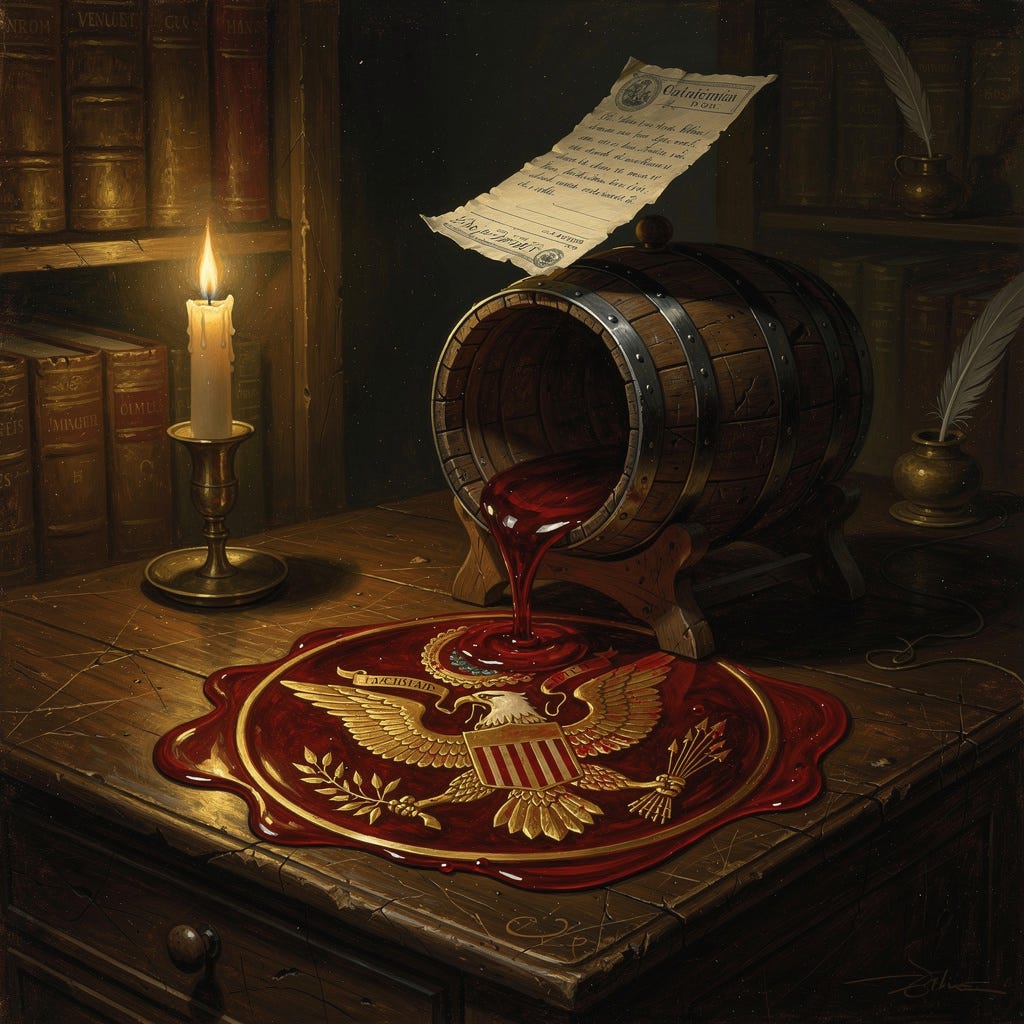
In 1780, Francis Hopkinson sent a bill to Congress.
He wanted payment for services rendered. Specifically, he claimed design work on the Great Seal and the American flag.
The amount he requested was a quarter cask of wine.
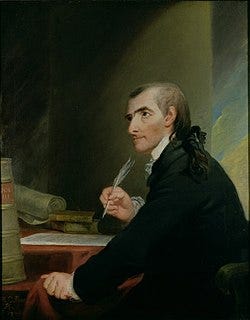
Congress refused. They said Hopkinson already held paid public posts and hadn’t worked alone on the designs. He pushed back. They held firm.
The dispute faded for decades. Then the late nineteenth century revived interest in who designed the flag, and suddenly Hopkinson’s claim mattered again.
The best answer was partial credit.
But the flag was the least interesting thing about Francis Hopkinson.
The Apple-Sized Head
To understand why Hopkinson kept asking for credit, you have to understand what kind of man was doing the asking.
John Adams met him at the Continental Congress in 1776 and left one of the most vivid physical descriptions of any founder. Adams called him “one of your pretty, little, curious, ingenious men.” Then he added the detail that stuck: “His head is not bigger than a large apple.”
He praised Hopkinson’s breeding and manners, calling him “genteel” and “well-bred” and “very social.” But he filed him away almost as a curiosity, an amusing specimen compared with the grim work of war.
Hopkinson was born on October 2, 1737, in Philadelphia. His father, Thomas, was a lawyer and one of Benjamin Franklin’s closest friends. When Thomas died in 1751, Francis was fourteen.
His mother held the family together and enrolled him as the first student at the Academy of Philadelphia. Today it is known as the University of Pennsylvania. He graduated in its first class.
He studied law and built a practice, but law was never the point. Hopkinson wrote songs and sketched designs for public symbols. He composed what music historians now consider among the first art songs written by a native-born American.
Jefferson called him “a man of genius, gentility & great merit” and then immediately noted he was poor, with a large family, holding “a little office more respectable than profitable.”
Franklin was closer. In his will, Franklin called Hopkinson “my ingenious friend” and left him all his scientific instruments.
Not books. Not money. The tools of investigation. He trusted Hopkinson to use them.
A man like that was never going to sit out a revolution.
The Comedian
When the war came, Hopkinson turned to the only weapon he’d ever had.
He had a gift for mockery. Starting in 1774, he published satirical pieces attacking the British and their American loyalist allies. “A Pretty Story” was a fable where Parliament became a wicked nobleman and the colonies became his long-suffering farm. It traveled fast through parlors and coffeehouses.
But his best-known work came in 1778. “The Battle of the Kegs” was a comic ballad mocking the British response to floating explosive devices in the Delaware River. The poem spread so fast it was printed as a broadside. A broadside was a single sheet posted on walls and passed hand to hand.
Gallants attend, and hear a friend Trill forth harmonious ditty: Strange things I’ll tell which late befell In Philadelphia city...
The British noticed.
Hopkinson staged “The Temple of Minerva,” an early attempt at American opera celebrating the French alliance. Loyalists in New York fired back with a parody called “The Temple of Cloacina.” Cloacina was the Roman goddess of sewers. They turned his temple into an outhouse.
That tells you he was effective. You don’t spend ink mocking someone who isn’t hurting you.
Hopkinson’s satire had consequences beyond the printed page. In December 1776, Hessian soldiers raided his house in Bordentown, New Jersey.
Captain Johann Ewald walked into Hopkinson’s library and found it full of books and scientific equipment. He wrote in one of the volumes: “one of the greatest Rebels... nevertheless a very learned Man also.” The house was looted but not burned.
Hopkinson didn’t just mock the enemy. He tried to give the new country a face.
The Flag
On June 14, 1777, the Continental Congress passed the Flag Resolution:
“the flag of the United States be made of thirteen stripes, alternate red and white; that the union be thirteen stars, white in a blue field, representing a new Constellation.”
The resolution named no designer.
That silence created a vacuum. In 1780, Hopkinson tried to fill it. He filed a claim for design work on the flag and several government seals, including an early version of the Great Seal. His proposed design included a striped shield in national colors and an olive branch. Both elements survived into the final version.
Congress acknowledged the work but wouldn’t pay. They said the design process involved committees. No single author could own a national symbol.
The flag claim sat quiet for nearly a century. Then in 1870, Betsy Ross’s grandson told a story: George Washington had visited his grandmother’s shop in 1776 and asked her to sew the first flag. No proof from the time supports this. No letter, no receipt, no diary entry.
Hopkinson’s claim is closer to the event and better documented. His letters and Congress’s replies survive. Ross appears in family memory and in the documented trade of flag-making.
Hopkinson contributed to the design. Ross may have sewn flags. Neither made the flag alone.
But ask most Americans who designed the Stars and Stripes, and they’ll say Betsy Ross. They won’t mention Hopkinson.
But he found different ways to be useful to building of a new nation.
The Judge
After the war, Hopkinson became a judge. First in Pennsylvania’s Admiralty Court. Then, in 1789, George Washington appointed him to the new federal bench, one of the first federal judges in American history.
Getting to the federal bench required surviving an impeachment. In 1780, Constitutionalist Party rivals in the Pennsylvania legislature formally accused him of accepting improper payments. A trial cleared his name and he kept his seat.
Meanwhile, he kept composing. In 1788, he published “Seven Songs for the Harpsichord or Forte Piano” and dedicated them to Washington. In the dedication, he made a bold claim: he expected “Credit” as “the first Native of the United States who has produced a Musical Composition.” Washington wrote back with dry humor, thanking him for the “delightful harmony” and joking the music might “melt the Ice of the Delaware.”
Hopkinson also won the Magellanic Premium, the American Philosophical Society’s top science prize. He was its first recipient, honored for inventing a spring-block device to help with sailing. He designed a keyboard upgrade for Benjamin Franklin’s glass armonica, a musical instrument made from spinning glass bowls. He wrote essays that mixed scientific description with comedy. Judge, composer, scientist, satirist, Hopkinson aimed to live his life to fullest.
On May 9, 1791, Hopkinson suffered a sudden seizure and died. He was fifty-three. He was buried at Christ Church Burial Ground in Philadelphia, not far from Franklin.
The bill he sent to Congress was never paid.
His son Joseph would later write “Hail, Columbia,” which served as the country’s unofficial national anthem until “The Star-Spangled Banner” replaced it in 1931.
What Hopkinson Teaches Us
Two generations of Hopkinsons gave the country its sounds and its symbols.
Both were forgotten.
Hopkinson spent his life doing the work that revolutions need but rarely remember. He designed the symbols and wrote the songs that gave a new country its look and its voice. He made the enemy look foolish in print.
Then he asked for credit. A quarter cask of wine. Congress said no.
Two hundred and fifty years later, most Americans know Betsy Ross but have never heard of Francis Hopkinson. The man who submitted documentation for the flag’s design is a footnote. The woman whose grandson told a story in 1870 is a legend.
The people who create a nation’s symbols rarely get to own them.
Next: Abraham Clark
From the man who may have designed America’s flag, we turn to the man who was asked to choose between his country and his sons.
Abraham Clark of New Jersey was called “The Poor Man’s Counselor.” He was a self-taught lawyer who gave free legal advice to farmers. He wore no wig and owned no ruffled shirts. He was the most ordinary man in Congress.
Then the British captured his two sons and locked them on HMS Jersey, the deadliest prison ship in the Revolution. They told Clark the terms: take back your signature on the Declaration, and your sons go free.
He refused. One son never recovered.
Next time, we tell the story of the father who would not unsign his name.
This is Essay #18 of 56 in the “The 56” series, profiling every signer of the Declaration of Independence. New essays every Friday and Sunday, ending on July 4, 2026, the 250th anniversary of American independence.
Sources:
Today in History: June 14 (Flag Resolution text) | Library of Congress
Francis Hopkinson’s Claim | Smithsonian National Postal Museum
The Legend of Betsy Ross | Smithsonian National Postal Museum
John Adams diary, 1776 (Adams Papers Digital Edition, Massachusetts Historical Society)
Thomas Jefferson to James Monroe, 1784 (Founders Online, National Archives)
Benjamin Franklin, Last Will and Testament, 1790
George Washington to Francis Hopkinson, February 5, 1789 (Founders Online, National Archives)
Captain Johann Ewald, diary entries, December 1776