

Every morning around 10:00 AM, a quiet whirring sound starts in my kitchen. It’s my robotic vacuum, beginning its daily pilgrimage. I’ve watched it navigate the legs of my dining room chairs so many times I can predict its every move. It will bump gently into a chair leg, pause for a robotic microsecond as if contemplating its existence, pivot 45 degrees, and continue on its way. It cleans the same patches of hardwood it has cleaned over a thousand times before. It’s dumb, persistent, and a tiny miracle of automation that I now take completely for granted.
Most days, I barely notice it.
But sometimes, as I’m eating my breakfast, I watch the little robot and I wonder. What happens when it gets smart? I don't just mean smart enough to not get tangled in a phone charger.
I mean truly capable.
What happens when its great-great-granddaughter can not only vacuum the floor but also notice a loose floorboard, order the part, and install it? What happens when it can fold the laundry, fix a leaky faucet, and prepare dinner for the family?
We are, as a society, having a full-blown panic attack about the future. You hear it everywhere, from billionaires on social media to anxious news anchors. The great fear is that we’re not having enough babies. Birth rates are falling, and if we don’t do something, we’re told, civilization will “crumble to dust.” It’s a terrifying story, one that taps into our deepest fears of extinction.
But I think we’re telling ourselves the wrong scary story. As I watch my cleaning robot doggedly suck up dust bunnies, I’m convinced the real story isn't about a shortage of people. It’s about a world that is rapidly discovering it might not need as many of us as it once did.
And this isn't a catastrophe.
It might be the most natural adaptation humans have ever made.
The Great Middle Management Extinction Event
Let’s start with the office.
Walk into any mid-sized corporation in America. Look past the cubicles and the sad desk plants. You’ll find an entire ecosystem of people whose primary job is to act as human routers. Assistant managers who manage other assistant managers. Coordinators who coordinate with other coordinators. Supervisors who supervise people who could supervise themselves.
These people exist because our system needed warm bodies to manage information. I’d like to introduce you to someone named Dave.
Dave is a director of something-or-other. His day is a back-to-back marathon of meetings.
At 9 AM, he has a pre-meeting to prepare for the 11 AM meeting.
At 11am, he has a meeting to discuss what other meetings he and the team will need to have that week.
At 2 PM, he has a post-meeting to debrief about the 11 AM meeting.
His most-used skills are calendar management and crafting emails that gently nudge other people to do their jobs.
Dave isn’t a bad person.
He’s not lazy.
He’s a product of a system that helped build the modern economy.
For a century, companies needed people like Dave to be the connective tissue that moved information up and down the chain of command. But now, AI is here to potentially change that. When it works correctly, AI doesn’t need a supervisor to check its work. It doesn’t get office anxiety or need someone to schedule its breaks.
When ChatGPT can draft a more persuasive and grammatically perfect email than Dave, what is his salary paying for? When a single AI dashboard can analyze sales data from every region in real-time, why do we need a whole department of analysts to compile weekly reports? When automated systems handle scheduling, logistics, and reporting without office drama, what’s left for the human routers to do?
The roles that exist purely to fill the gaps in our information systems are evaporating. Those gaps are closing, and the Daves of the world are standing right on the fault line.
The Blue-Collar Reality Check
“Okay,” the skeptic says, “but AI can’t fix my plumbing! A robot can’t wire my house!” This has become the go-to defense for the irreplaceable nature of skilled trades. And it’s true, for now.
But we’re confusing what’s true today with what’s true forever.
Let's look at what’s already happening on the ground. Figure recently demoed their new humanoid robot folding laundry. Tesla’s robots are scheduled to help build a base on Mars.
The reality check, of course, is that these machines are still expensive and rare. The Bureau of Labor Statistics predicts that jobs for electricians will grow by ~9% through 2034. Mass automation of construction might be decades away. My robotic vacuum is like the Model T of home robotics, a clumsy and early version of something that will one day be transformative.
But the next generation is coming. Picture a single home-service unit, a descendant of today's cleaning robots. It will be equipped with manipulator arms, 3D scanners, and a connection to a vast library of DIY knowledge. It will be the robot that can also fix that loose cabinet door, snake a clogged drain, and assemble that nightmare IKEA bookshelf.
When these multi-purpose robots cost as much as a high-end washing machine, large swaths of the service economy will be fundamentally reshaped. We won’t stop needing these services. We’ll just start getting them from machines that work 24/7, never get injured, and never ask for a raise.
The Great Divide: The Connected vs. The Human
As this technological shift accelerates, a fascinating cultural split is emerging. It’s the divide between the hyper-connected and the deliberately disconnected.
On one side, you have the world of ultimate efficiency, optimized by AI. Imagine restaurants where an AI takes your order and robotic arms prepare your food. Think of hotels where you check in with facial recognition. These places will be fast, cheap, predictable, and utterly sterile.
On the other side, you have a powerful counter-movement: the embrace of the deliberately disconnected. This is already a thriving luxury.
Take a look at Caterina’s, a restaurant in Fort Worth, Texas, where diners are required to place their phones in a locked pouch. The result is a dining room that buzzes with actual human conversation. In London, The French House pub has banned phones for decades.
Restricting phones doesn’t only happen in the dining room, it is also happening in schools. An ultimate tell is what some people in the tech industry do with their own children. Many executives and engineers in Silicon Valley have sent their own kids to tech-free schools while pushing more technology on unsuspecting school districts.
Why?
Because in a world saturated with technology, the new luxury is humanity.
These schools use old-fashioned chalkboards and teach cursive with pen and paper, believing that true creativity is fostered through physical interaction, not by staring at a screen.
The Longevity Factor: The 60-Year Career
There’s another massive piece of this puzzle that the population doomsayers consistently miss. We aren't just having fewer babies; we are getting astonishingly good at keeping the people we already have alive.
Average life expectancy is a modern miracle. In 1950, the average American lived to be about 68. Today, that number is closer to 77. In places like Japan, it’s over 80. People are staying healthy, active, and productive much longer than ever before.
When someone can have a productive working life of 60 or 70 years instead of 40, the entire math of population replacement changes. We simply don't need to replace every worker one-for-one as quickly when the existing workforce sticks around, contributing for decades past the traditional retirement age.
The Wars That Aren't Happening
For all of human history, societies needed to produce a surplus of people simply because so many of them would be killed off. Wars, plagues, and famines were grimly reliable.
But over the past 80 years, something extraordinary has happened. Despite terrifying headlines, we are living in one of the most peaceful periods in recorded human history.
World War II killed an estimated 75 million people, roughly 3% of the global population at the time. To put that in perspective, imagine three out of every hundred people you know being wiped out. In recent years, by contrast, the total number of deaths from all armed conflicts worldwide has been a tiny fraction of that. According to the Uppsala Conflict Data Program, one of the leading academic sources, battle-related deaths in 2023, a year that included major conflicts, numbered around 154,000 globally. While every death is a tragedy, war has gone from a primary threat to humanity's existence to a much smaller (though still serious) problem.
We no longer need a large population to serve as a buffer against mass casualties because, by and large, the mass casualties aren't happening. Modern warfare is fought with drones, cyberattacks, and economic sanctions, not with massive conscript armies.
The Uncomfortable Truth
We have to face the most sensitive reason birth rates are falling. It comes down to two forces that have reshaped the modern world: women's empowerment and reliable birth control.
The pattern is undeniable in every developed country. When women gain access to education and meaningful career opportunities, they choose to have fewer children. When birth control becomes widely available, birth rates fall. This isn't an anomaly or a problem to be solved. This is the predictable result of women gaining agency over their own lives.
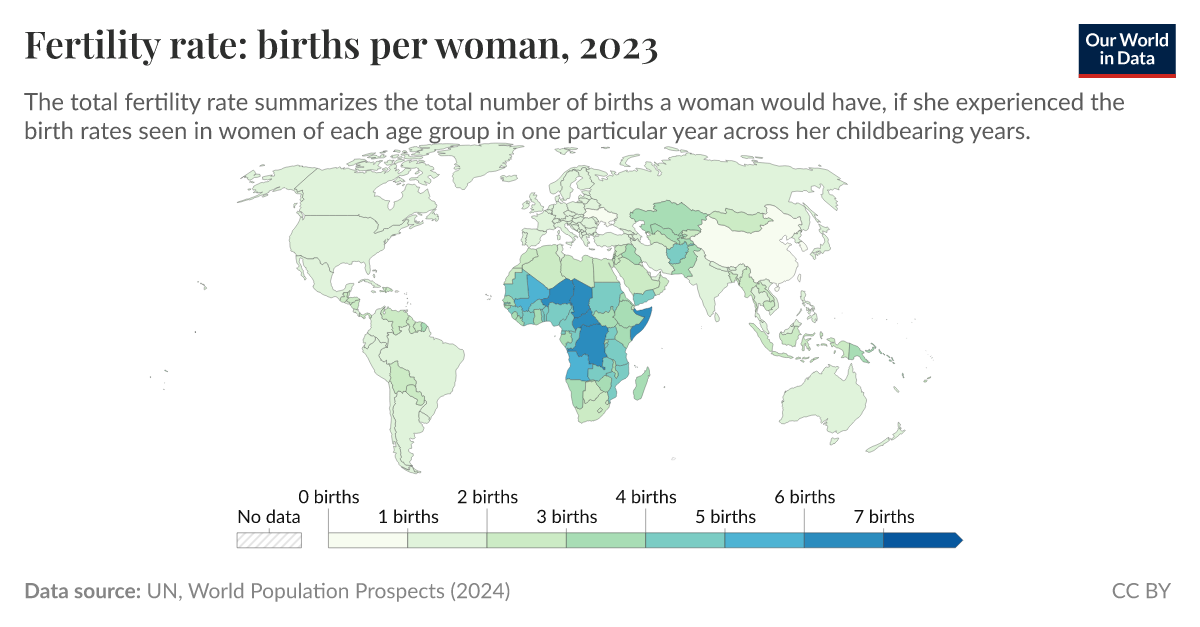
South Korea currently has the lowest birth rate in the world, a staggering 0.72 children per woman. The reason isn't a mystery. South Korean women face the largest gender pay gap in the developed world, a notoriously brutal work culture, and immense social pressure to abandon their careers to become full-time mothers. In response, many young women are choosing a path they call the "4B movement": no dating, no marriage, no sex, and no children.
The same dynamic, in less extreme forms, is playing out everywhere. The result of these widespread personal choices is a measurable decline in birth rates across the developed world.
The Problem with Fake Solutions
If this demographic decline were truly the existential crisis people claim it is, you’d expect the world’s most powerful people to be throwing everything they have at solving it. They aren’t.
Consider Elon Musk. He is perhaps the world's most vocal prophet of population collapse, constantly stating it's the "biggest danger civilization faces." Yet, what has Musk, a man with a net worth of over $200 billion, actually spent to solve humanity's greatest threat? In 2021, his foundation donated $10 million to a research network to study the issue. For comparison, he spent $44 billion to buy Twitter.
This pattern repeats itself.
Powerful people and governments sound the alarm and then spend their time, money, and political capital on literally anything else.
Their actions betray their words.
Learning to Adapt in a World Built for Less
So, we come back to my little cleaning robot, circling the dining room table. Its quiet, persistent work is a symbol of a future that is arriving not with a bang, but with a whir.
The question "Do we still need people?" is the wrong frame.
Of course we do.
The real question is: how many people, doing what kinds of work, and living what kinds of lives?
Our entire social and economic architecture was built for a world that no longer exists. It was a world of scarce information, plentiful manual labor, and short lifespans. Trying to force our 21st-century reality into that 20th-century container is causing immense friction.
We need to stop framing falling birth rates as a crisis to be solved and start seeing them as an adaptation to be managed. They are a sign of success: a world where women have choices, where war is rarer, and where people live longer.
This transition requires a radical redesign of our society. It means reimagining education to focus on lifelong learning for skills like creativity and critical thinking.
We are not heading toward a crisis of too few people. We are heading toward a world that simply works differently. It’s a world where technology handles the tedious and the routine, freeing up human beings to focus on the things that give life meaning: creativity, exploration, relationships, and care.
That sounds pretty good to me.