


The email notification pops up.
Your heart jumps, maybe…this is the one.
You click. "Thank you for your application. We'll be in touch if your qualifications match our needs."

You're not just looking for a job.
You're looking for survival.
The bills don't care that you're "networking" or "building your personal brand."
They just want to be paid. And every rejection email is another reminder that time is running out.

You put on your professional mask and go through the motions. But behind the scenes, you're doing math: rent due in 3 weeks, savings gone in 6, debt collectors getting louder. You have to act confident when you're terrified.
You have to smile while your university sends 'debt counseling' emails, like a loan shark offering financial advice to his victims.

You might be thinking, "Is this about you, Jason?"
Sort of.
I'm on Month 2 of a 100-day mission to pull my own life out of a ditch. After a stint in Los Angeles, I'm back in Dallas, a city I thought I'd left for good. The move wasn't a victory lap; it was a retreat. And that retreat has forced a reckoning, 100 days to try to "sort out my shit" as some old timers used to tell me.
That pressure has me working 15-hour days, fueled by the kind of desperate energy that only comes when you have no other choice.
It has forced me to confront a lot of broken systems, both in myself and in the world.
And the hiring system is the most broken one I've ever seen.
A system built on ghosting you every step of the way. For many of you, the ghosting begins early. You never make the interview stage and your resume simply gets lost in the void.
If you are lucky enough to get an interview, don’t worry, you can still get ghosted here too. The company can decide mid-process to stop responding to you. Forcing you start the process all over again.
One more resume
One more cover letter
One more networking event.
Trying to avoid having a broken system break your spirit.
This essay is for you.
The World We Lost
To understand how we got here, you have to remember the world we lost. It wasn't a perfect world, but it was a human one.
What's the first thing that comes to your mind when you think of 1985? For at least some of you, it's probably "Stranger Things."
The 80s weren't just a great time to be a kid; they were maybe an even better time to be a worker.
Your job search might have gone somewhat like this. It started with the thud of the Sunday paper on your doorstep. You'd spread the classifieds out on the kitchen table, the smell of newsprint in the air, a red pen circling possibilities. The job descriptions were a sentence or two, not a laundry list of impossible demands.
You'd prepare your resume.
You'd put on your best clothes, drive to an office building, and hand your resume to a real person at the front desk.
That person, the receptionist, might tell you the hiring manager was out to lunch but should be back around 2 PM. That single piece of human intelligence was more valuable than any keyword optimization today. The process had friction, yes, but it also had something we've completely lost: humanity.
Companies hired people, not keywords. They took chances. They understood that a candidate with 80% of the skills could be trained for the other 20%. They weren't hunting for "unicorn candidates” who could do the job with zero training. They were building a workforce. The goal was to screen people in, not screen them out.
This wasn't because people were nicer back then. It was because the system was built on a human scale. There was no firehose of digital applications to drink from. There were no robots to do the dirty work. You had to look a person in the eye, and that changes things.
The Machine We Built: A Comedy of Bad Ideas
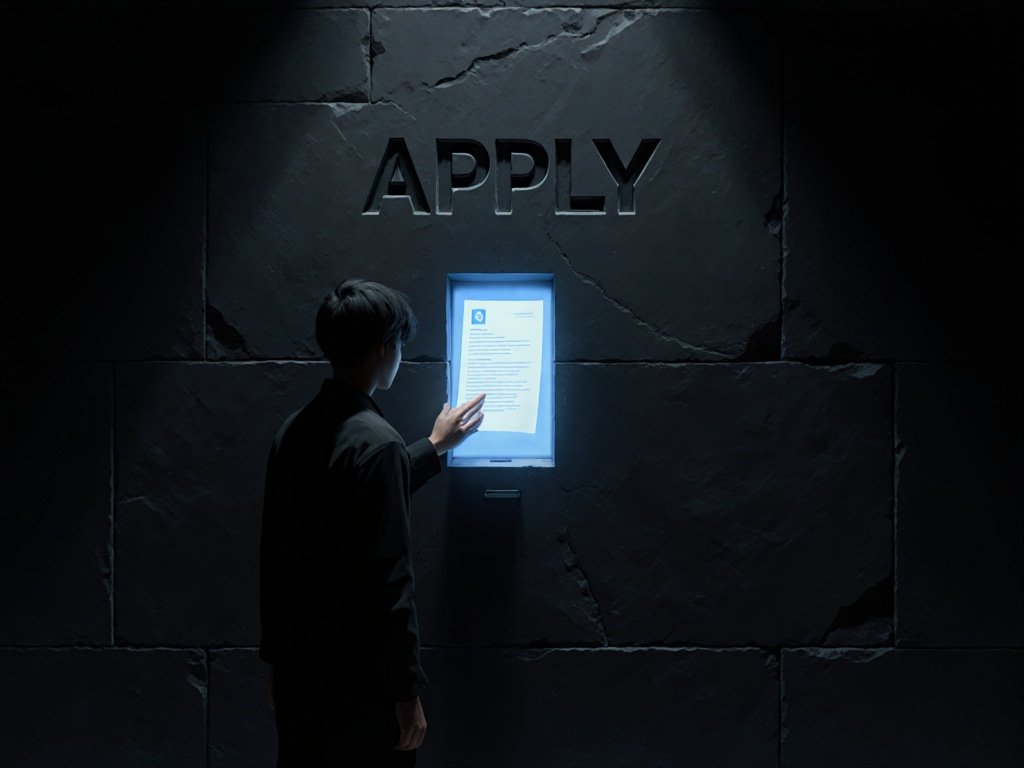
So, how did we trade that human system for the digital black hole we have today?
It wasn't a single event, but a slow, cascading failure.
A comedy of bad ideas, each one logical at the time, that together built a monster.
Act I: The Floodgates Open
Enter the online job board. Monster.com and CareerBuilder hit the scene in the mid-90s, and everyone thought it was the future. Finally, you weren't chained to your local newspaper's classifieds. You could reach across the country with a single click. It felt like pure magic.
But what nobody predicted: the flood.
Companies that were used to a manageable stack of local resumes suddenly found themselves drowning in thousands from everywhere. The good candidates got lost in the noise and "application inflation" was born. Your carefully crafted resume became just another drop in the ocean. The goal shifted from making a real impression to hoping you'd get noticed in the chaos.
Act II: The Rise of the Robots
Companies were drowning in digital resumes, so they turned to what they thought was a technological savior: the Applicant Tracking System (ATS). This was the original sin of modern hiring. The ATS wasn't designed to find the best candidate. It was designed to reduce a pile of 1,000 resumes to a manageable pile of 50. Its only job was to say "no."
Think of an ATS as a bouncer at an exclusive nightclub with a ridiculously specific dress code. The bouncer doesn't care if you're a Nobel laureate or the most charming person on Earth. If the list says "black Gucci loafers" and you're wearing brown Allen Edmonds, you're not getting in.
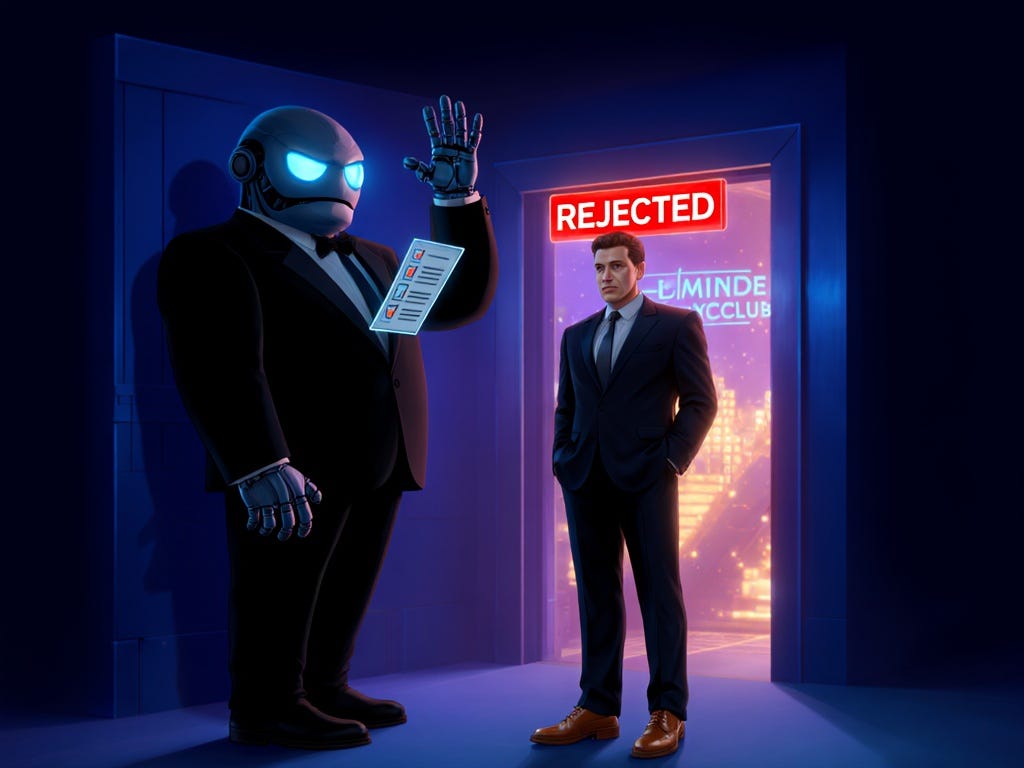
That's exactly how these systems work. They scan for keywords. If your resume says you "managed a team," but the robot was programmed to look for "team leadership," you're rejected.
If you use a creative format that the robot can't parse, you're rejected.
A study by Harvard Business School found that a staggering 88% of employers believe their own hiring system is filtering out qualified candidates. They know the robot is broken, but they use it anyway because they feel they have no choice.
A study by Harvard Business School found that a staggering 88% of employers believe their own hiring system is filtering out qualified candidates.
Act III: The Farce of Fairness
The final nail in the coffin came from the place you probably expected: the government.
Because of course it did.
When has the government ever made anything simpler?
In an effort to ensure fairness and equal opportunity, federal regulations were passed that required companies, especially federal contractors, to publicly post all job openings.
The intention we can debate, but the result we cannot.
It was a farce.
A company that already has a star internal employee ready for a promotion now has to post that job publicly, collect hundreds of applications, and pretend to conduct a fair and open search, all while knowing exactly who is going to get the job.
This is the birth of the "ghost job" all in the name of "fairness". It turns the hopes of hundreds of applicants into collateral damage for a company's legal compliance.
It's why you can apply for a job that seems perfect for you and never hear a word back, likely because that job was never really for you in the first place.
And when you do get rejected, companies hide behind the same tired line: "We can't provide feedback" or "No further feedback will be given."
They've turned the most human part of the process, having closure, into a corporate policy designed to avoid lawsuits.
These forces
The application flood
The dumb robots
Fairness theater
The resume arms race
The feedback blackout
Have combined to create the perfect storm of misery that is the modern job search.

It's a machine built to chew up your hope and spit out silence.
And it's not just happening in the US. Job seekers across the globe are experiencing the same cold silence.
In Ontario, Canada, that silence may soon be illegal. New legislation requires companies to respond to applicants within 45 days, disclose if AI tools are used in hiring decisions, and clarify if a job posting is actively recruiting or a ‘ghost job.’ Failure to comply could mean hefty fines.
Which brings us to the question: if other countries can tackle this, why can't we?
The Solution We Forgot We Had
Scroll through the internet and you'll trip over endless rants about how broken this all is.
They all offer the same tired advice: "tweak your resume," "network harder," "build your personal brand." As if the problem is you, not the system.
But that's asking the wrong question entirely. The real question is: What if we just built a better system?
I think we can, and here's how.
The answer comes from a technology that most people associate with scams and speculation: blockchain.
But strip away the crypto bros, the NFT nonsense, and the get-rich-quick schemes. What's left is something the original Bitcoin believers actually cared about: using cryptography to build transparent, decentralized systems that solve real problems for real people. That vision got lost in a sea of greed and hype, but the underlying technology is still powerful.
We can use the technology for good and here’s how.
We create a national job board that operates as a public utility, like electricity or water. It's not controlled by any corporation; it's public infrastructure built on blockchain technology, which is essentially a shared ledger that can't be manipulated.
A Public Receipt for Every Application. When a company posts a job, it becomes a public record. When you apply, you receive a digital receipt that serves as proof. But the real power is transparency. You can see exactly how many people applied. You can track whether interviews are actually happening. You can verify if the job was filled or if it simply disappeared. Ghost jobs become impossible to hide.
A Digital Notary for Your Resume. This is where it gets really powerful. Instead of just listing your experience, you can prove it. Using a technology called a zero-knowledge proof, you could get a "digital stamp" from a trusted source like the IRS that says, "Yes, this person worked at this company for these two years." The company doesn't see your salary or any of your private information; they just see the stamp of approval. It's like a bouncer who can verify you're over 21 without ever looking at your driver's license. Resume fraud becomes harder. The system runs on verified facts, not speculation.
The Digital Handshake. To stop the endless spam of hundreds of applications, you'd pay a small fee with each application. That amount could be proportional to the salary for the role. For example, a lower-value role would cost less than a more senior position. This is a way for an applicant to prove, "I'm serious about this, and I expect you to be serious in return." It forces everyone, both candidates and companies, to be more thoughtful and intentional.
The beauty of this system is that it is ideally designed to pay for itself through these application fees. It could use cryptocurrency and traditional payments, allowing applicants to pay how they please. And once it's proven, this public blockchain based system could become a model for other government systems at every level.
This technology is real, it's available, and it's waiting for us to put it to work on problems that matter. Superteam Earn on Solana has a rough system that provides something of a basis for how this could work. Estonia’s KSI blockchain provides a model for how Blockchain could work in the public sector.
It's Not You, It's the System
So when that familiar Monday morning panic hits, when you're clicking through another soulless application form and feeling like a number in a database, remember this:
You're not imagining things because the system is fundamentally flawed.
Your frustration isn't irrational; it's the only sane response to an insane situation.
The answer isn't working harder or gaming the system.
It's not about crafting the perfect resume or memorizing the right buzzwords.
The real solution is refusing to play a rigged game.
We need a system built on fairness, where everything is transparent, and where your time, your most precious and finite resource, is valued properly.
The real work isn't submitting another application. It's challenging the entire process.
It's asking why we've surrendered to a system that treats people like data points.
It's time to stop optimizing for a broken system and start building a working one.

Thank Yous
Thanks to Bill, Vito, Erika, F3 Guys, and family for helping with putting this essay together.